UPSC Interview Questions 2026: 100+ Questions by Category (and How to Answer Them)
By FluentlySaid Editorial TeamUpdated 27 November 202620 min read
In short
The UPSC interview, officially the Personality Test, carries 275 marks and is held by a board of a Chairman and members. Most UPSC interview questions come from your DAF, followed by current affairs and situational questions. The best preparation is repeated mock interviews, answered aloud and reviewed.
Interviews run 7 Dec 2026 to 12 Feb 2027. Schedule, e-Summon and prep: UPSC Interview Schedule 2026: Dates, e-Summon Letter and What to Do Next
This guide lists more than 100 UPSC interview questions in ten categories, explains why the board asks each kind, and shows how to answer them. Use the lists to find your weak spots, not to memorise answers. Every question is a practice question and is not attributed to any real candidate or board.
UPSC interview 2026: key facts
| Fact | Detail |
|---|---|
| Marks | The UPSC interview (Personality Test) carries 275 marks. See UPSC's 2026 notice. |
| Board | A board of a Chairman and members questions each candidate. |
| Venue | UPSC, Dholpur House, Shahjahan Road, New Delhi. |
| Qualified for the interview | 2,526 candidates qualified the CSE Mains 2026 result of 5 November 2026 (see UPSC's What's New listing). |
| DAF-II window | 11 to 25 November 2026, till 6:00 PM. It has closed. |
| Interview schedule | 7 December 2026 to 12 February 2027, per UPSC's notice of 17 November 2026. Reporting time: Forenoon session 9:00 AM, afternoon session 1:00 PM. |
| e-Summon letters | Not yet released as of 26 November 2026. UPSC says they will be made available shortly. |
Sources: UPSC notices on upsc.gov.in, as compiled on our UPSC interview 2026 hub. Checked on 26 November 2026.
What do UPSC interview questions actually test?
UPSC describes the interview as an assessment of the personal suitability of the candidate for a career in public service. It is not a test of knowledge. The board has already read your Mains papers. It wants to see how you think and how you behave under pressure.
- Clarity: can you say a complex thing simply, and stop?
- Balance of judgement: can you hold two sides of an issue without becoming either extreme?
- Integrity: do your answers stay the same when the pressure changes?
- Social awareness: do you know the people and places your decisions would affect?
These map to the qualities UPSC lists for the Personality Test, such as mental alertness, clear and logical exposition, balance of judgement and intellectual and moral integrity. Every question below is a way for the board to look at one of them.
UPSC interview questions by category
The ten categories below follow the order a board tends to move in: your form first, then the world, then pressure. Each list is for practice. Answer aloud, with a timer, and aim for about a minute per answer.
DAF-based questions: name, hometown, district and home state
The board has your form open, so the easiest way into a conversation is your name, hometown and state. These are UPSC interview questions on your home state and district, and they are the warm-up that decides how comfortable the next twenty minutes feel. Expect questions about your place, then about what is wrong with it.
- What does your name mean, and does your family have a story behind it?
- What is your hometown known for, and what is it not known for but should be?
- What is the biggest unsolved problem in your district?
- If you were the Collector of your district, what would you do in the first month?
- Which river, road or industry matters most to your district's economy?
- How has your home state's economy changed in the last ten years?
- Why do people leave your district for work, and would you stop them?
- Which scheme works well in your state, and which one exists only on paper?
- What is one festival or craft from your region that you would promote, and how?
- How does your state's literacy or health record compare with the national average?
- Which neighbouring state do you most compare yourself with, and why?
- What would a visitor from outside your state misunderstand about it?
For the full pattern of questions by DAF section, read our guide to DAF based questions in detail. To prepare your own form line by line, follow our method for UPSC DAF analysis.
Graduation and academic background
The board asks about your degree to see whether your choices were considered, and whether your subject connects to public life. A candidate who studied engineering and chose civil services will be asked why, and what the subject taught them about problems.
- Why did you choose this graduation subject?
- Why did you leave this field for the civil services?
- What is one idea from your degree that applies to governance?
- Which professor or book shaped how you think?
- What would you change about how your subject is taught in India?
- What is a recent development in your field that a district officer should know about?
- Your marks dipped in one semester. What happened?
- Which part of your degree did you find least useful, and why?
- How would an engineer, a doctor or a lawyer each approach a flood response differently?
- Is a specialist or a generalist better suited to run a district?
UPSC interview questions on your optional subject
Your optional is a subject you chose, so the board expects more depth and a view of your own. Expect a question on a current issue in the subject, and then a question that argues against your view.
- Why did you choose this optional subject?
- What is the central idea of your optional in one minute?
- Which thinker or theory in your optional do you disagree with, and why?
- Where would a district officer use your optional on a difficult day?
- What is one current issue in the news that your optional helps explain?
- What is the biggest criticism of your optional subject?
- Did your optional help or hurt you in the Mains? Be honest.
- How is a theory in your optional different from how things work on the ground?
- If you had chosen a different optional, which one and why?
- Which topic in your optional would you drop from the syllabus, and which would you add?
- How does your optional connect to the General Studies papers?
Work experience and gap years: UPSC interview questions for working professionals
For working professionals, the board treats your job as evidence of how you behave in an organisation. Gap years are not a problem, but the board wants to hear that you used them on purpose. These are the UPSC interview questions for working professionals that tend to come up.
- What did you do in your last job, in one minute?
- Why are you leaving a stable job for the civil services?
- What was the hardest decision you took at work, and what did it cost you?
- Tell us about a time you disagreed with your boss.
- What did you learn about people from managing a team?
- Which part of your work could be done better by the government, and which by the private sector?
- What would you carry from your job into an administrative post?
- You took two gap years. What did you do, and what would you do differently?
- How did you pay your bills while preparing?
- What was your biggest failure at work?
- How would you handle a subordinate who is senior to you in age and experience?
UPSC interview questions on hobbies and extracurriculars
A hobby on your DAF can become five minutes of the board. The board checks whether the interest is real by asking a second and a third question. Our guide to UPSC interview hobbies in your DAF covers how to choose and defend them.
- Which hobby on your DAF do you spend the most time on, and when did you last do it?
- What are you reading right now, and where do you disagree with it?
- You play cricket. What do you do when your team is losing?
- What does a team game teach that an office does not?
- Who taught you this hobby, and what went wrong the first time?
- What is the story behind your favourite dish from your region?
- Which place did you last travel to, and what did a tourist miss there?
- Why did you list this hobby on your DAF?
- How would your hobby help you as an officer in a stressful posting?
- If you had to drop one hobby from your DAF, which one would it be?
Service preference and cadre: IAS, IPS and IFS questions
Your order of service preference tells the board what you value. These are the IAS interview questions and IPS interview questions that test whether you know what the job is really like, and not only the title. For more on policing, read our guide to IPS interview questions.
- Why did you put IAS first, and why IPS second?
- What does a District Magistrate actually do on a normal day?
- What is the difference between an IAS and an IPS officer's role in a riot?
- If you do not get your first service, will you reattempt?
- Why did you rank IFS lower, and what would an Indian diplomat do in a crisis abroad?
- A friend says choosing IPS over IAS is a mistake. How would you answer?
- Which cadre or state do you prefer, and why?
- What would you do if posted to a state whose language you do not speak?
- Which service has the most power, and is power the right thing to want?
- If you were the Superintendent of Police, how would you win the trust of a community that fears the police?
- What is one reform you would push for in the police or the administration?
Current affairs and governance questions for 2026
The board expects you to follow the news, but it asks for your view and not a recital. These questions change every year, so treat the list below as themes to refresh in the week of your interview. Verify every fact against a current source before you speak.
- Which policy decision of the last year do you think will matter most in ten years, and why?
- How should India balance economic growth with its climate commitments?
- What are the arguments for and against holding Lok Sabha and state elections together?
- How should the government regulate artificial intelligence without slowing innovation?
- What does the Census and a caste enumeration mean for policy design?
- What are the risks and benefits of the new data protection law for ordinary citizens?
- Is India's current trade policy protecting farmers or consumers more?
- How do you read India's relations with its neighbours over the last year?
- What is one budget announcement you would change, and what would you replace it with?
- How should cities prepare for heatwaves and urban flooding?
- Is the debt level of states a concern, and what should the Centre do about it?
- Which recent Supreme Court judgment do you think will change governance the most?
Situational and ethical questions
Situational questions test how you act, not what you know. The board listens for the order of your steps, who you involve, and where you draw a line. There is rarely one right answer.
- A bridge has washed out and a village is cut off. What do you do in the first two hours?
- A colleague asks you to ignore a small irregularity. What do you do?
- A minister asks you to speed up a file beyond the rules. How do you respond?
- A mob has gathered outside a government office. What is your first step?
- You find that a scheme's beneficiary list includes ineligible people. What do you do?
- Your superior asks you to backdate a document. What do you say?
- A contractor offers you a gift at Diwali. What do you do?
- A subordinate has done good work but has a poor attendance record. How do you decide?
- You must choose between relocating a village for a dam and cancelling the dam. How do you decide?
- A journalist asks you about a rumour that could cause panic. What do you say?
- Your friend from college is under investigation in your district. What do you do?
Opinion and controversial questions
The board asks about sensitive topics to see whether you can stay balanced. It does not want a position it agrees with. It wants to see that you can hear a different view without anger or flattery.
- Should reservation be based on economic status alone?
- Is a Uniform Civil Code desirable, and how should it be introduced?
- Should the death penalty be abolished?
- Do protests help or harm democracy?
- Is social media regulation a threat to free speech?
- Should the government fund religious pilgrimages?
- Is a freebie a welfare measure or a vote-buying tool?
- Should private companies be allowed to run prisons or hospitals?
- Is India's federal structure too centralised?
- Do you think the media in India is free?
Stress and tricky IAS interview questions
Tricky IAS interview questions are rarely traps. The board tests composure: it interrupts, disagrees, or points out a flaw to see how you react. Staying calm and honest is the right response. Our guide to tricky IAS interview questions gives a weak and a strong answer for each type.
- What is the weakest part of the answer you just gave?
- Why should we select you over another candidate?
- Your Mains marks are average. Why do you think you deserve this service?
- What would you do if you are not selected this year?
- I think your answer is wrong. Convince me.
- What is your biggest weakness, and what have you done about it?
- Tell us something that is not on your DAF.
- If you could meet one world leader, who would it be and what would you ask?
- What is the last mistake you made, and how did you correct it?
- If your minister disagreed with a decision you thought was right, what would you do?
- How would you answer a question to which you do not know the answer?
How to answer UPSC interview questions
A simple four-step frame works for most questions, whatever the topic. Use it in practice until it is automatic, then drop the labels.
- Pause: take two seconds. Listen to the whole question.
- Structure: give your answer in one line, then two or three points.
- Balance: name one counter-view or limit, fairly.
- Conclude: end with your position or the action you would take, then stop.
Take a practice question: "Should cities ban private vehicles in the centre?" A weak answer and a strong answer differ in structure and honesty, not in knowledge.
| Answer | |
|---|---|
| Weak | "Sir, pollution is a big problem. Many cities have it. The government should do something. Vehicles are increasing, and people do not use public transport. So I think we should ban them." |
| Strong | "I would restrict, not ban. Private vehicles in a congested centre cost time and add to pollution, so a restriction in the busiest hours makes sense. But a ban hurts shopkeepers and the elderly if public transport is weak. I would first improve buses and metro links, then add congestion charges. So: restrict after the alternative is ready." |
Source: written by FluentlySaid for practice. It is not taken from any real interview.
The strong answer states a position first, shows two sides, gives a sequence of action and ends. It is no longer than the weak one. For a wider list of habits, see the do's and don'ts of the UPSC interview.
Common mistakes that cost marks
- Memorised answers. The board follows what you say. A scripted answer breaks at the first follow-up.
- Bluffing. Saying you know something you do not is the fastest way to lose trust. Say you are not sure and offer what you do know.
- Listing DAF entries you cannot defend. A hobby or a book you cannot discuss is a liability, not a decoration.
- Long answers without an ending. If you cannot summarise in a minute, you will drift.
- Taking extreme positions. The board wants balance. A strong view without the other side reads as rigid.
- Arguing with the board. Disagree politely and give a reason. Do not win the argument and lose the room.
- Reciting current affairs. Boards ask for your view. Facts without a view sound like a newspaper.
- Skipping spoken practice. Reading answers is not the same as saying them. Speak, record and listen.
How to practise UPSC interview questions
Short of time? Our 30-day UPSC interview preparation plan gives a task for every day, with a practice mock built in.
Preparation for the UPSC interview is mostly repetition of a spoken task. Here are the main ways to do it, and what each is good at.
- Self-practice. Record your answers, listen once and fix one thing. Cheap and always available, but nobody interrupts you. See our seven-day method to practise the UPSC interview alone.
- Peer mocks. A friend who asks follow-ups and says "why?" three times. Honest, but peers tend to be kind and to run out of questions.
- Institute mock interviews and an interview guidance programme. (Our buyer's guide to the UPSC interview guidance programme lists what to ask before you join.) Experienced panellists can read your presence in a room and share how they judge candidates. They are limited by dates, slots and the number of sittings you can afford.
- AI mock interviews. (Wondering how many to sit? See how many mock interviews for UPSC.) A voice mock that asks questions from your DAF and follows up on your answers. It adds repetitions between human mocks. It cannot read your body language.
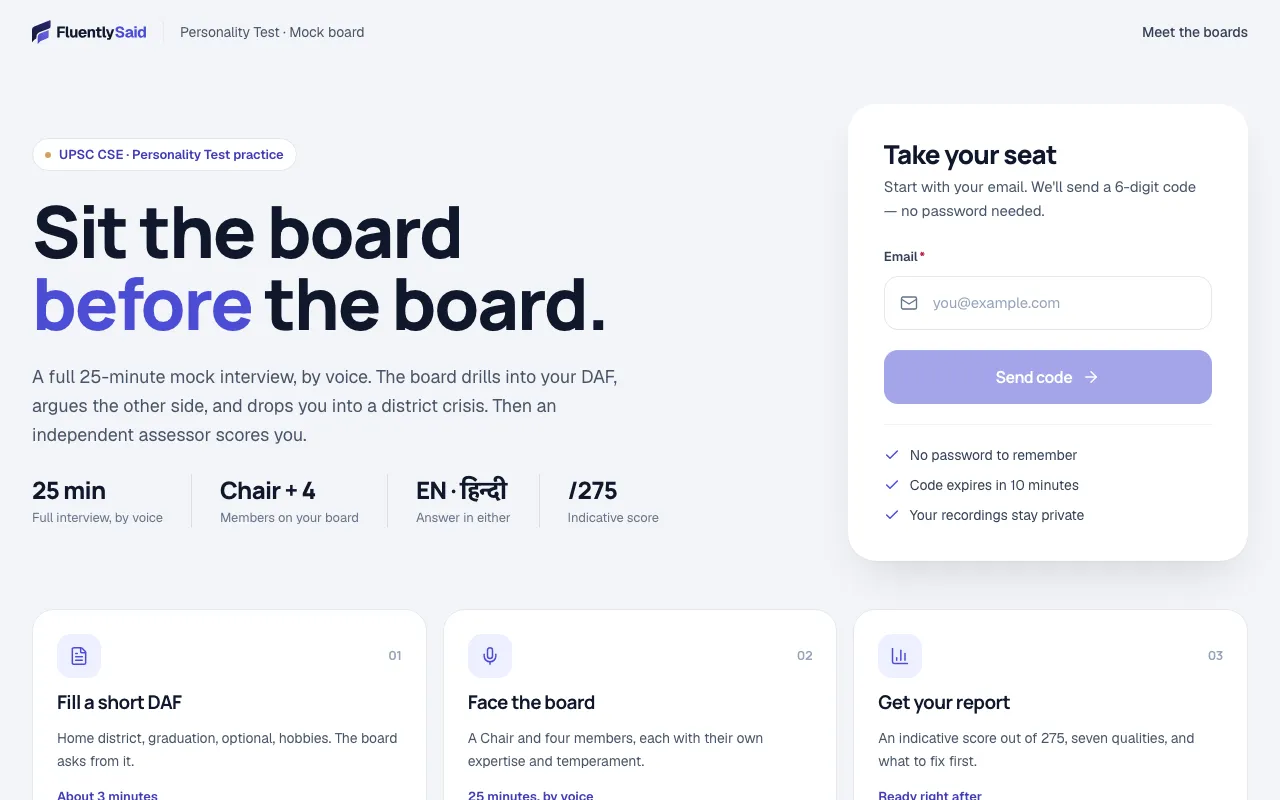
FluentlySaid is one option in that last group. A UPSC mock interview on FluentlySaid offers unlimited mock interviews at any hour, whether 11 PM or 6 AM, with no slot booking. You face a 5-member AI board, a Chairman and four members, with questions based on your profile, and you get a detailed report after every mock. It is voice-only and its scores are practice estimates, so use it alongside human panels, not instead of them. If you will answer in Hindi, read our guide to the UPSC interview in Hindi medium. Read how it works in our guide to the AI mock interview for UPSC, or see the UPSC interview practice page.
The Personality Test for CSE 2026 runs 7 December 2026 to 12 February 2027. Our UPSC Mains result 2026 hub keeps the schedule and e-Summon status in one place.
Questions
How many questions are asked in the UPSC interview?
UPSC sets no fixed number. The board asks as many questions as the time allows, and follow-ups on your answers often matter more than the opening question. Expect fewer, deeper chains of questions rather than a long list of unrelated ones, and prepare each DAF entry for several follow-ups.
Are UPSC interview questions asked in English or Hindi?
You choose the medium of your interview in your application, and UPSC arranges the board accordingly, with an interpreter where needed. Follow the instructions in your e-Summon letter. Practise in the language you will use, because technical terms often come slowly in a language you only read in.
How many marks is the UPSC interview?
The UPSC interview, officially the Personality Test, carries 275 marks. Together with the 1,750 marks of the Mains written papers, it makes a total of 2,025 marks for the final merit list. The interview marks decide ranks among candidates whose written scores are close.
What are DAF based questions?
DAF based questions are questions drawn from the Detailed Application Form you submitted: your name, hometown, home state, graduation, optional subject, work experience, hobbies and service preferences. The board has the form in front of it, so every entry can become a question, and the follow-ups go deeper than the form.
What are some tricky IAS interview questions?
Tricky questions are usually not trick questions. They test composure: a hypothetical dilemma, a view opposite to yours, a gap in your record, or a fact you got wrong. Examples: why did you leave a stable job, what is the weakest part of your own argument, and what would you do if a minister disagreed with you.
How do I prepare for the UPSC interview in one month?
Spend week one on your DAF, with one prepared answer per entry. Spend week two on current affairs and your home state. In weeks three and four, sit a full mock every two or three days, read each report, and fix one thing at a time. Speak aloud every day. Reading alone does not prepare you.
Are mock interviews useful for UPSC?
Yes, because the interview is spoken and reading cannot train speaking. A mock makes you answer aloud, gets you interrupted and shows habits you cannot hear yourself. Their value depends on feedback you act on. Mix human panels, which read your presence in a room, with more frequent practice mocks.
When is the UPSC interview schedule for 2026?
UPSC's notice of 17 November 2026 schedules the Civil Services Personality Test from 7 December 2026 to 12 February 2027, at UPSC, Dholpur House, Shahjahan Road, New Delhi. The notice lists each roll number's date and session. As of 26 November 2026, e-Summon letters were not yet released. Check upsc.gov.in for updates.
Can I prepare UPSC interview questions with answers from a list?
A list helps you see patterns, but memorised answers fail because the board follows what you say, not what you rehearsed. Use question lists to find gaps, then build answers from your own facts, a clear structure and a balanced view. Answer aloud, with a timer, until you can do it without notes.
FluentlySaid is not affiliated with or endorsed by UPSC. Every question here is written for practice and is not taken from any real interview. Nothing here promises selection, rank or marks. Check dates and rules at upsc.gov.in.