Solutions · Sales Readiness
Your reps should lose the deal in practice, not on the call.
FluentlySaid is an AI sales roleplay platform. Reps run live voice calls against an AI buyer built from your playbook, your products and your market, then get a scorecard as blunt as their manager's.
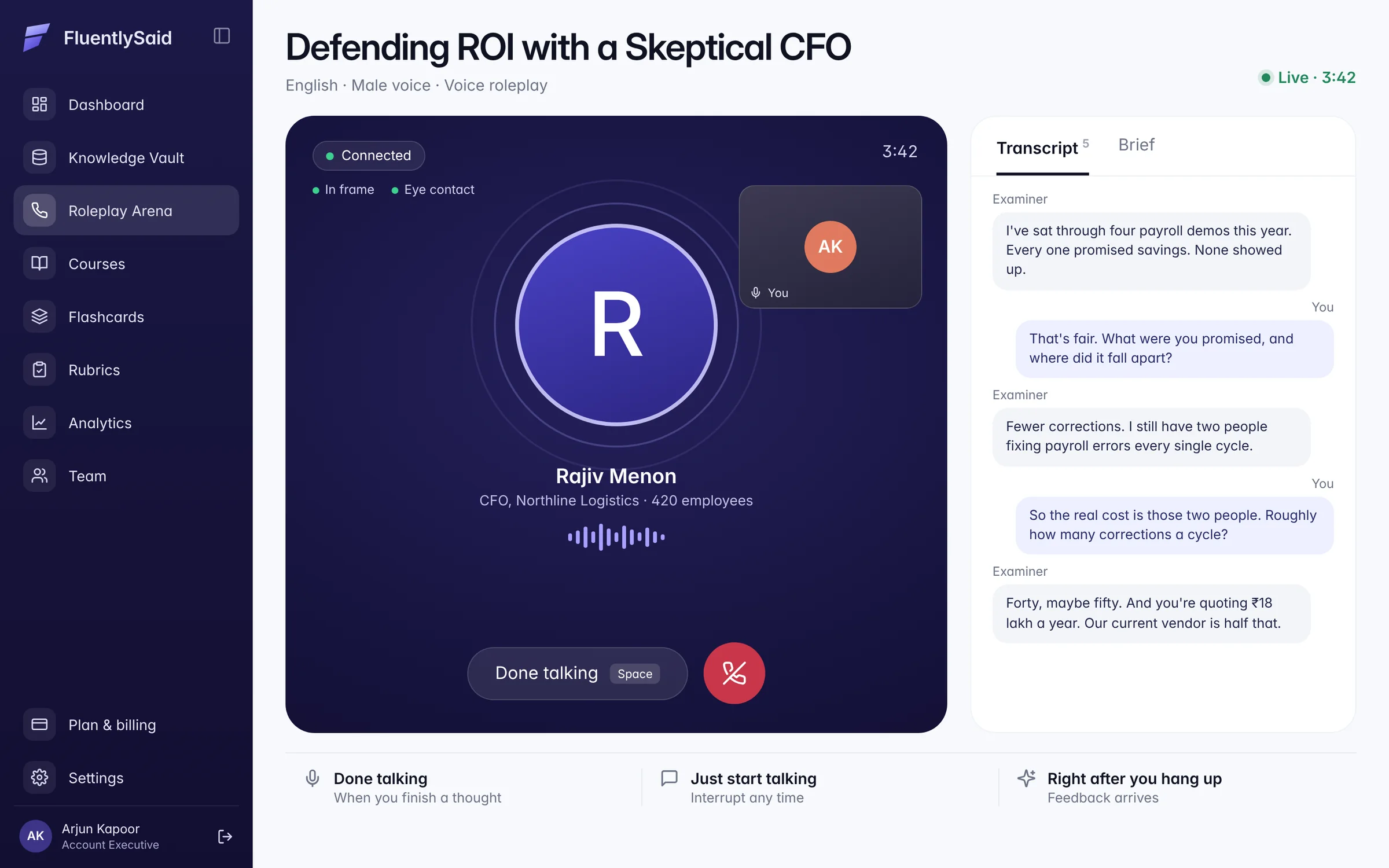
- 1The buyer talks back, out loud
- 2A real objection, not a script
What is AI sales roleplay? AI sales roleplay is practice software where a sales rep talks out loud to an AI buyer that behaves like a real prospect: it asks questions, pushes back on price and raises objections. FluentlySaid builds that buyer from your own knowledge base and scores every call on discovery, objection handling, closing and delivery.
Why sales readiness breaks down
Most teams get reps ready on live calls, on a manager's calendar, or with a bot that has never heard of their market.
Reps practice on real buyers.
Every fumbled pricing question is a live deal.
Manager roleplays don't scale.
A frontline manager can run maybe a few a week, and the manager plays a buyer who is far too nice.
Generic roleplay bots don't know your market.
A bot that has never heard of your competitors can't throw your real objections.
How AI sales roleplay works in FluentlySaid
A rep goes from your documents to a scored call in four steps.
- 1
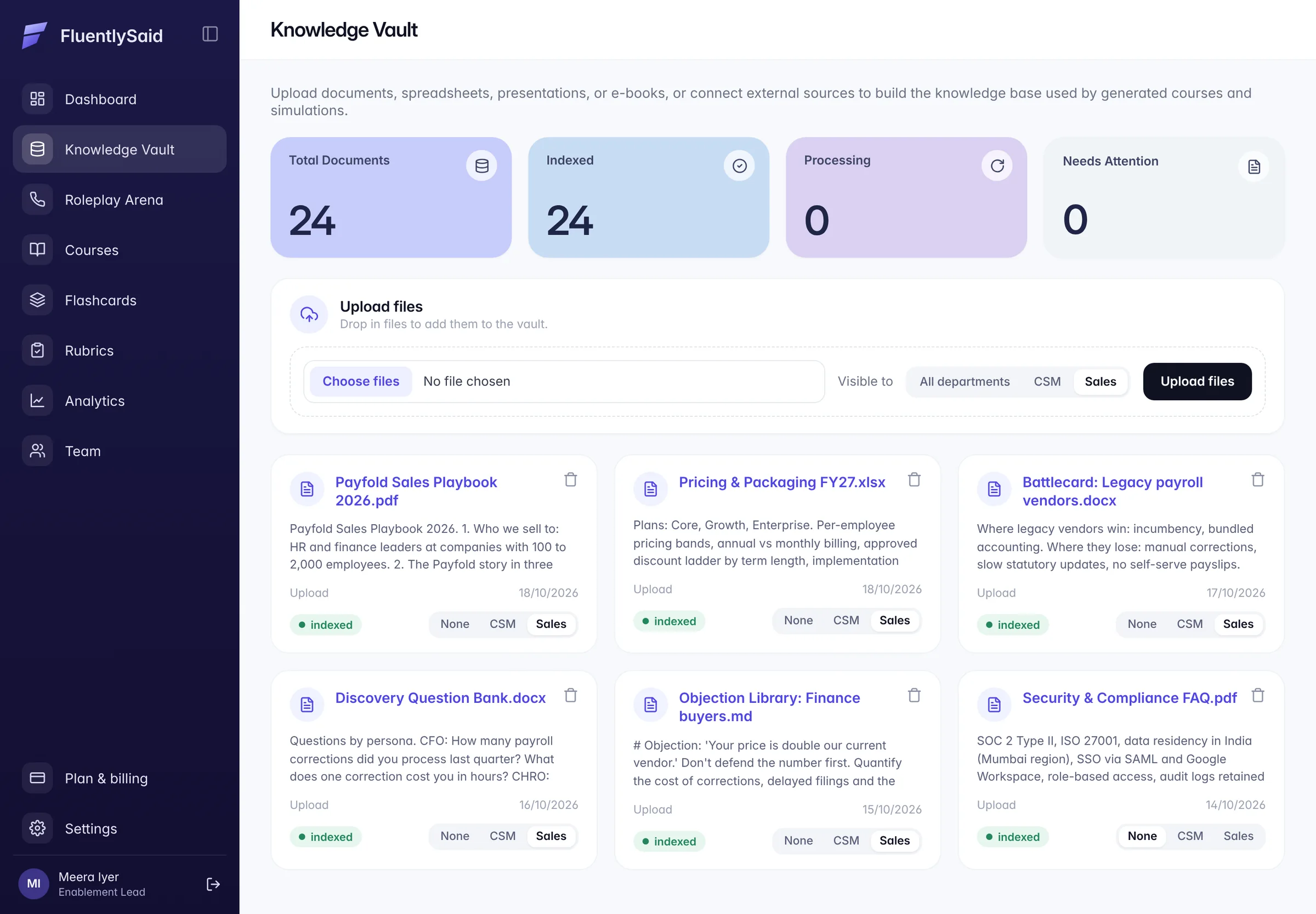
Upload your playbook
SOPs, pitch decks, pricing sheets and battlecards go into the Knowledge Vault.
- 2
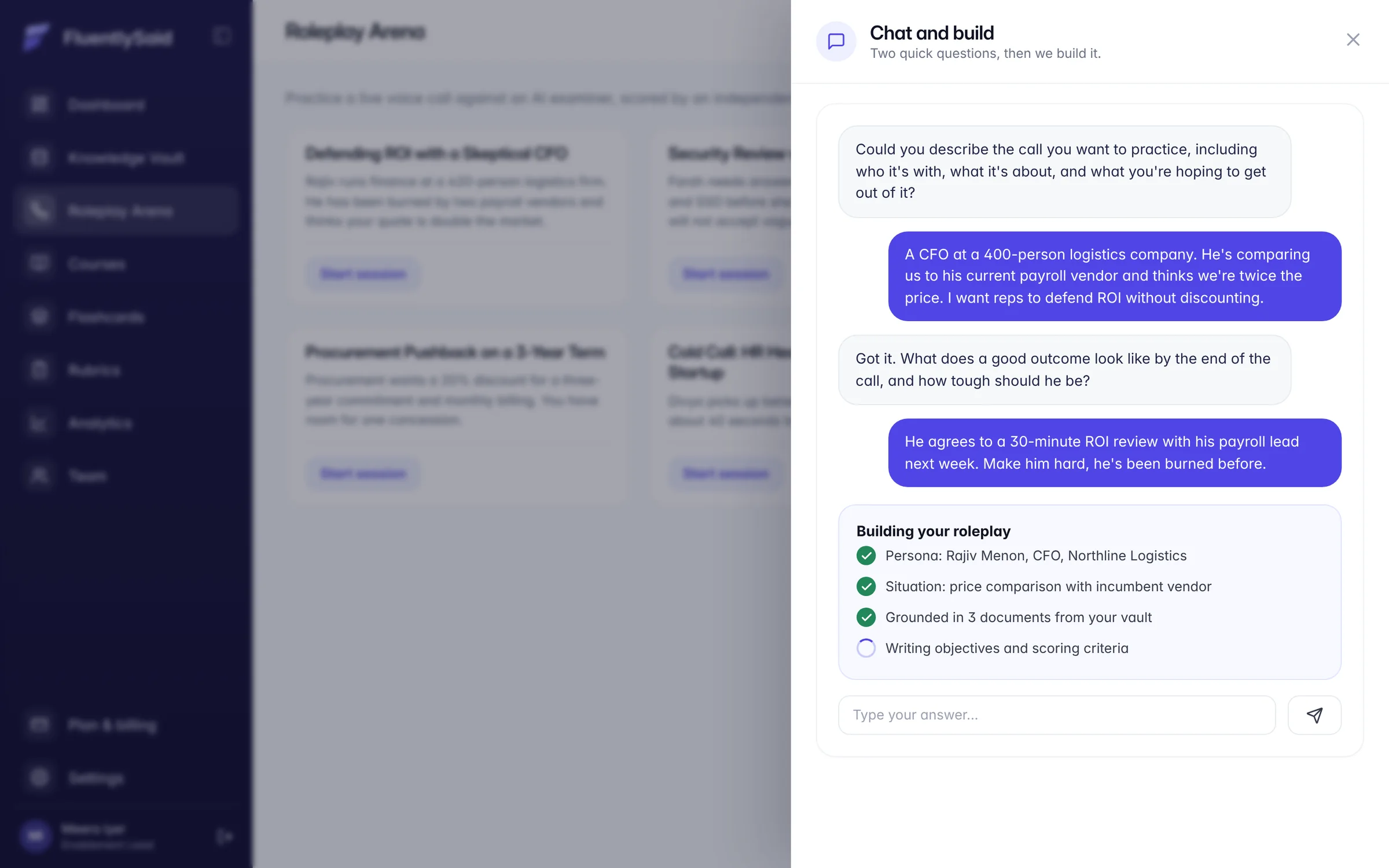
Build the buyer
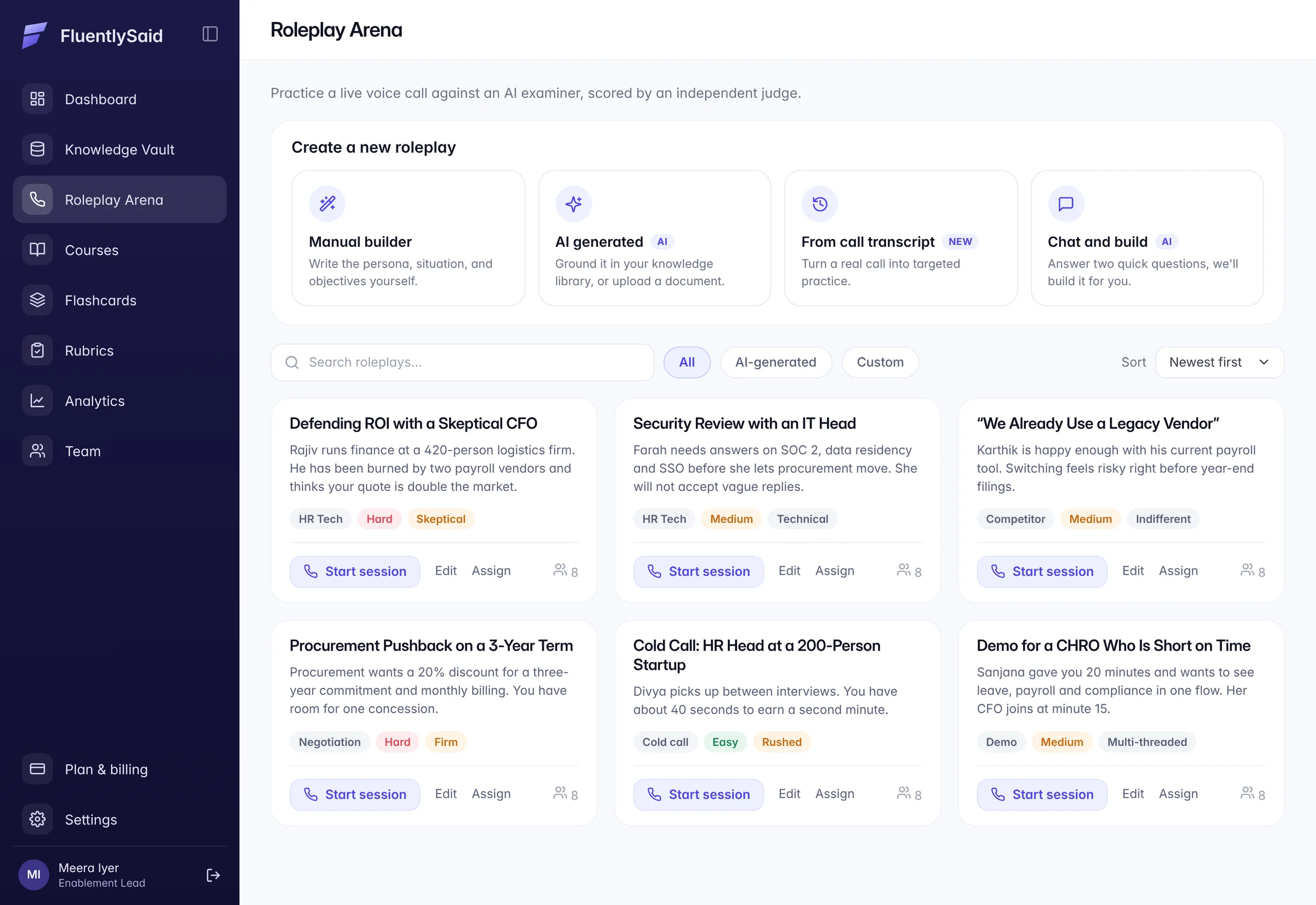
Pick a starting situation (Skeptical CFO, Technical evaluator, Competitor comparison, First-time buyer) or describe the call in chat.
- 3
Run a live voice call
The rep talks, the AI buyer interrupts, objects and decides.
- 4
Get scored
An independent AI judge scores each skill and tells the rep the one thing to fix first.
Domain-specific AI buyers, not generic bots
A domain-specific AI buyer knows your industry before the call starts.
It uses your industry vocabulary, your pricing model and your competitors because it is grounded in your Knowledge Vault. Ready-made market tuning covers HR Tech, Fintech, Dev Tools, Security, CX and Health Tech.
- Objections written from your own battlecards
- Pricing questions that match your actual discount ladder
- Six scenarios on day one, a library you keep adding to
Dial the buyer's emotion up or down
Every AI buyer has a temperament you set, from curious to furious.
Set how skeptical, rushed, friendly, frustrated or price-sensitive the buyer is. Start new reps on a curious first-time buyer, then promote them to the CFO who has been burned by vendors before.
- Starting mood plus sliders for skepticism, price sensitivity, patience and warmth
- Toggles for interrupting long answers and softening when the rep quantifies value
- A hidden objection that only surfaces if the rep asks the right question
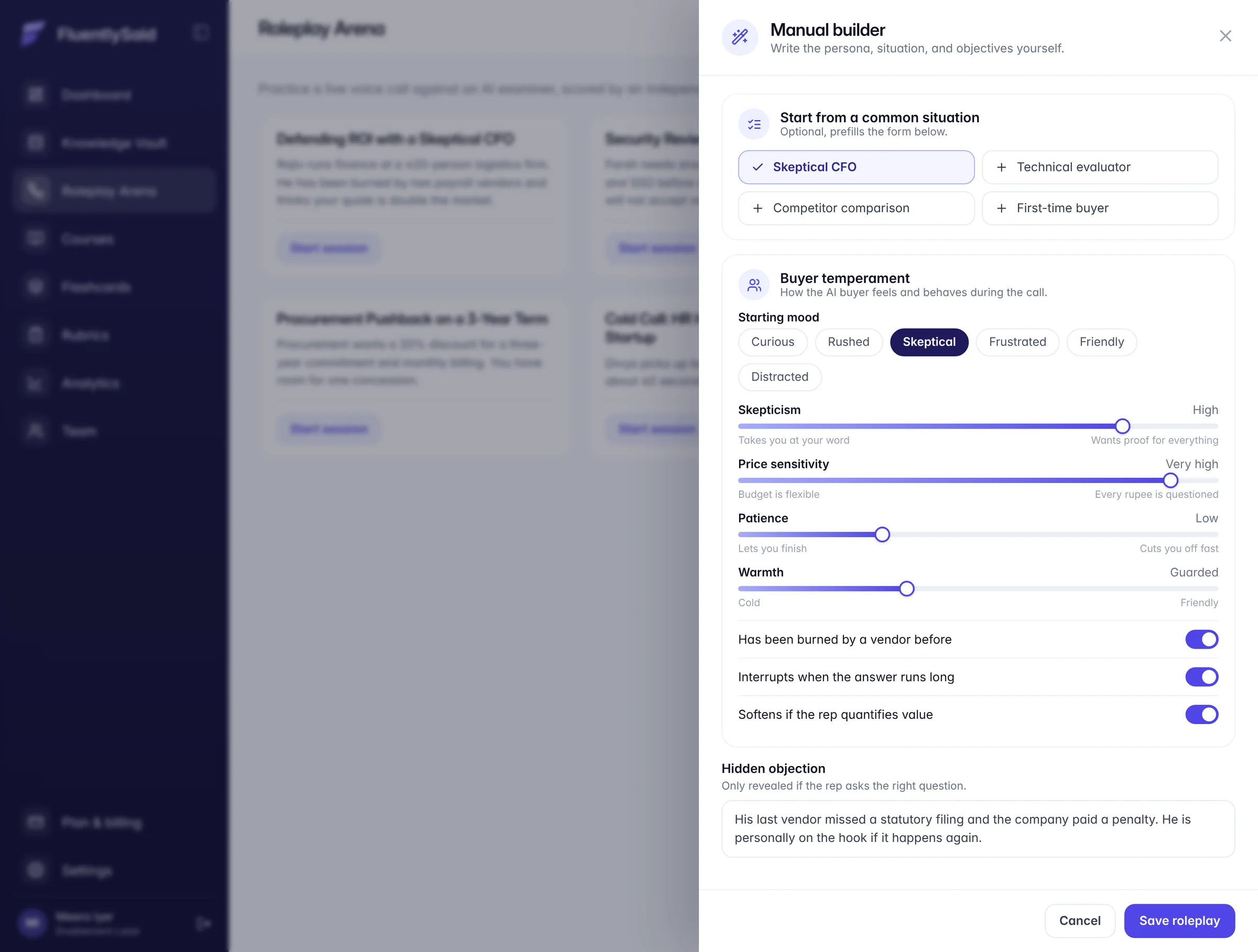
- 1Skepticism: wants proof for everything
- 2Behaviour toggles
- 3Hidden objection
Grounded in your knowledge base, so the AI doesn't make things up
Roleplays and the Ask Agent answer from your uploaded documents and cite them.
If a fact is not in your vault, the agent says so instead of guessing. Visibility is set per department, so Sales sees the sales material and CSMs see theirs.
- Every answer links back to the file and section it came from
- An honest "not in your vault" reply when the document is missing
- Department-level visibility for Sales and CSM content
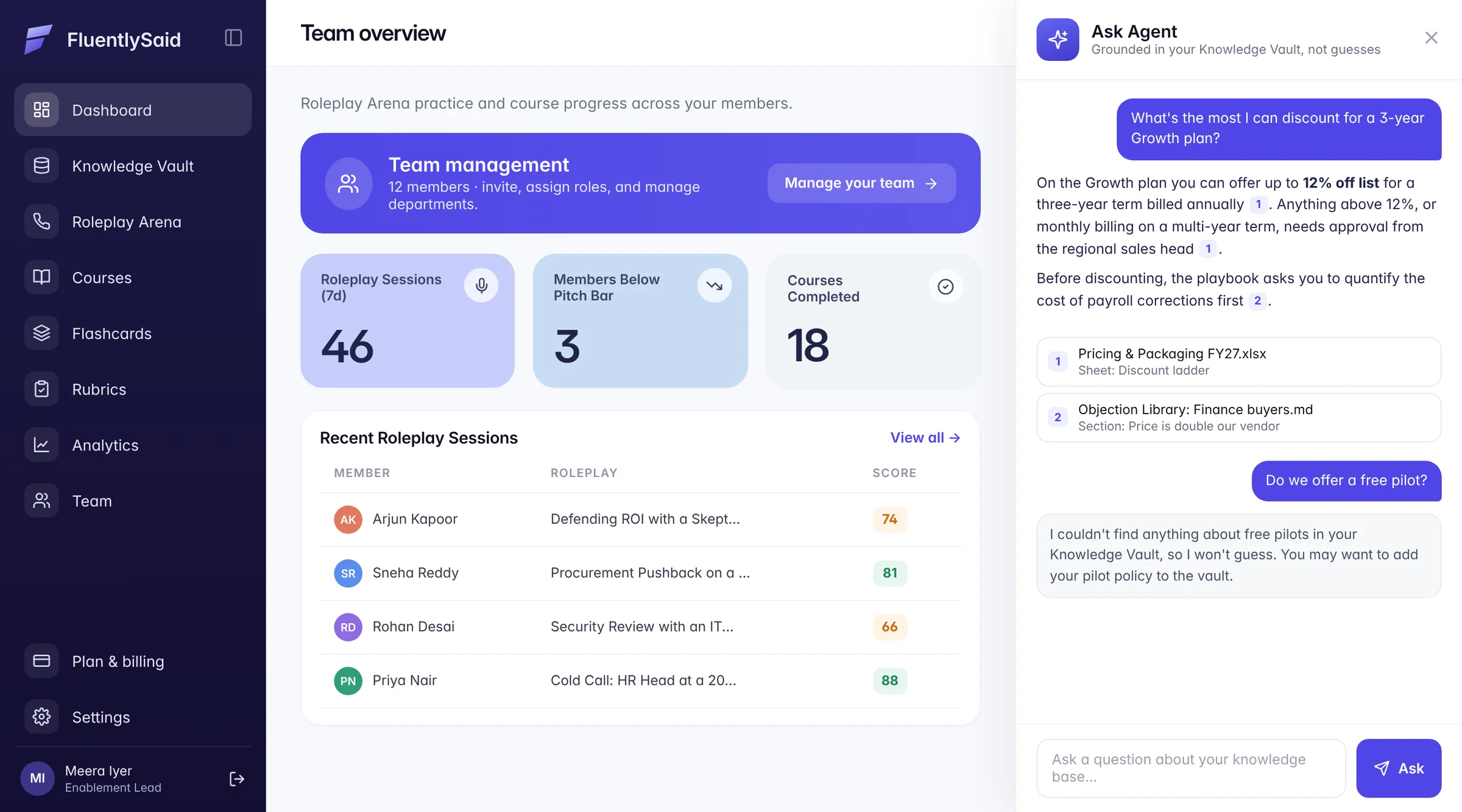
- 1Cited from the pricing sheet
- 2Says so when it doesn't know
Customize everything: personas, situations, rubrics, language
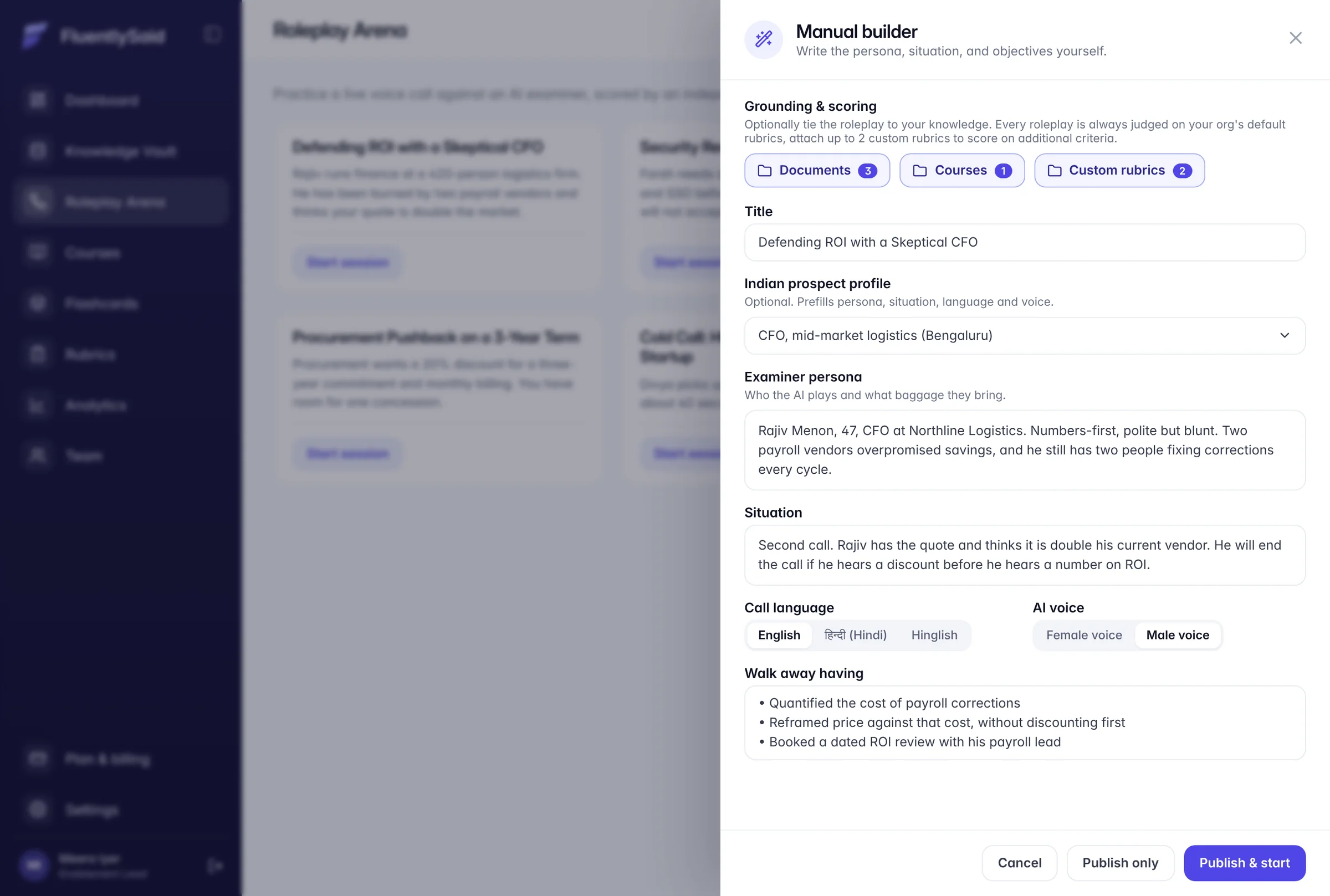
You can build a roleplay four ways and tune every part of it.
Use the manual builder, generate one from a document, build one from a real call transcript, or chat and build. Add custom rubrics on top of the org-wide defaults. Calls run in English, Hindi and Hinglish, with male or female voices.
- Manual, from a document, from a transcript, or by chat
- Custom rubrics layered on org-wide defaults
- English, Hindi and Hinglish, male or female voice
A scorecard reps actually act on
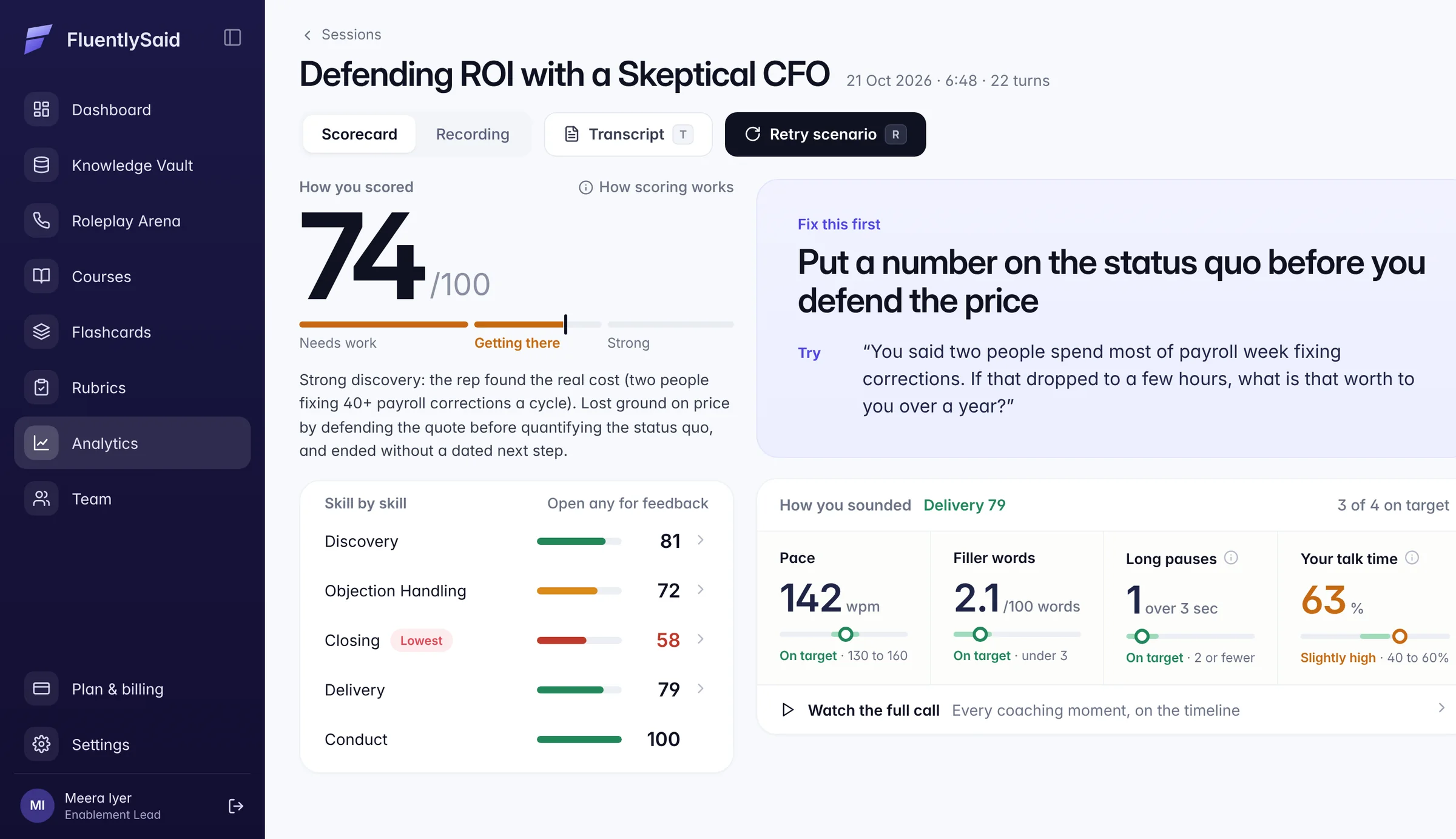
Every call ends with a scorecard that names the single biggest gap.
It shows an overall score, a skill-by-skill breakdown (Discovery, Objection Handling, Closing, Delivery, Conduct), delivery metrics (pace in words per minute, filler words, long pauses, talk-time ratio) and one Fix this first line with an exact sentence to try.
- The lowest skill is flagged so nobody has to hunt for it
- Delivery measured in numbers: 142 wpm, 2.1 fillers per 100 words
- A sentence to try on the retry, not a lecture
- 1Fix this first: the one gap that matters
- 2Lowest skill, flagged
- 3Delivery in numbers
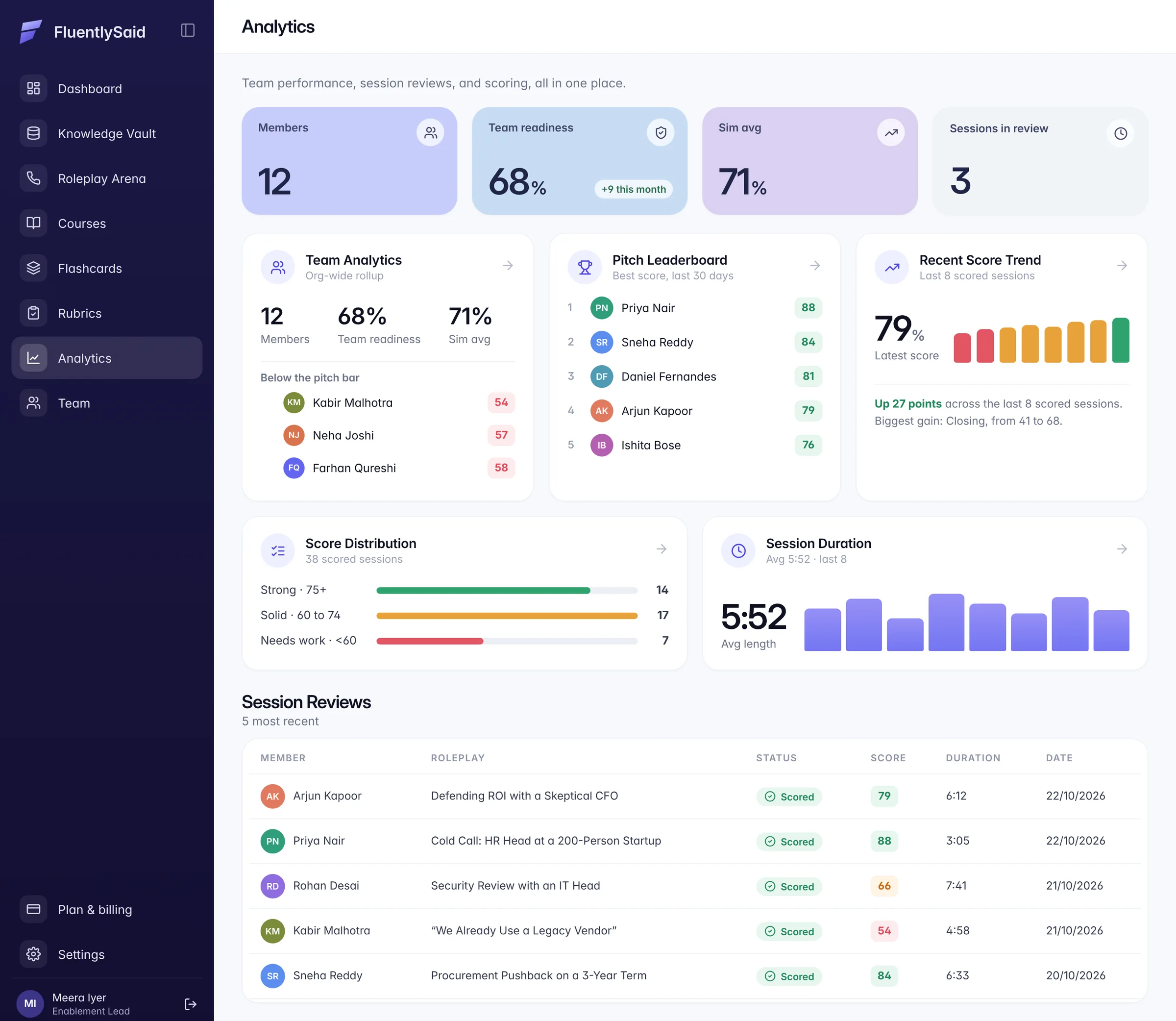
See who is ready before quota day
Team analytics show which reps are ready and which are still guessing.
Managers get team readiness, score distribution, the members below the pitch bar and a leaderboard, all from calls that already happened.
- Members below the pitch bar, by name
- Score distribution across the team
- A leaderboard across the team
Sales scenarios your reps can practice today
These are the calls reps tell us they dread most, ready to build in a few minutes.
See a full practice call, start to scorecard
This video walks through one rep's call from first question to final score.
FluentlySaid vs. manager roleplays vs. generic AI roleplay
The three common ways to practice sales calls differ most on product knowledge, realism and manager time.
| FluentlySaid | Manager roleplays | Generic AI roleplay | |
|---|---|---|---|
| Available 24/7 | Yes | No | Yes |
| Knows your products and competitors | Yes | Depends on the manager | No |
| Configurable buyer emotion | Yes | The manager's best guess | Usually fixed |
| Hindi and Hinglish calls | Yes | Only if the manager speaks it | Rarely |
| Consistent scoring across reps | Yes | No | Varies |
| Manager time required | None per session | A calendar slot per rep | None per session |
| Real call-transcript scenarios | Yes | From memory only | Rarely |
AI sales roleplay questions, answered
Short answers to what sales leaders and enablement teams ask us first.
What is AI sales roleplay?
AI sales roleplay is practice software where a rep talks to an AI that plays a prospect. The AI asks questions, pushes back on price and raises objections like a real buyer would. FluentlySaid builds the buyer from your own documents, runs the call by voice, and scores discovery, objection handling, closing and delivery afterwards.
How is FluentlySaid different from other AI sales roleplay tools?
FluentlySaid builds each buyer from your playbook, products and competitors instead of a generic script. You also set the buyer's emotion, run calls in English, Hindi or Hinglish, and get a scorecard that names the one thing to fix first. Roleplays can start from a real call transcript too.
Can the AI buyer use our own products, pricing and competitors?
Yes. Upload your pitch decks, pricing sheets and battlecards to the Knowledge Vault and the buyer is grounded in them. It raises your real objections and asks about your actual pricing model. If something is missing from the vault, the agent says so rather than inventing an answer.
Can we control how difficult or emotional the buyer is?
Yes. You set a starting mood (curious, rushed, skeptical, frustrated, friendly or distracted) and tune skepticism, price sensitivity, patience and warmth. You can also add a hidden objection that only appears if the rep asks the right question. New reps start easy, experienced reps get the hard buyer.
How are calls scored?
An independent AI judge reads the full call and scores Discovery, Objection Handling, Closing, Delivery and Conduct, plus any custom rubric you add. It also measures pace, filler words, long pauses and talk time. Every scorecard ends with one Fix this first line and a sentence to try.
Does it support Hindi and Hinglish sales calls?
Yes. Calls run in English, Hindi and Hinglish, with a male or female voice for the AI buyer. That matters for teams selling across India, where real calls switch between languages mid-sentence. You choose the language when you build the scenario.
How long does it take to set up a first roleplay?
A first roleplay takes a few minutes. Pick a common situation like Skeptical CFO or describe the call in a couple of lines in chat, and FluentlySaid builds it. Uploading your playbook to the Knowledge Vault first makes the buyer sharper, but you can try a free call without any setup.
Is our data used to train models?
No. FluentlySaid uses pre-trained models to generate scenarios and score calls, and your recordings, transcripts and documents are never used for training or fine-tuning. You can read the full retention and security details on our Data and security page.
More on how we handle your data: Data and security. Looking for the other team? Customer Success or the full feature list.