Solutions · Customer Success
Most churn is decided in one sentence. Practice that sentence.
FluentlySaid gives customer success teams AI roleplay training on the conversations that protect revenue: renewals, price increases, escalations and churn saves. The AI customer is built from your accounts, your product and your playbook.
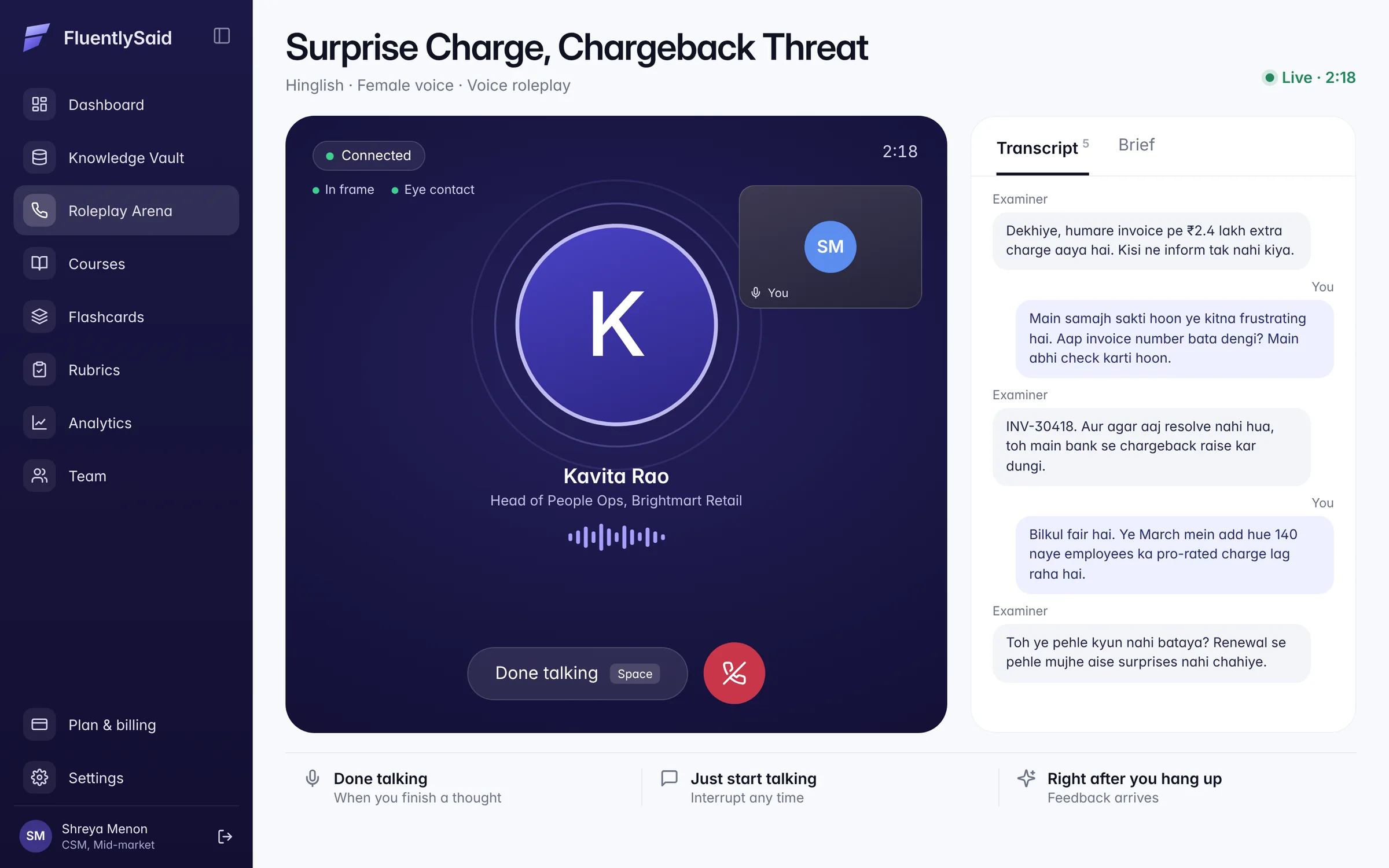
- 1An upset customer, speaking Hinglish
- 2Opens with the surprise charge
What is customer success roleplay training? It is practice where a CSM talks to an AI customer who behaves like a real account: hesitant to renew, upset about a surprise charge, or quietly evaluating a competitor. FluentlySaid scores how well the CSM uncovers the real concern, defends value and agrees a next step.
Why customer success teams struggle to practice the hard calls
The calls that decide retention are the ones CSMs get the fewest chances to rehearse.
CSMs learn renewals on live accounts.
That's the most expensive classroom you have.
The hard calls are rare.
A CSM might face an angry escalation once a quarter, which is not enough reps to get good at it.
Peers play bad customers badly.
Too angry or too cooperative. Neither is real.
How customer success roleplay works in FluentlySaid
A CSM goes from your renewal playbook to a scored customer call in four steps.
- 1
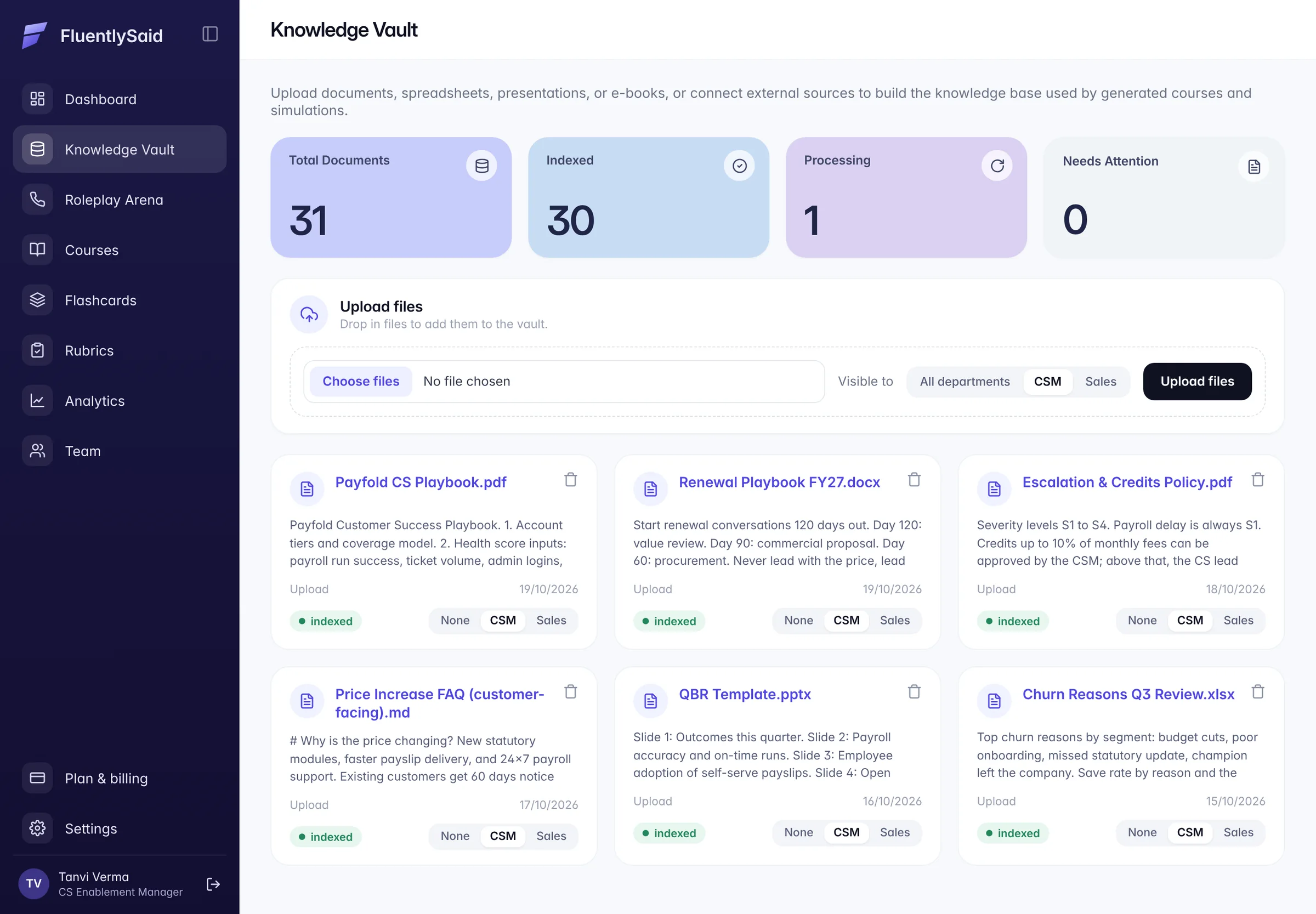
Upload your CS playbook
The CS SOP, renewal playbook and escalation policy go into the Knowledge Vault.
- 2
Pick or build the customer
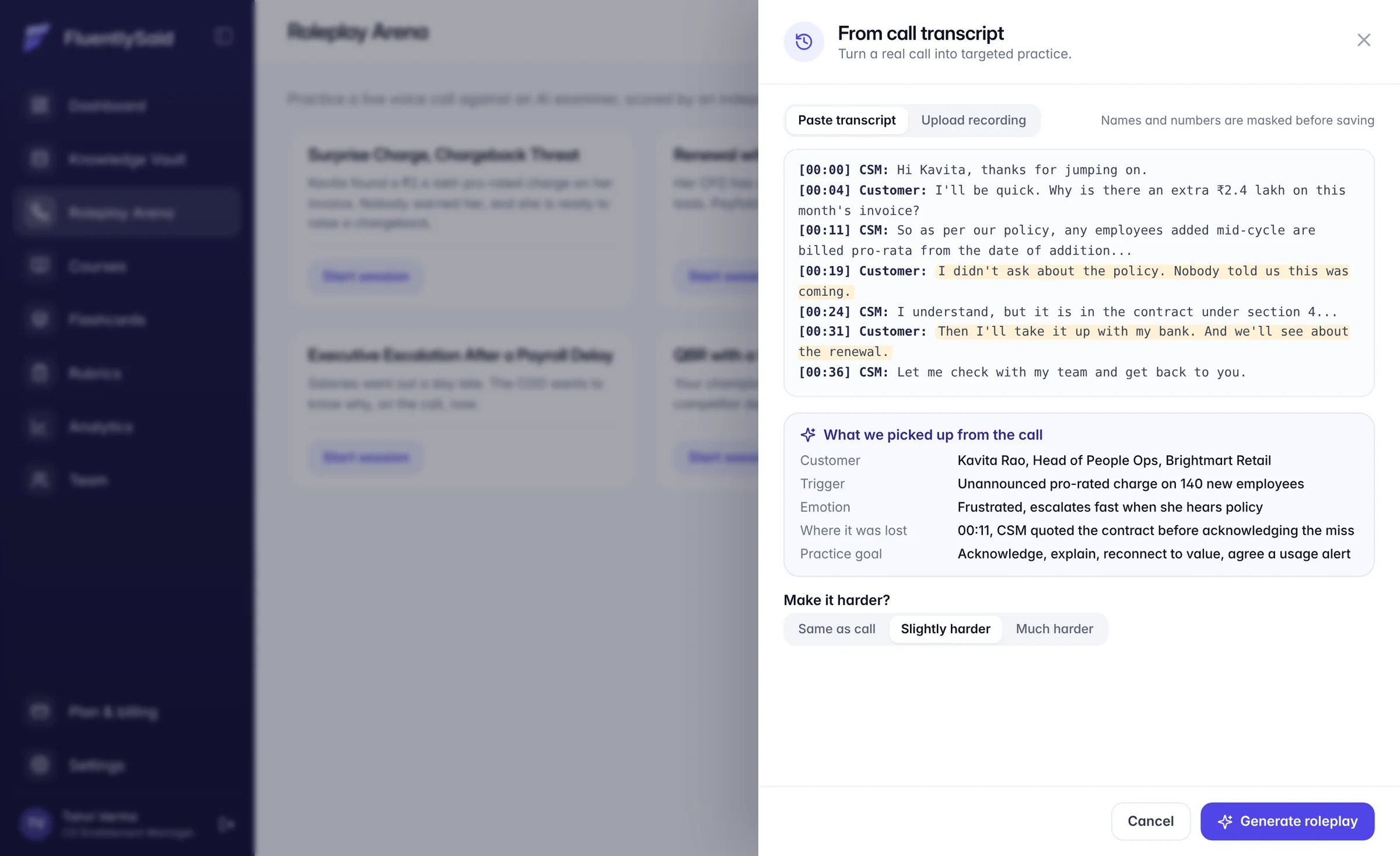
Choose Renewal at risk or Angry escalation, or start from a real call transcript.
- 3
Take the live call
The AI customer pushes back, brings up the charge and decides whether to stay.
- 4
Review the scorecard
Empathy, de-escalation, root cause and next step are scored, with one thing to fix first.
AI customers that know your product and your customers
The AI customer is grounded in your Knowledge Vault, so it argues from your real context.
It knows your pricing policy, your renewal terms and your escalation rules, plus the account context you give it. When a customer brings up an invoice, the CSM has to answer from your actual policy.
- Built from the CS SOP, renewal playbook and escalation policy
- Account context carried into the call
- Visibility set per department, so CSM material stays with CSMs
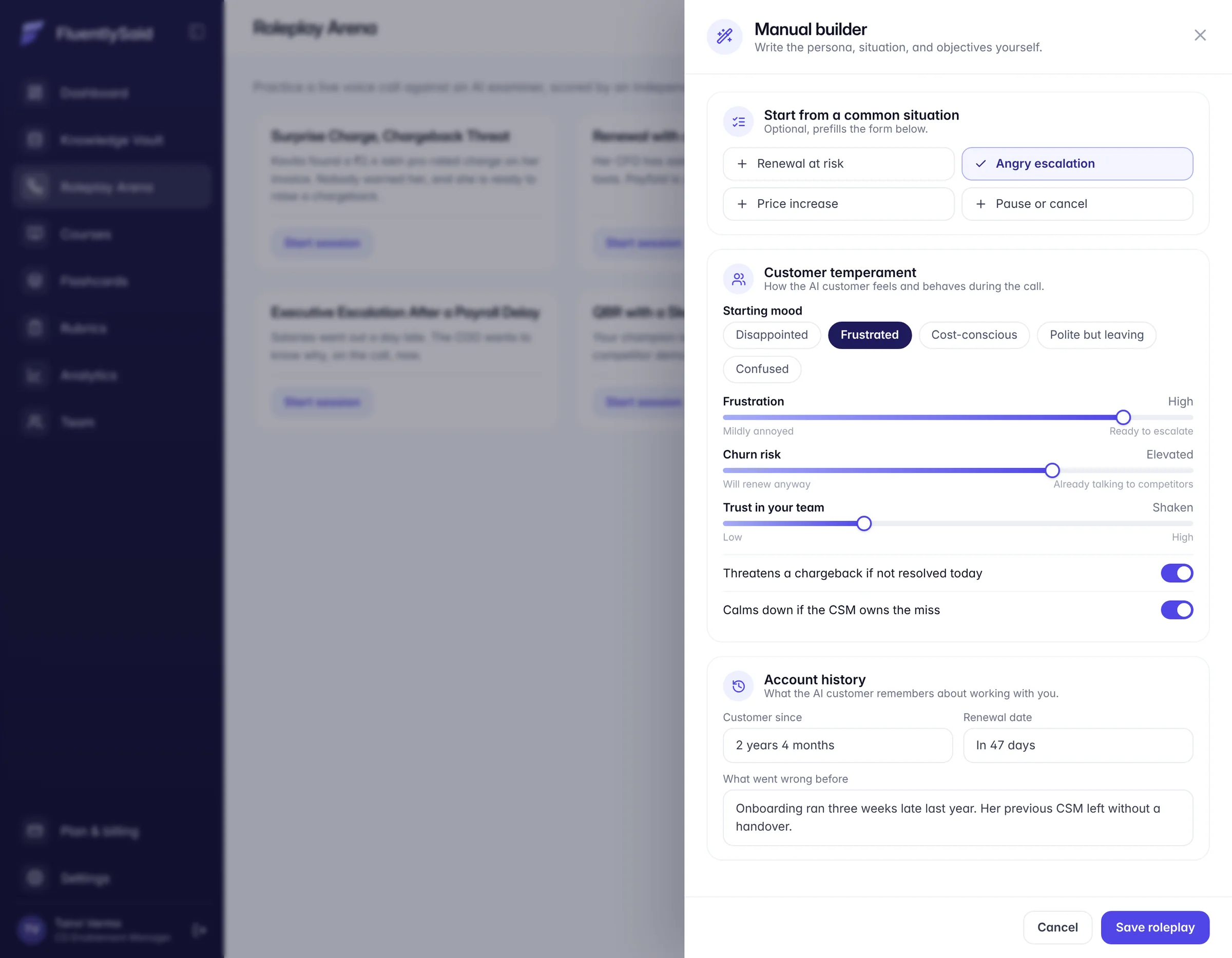
Configure the customer's emotion and history
You decide how the customer feels and what went wrong before the call starts.
Set them frustrated, disappointed with progress, cost-conscious, or polite but leaving. Add how long they have been a customer and what happened on the account.
- Mood and temperament sliders
- Tenure, history and the incident behind the call
- Churn risk set for the account before the call
Turn a real lost call into practice
The From call transcript builder turns a real customer conversation into a roleplay.
Paste a transcript from a renewal that slipped or an escalation that went badly. FluentlySaid builds the customer from what they actually said, so the team can replay the exact moment and try a different answer.
- Start from a real transcript, not a hypothetical
- Replay the sentence where the account turned
- Keep the roleplay in your library for the next new hire
Built for your exact playbook
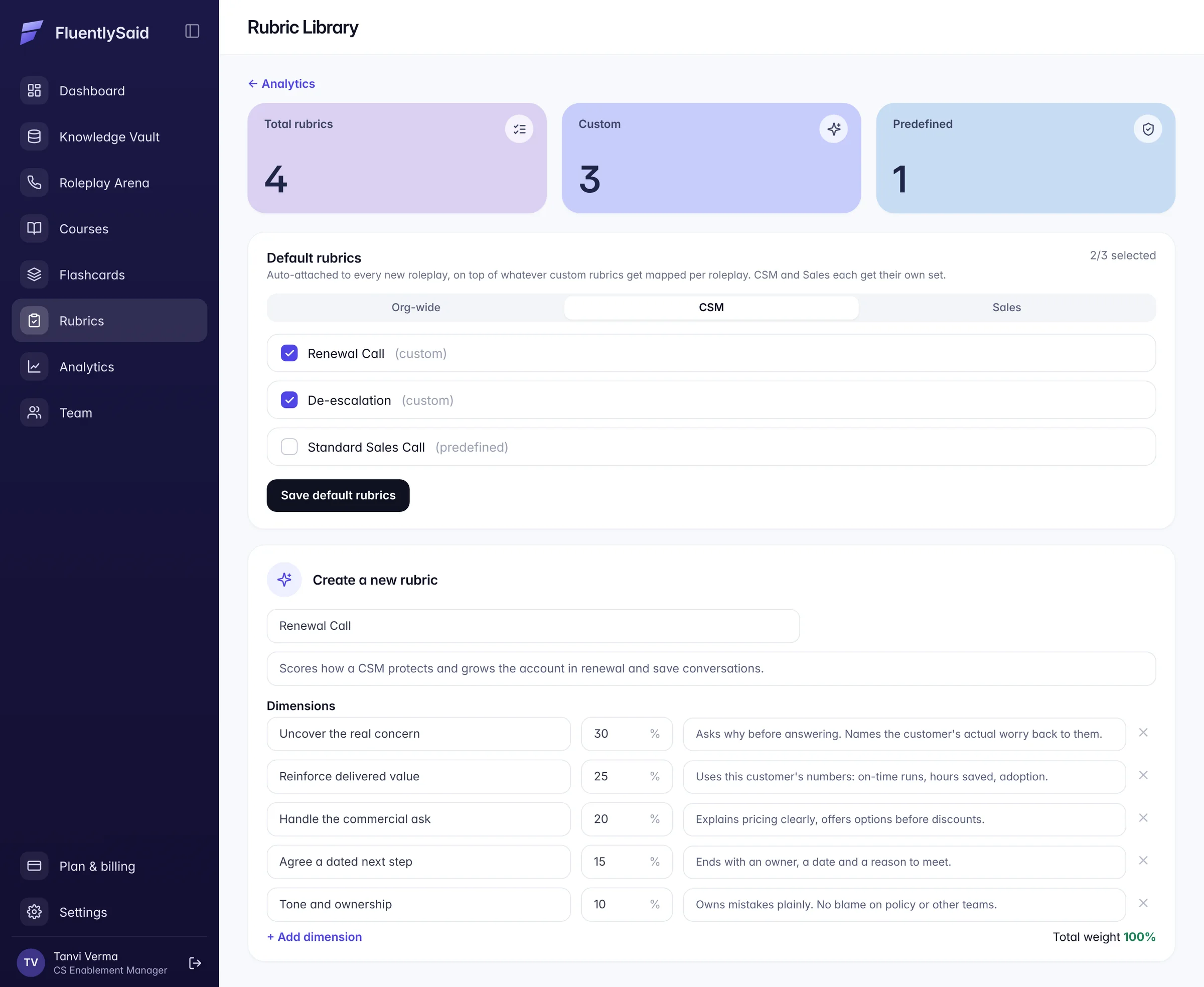
Rubrics are set per department, so CSMs are scored on CSM skills.
Build a Renewal Call rubric with weighted dimensions, or start from the CSM defaults. Sales rubrics stay with Sales, and CS rubrics stay with Customer Success.
- Weighted dimensions for renewal calls
- CSM defaults to start from
- Separate rubrics for separate departments
Coaching on what you said and how you said it
The scorecard grades the words and the delivery.
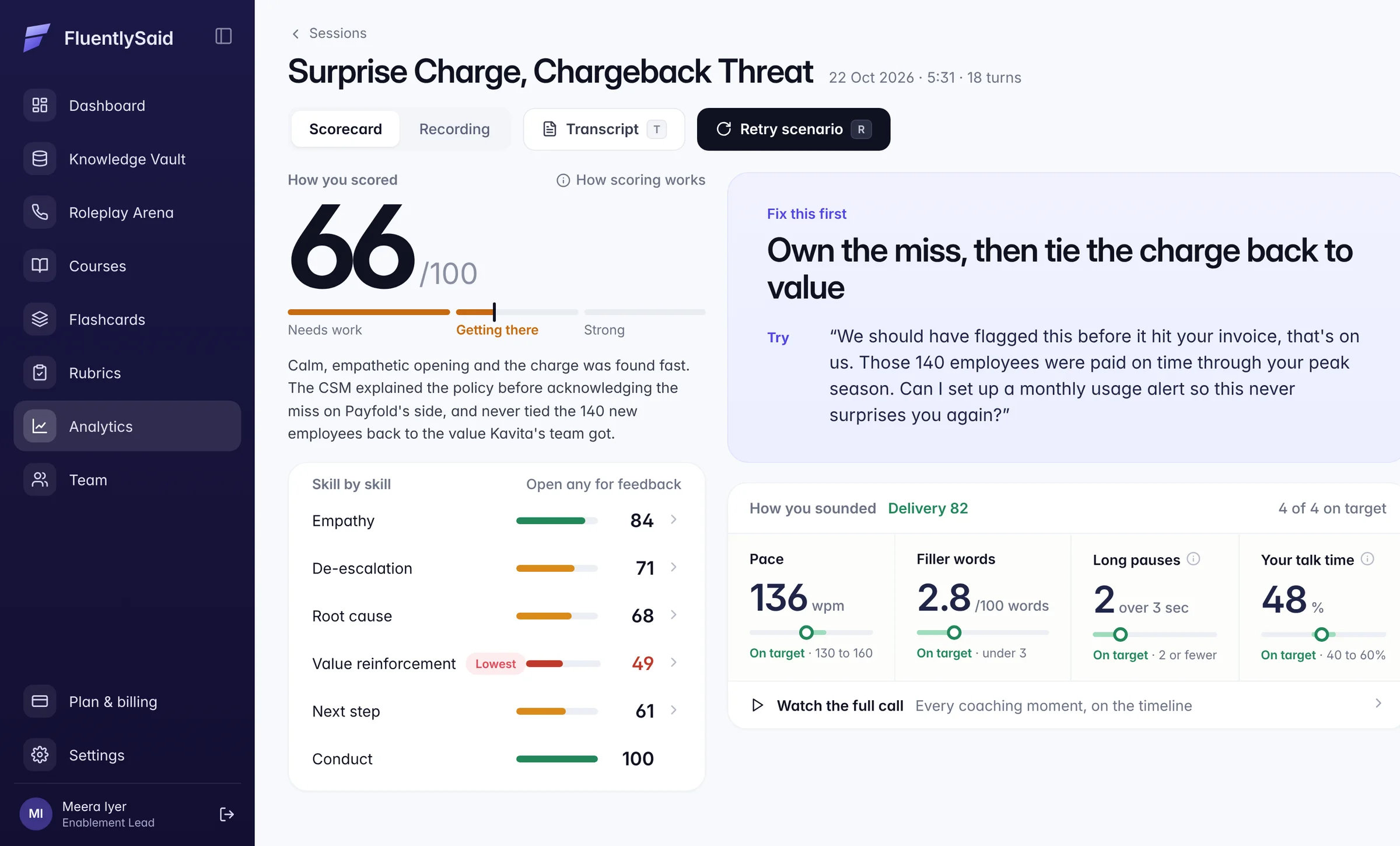
A CSM sees scores for Empathy, De-escalation, Root cause, Value reinforcement and Next step, plus pace, filler words, long pauses and talk time. The Fix this first line gives an exact sentence to try on the retry.
- Empathy and de-escalation scored on their own
- Lowest skill flagged (Value reinforcement in this call)
- Delivery measured against target ranges
- 1Own the miss, then tie it to value
- 2Lowest skill, flagged
- 3Delivery on target
Know which CSMs are ready for the renewal season
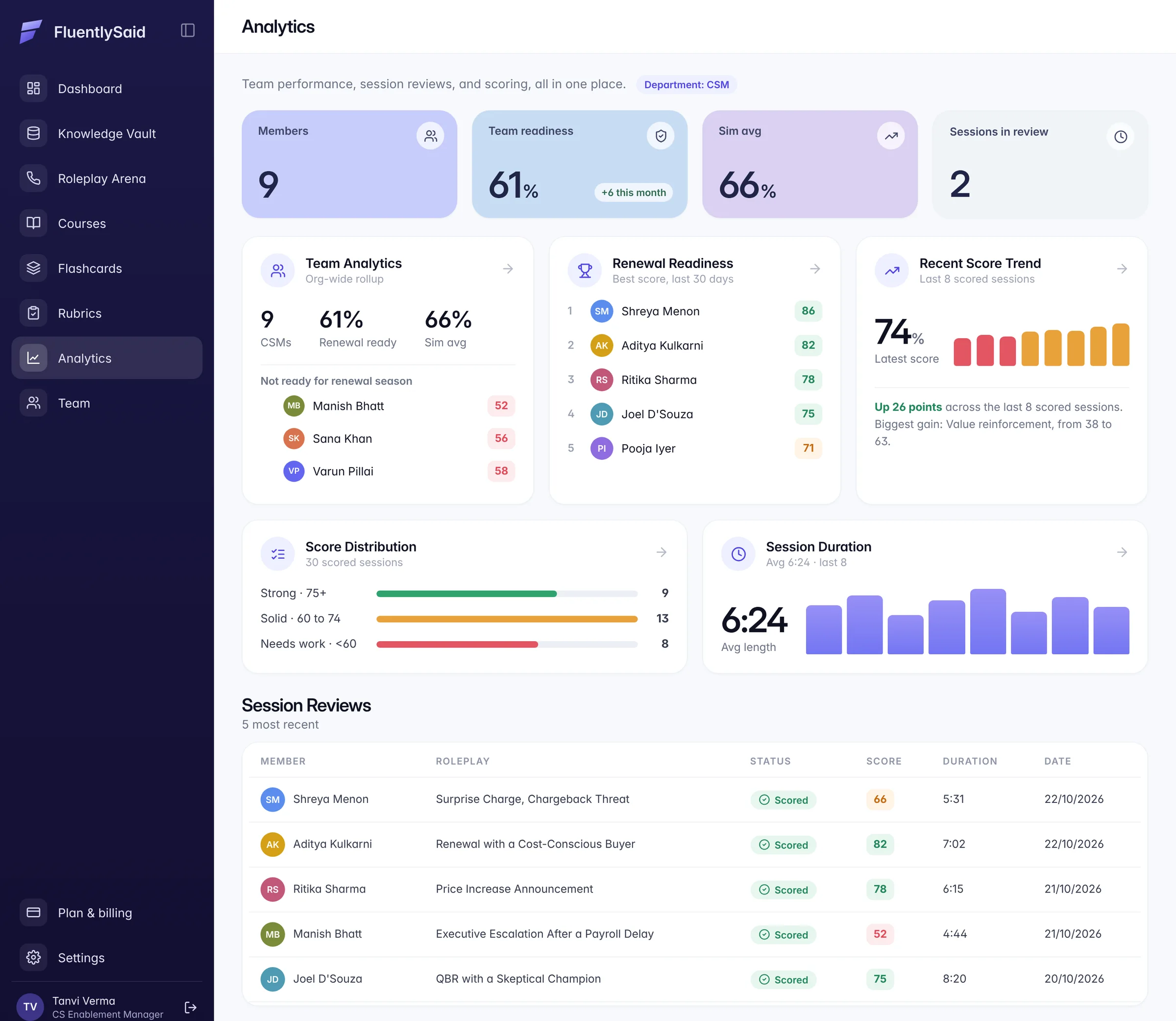
Department analytics show how prepared the CSM team is before renewals land.
Managers see readiness by CSM, who is below the bar, and how scores are spread across the team, from practice that already happened.
- CSM department view, separate from Sales
- Members below the bar, by name
- Score distribution across the team
Customer success scenarios your team can practice today
These are the conversations that put revenue at risk, ready to build in a few minutes.
- Renewal with a cost-conscious buyer
- Price increase announcement
- Surprise charge and chargeback threat
- Customer reluctant to renew due to poor results
- Executive escalation
- QBR with a skeptical champion
- Upsell after a support incident
- Pause or cancellation request
- Onboarding kickoff with a new stakeholder
- Support ticket de-escalation
See a renewal save call, start to scorecard
This video walks through one CSM's call with an upset customer, from first word to final score.
FluentlySaid vs. shadowing vs. generic training modules
The three common ways to train CSMs differ most on how often the hard calls get practiced.
| FluentlySaid | Shadowing | Generic training modules | |
|---|---|---|---|
| Practice the hard call on demand | Yes | Only when one happens | No |
| Customer knows your product and policies | Yes | Real customers do | No |
| Configurable customer emotion and history | Yes | No | No |
| Safe to fail | Yes | No | Yes |
| Consistent scoring across CSMs | Yes | Depends on who observes | Quiz scores only |
| Hindi and Hinglish calls | Yes | Only if the customer does | Rarely |
| Built from a real call transcript | Yes | No | No |
Customer success roleplay questions, answered
Short answers to what CS leaders and enablement teams ask us first.
What is customer success roleplay training?
Customer success roleplay training is practice where a CSM talks to an AI customer who behaves like a real account. The customer can be hesitant to renew, upset about a charge or quietly looking at a competitor. FluentlySaid scores how well the CSM finds the real concern, defends value and agrees a next step.
Which customer success conversations can we practice?
You can practice renewals, price increases, surprise charges, executive escalations, QBRs, upsells after an incident, pause or cancellation requests, onboarding kickoffs and support de-escalations. Each can be built from a starting situation, a document, a chat description or a real call transcript.
Can the AI customer act angry, disappointed or close to churning?
Yes. You set the customer's mood and temperament, from polite but leaving to openly angry, plus their tenure and what went wrong on the account. The customer reacts to what the CSM says, so an empathetic, specific answer can bring them back and a defensive one pushes them further out.
Can we build a roleplay from a real customer call?
Yes. The From call transcript builder takes a transcript of a real customer call and turns it into a roleplay. The AI customer is built from what that customer actually said, so your team can replay the moment an account turned and try a different answer.
How do we measure if CS training is working?
Check score trends per CSM, the skill that is lowest across the team, and who is below your readiness bar. Retrying the same scenario shows whether the Fix this first advice landed. Pair this with your own retention numbers over time. We do not publish retention uplift figures until we have pilot data.
Does it work for customer support and account management teams too?
Yes. Support teams can practice ticket de-escalation and frustrated callers, and account managers can practice QBRs, expansions and executive conversations. Rubrics are set per department, so each team is scored on the skills that matter for its role.
Does it support Hindi and Hinglish?
Yes. Calls run in English, Hindi and Hinglish with a male or female voice for the AI customer. The Surprise Charge scenario in our demo runs in Hinglish. You pick the language when you build the scenario.
How is our customer data protected?
Your recordings, transcripts and documents are never used to train or fine-tune any model. We use pre-trained models for generation and scoring only, set retention windows with you, and support deletion of a session, a user or a whole workspace. Full details are on our Data and security page.
More on how we handle your data: Data and security. Looking for the other team? Sales Readiness or the full feature list.