UPSC Mock Interview with AI: How It Helps You Crack the Personality Test (2026-27)
By FluentlySaid Editorial TeamUpdated 7 November 20268 min readहिन्दी में पढ़ें
Cleared Mains? Dates, DAF-II and next steps: UPSC Mains Result 2026
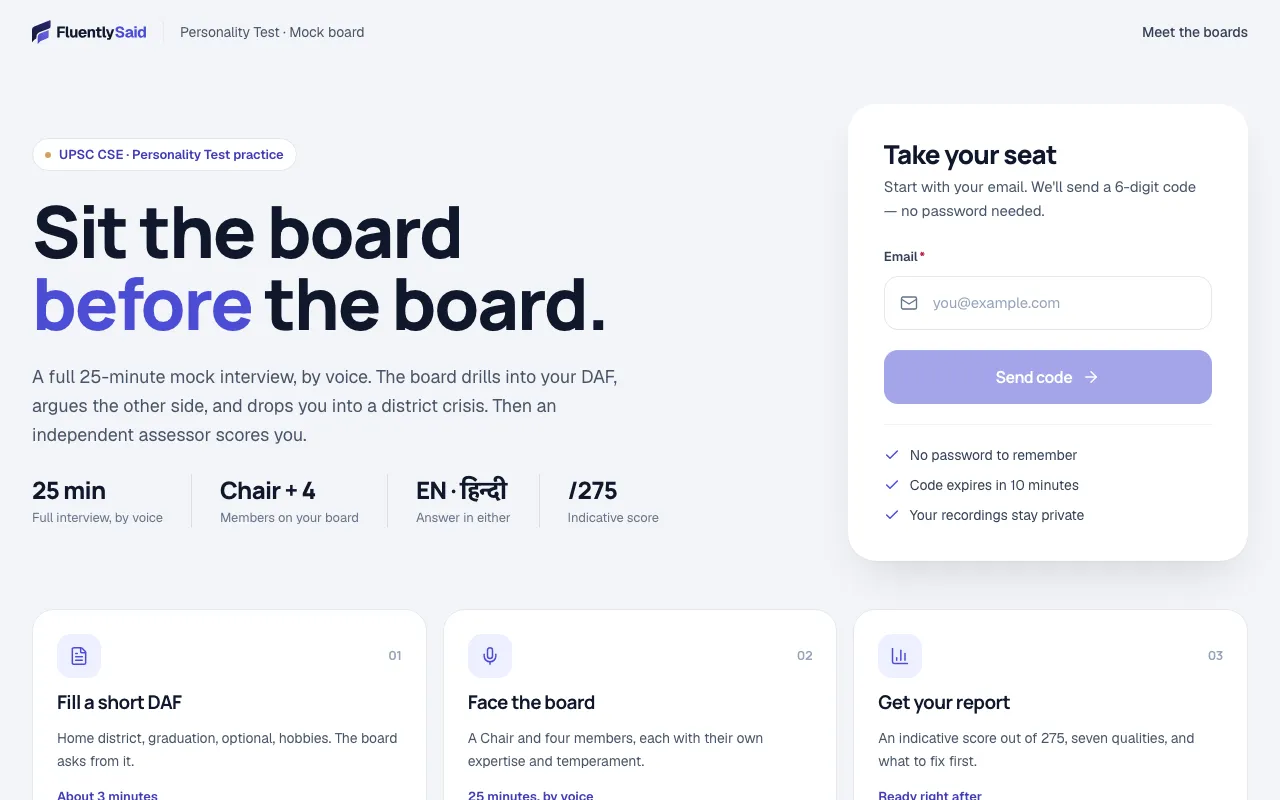
After months of Mains preparation, the Civil Services Examination closes with a conversation. A UPSC mock interview is how you find out what you sound like in that conversation before it carries marks. The personality test carries 275 marks, and much of what the board asks can start from your Detailed Application Form. You cannot revise for that the way you revise for GS. You have to say your answers out loud, hear them challenged, and try again.
This guide explains what the board tests, where an AI mock interview helps, where it does not, and how to use four weeks well.
What the UPSC personality test actually assesses
UPSC's notice says the object of the interview is to assess the personal suitability of the candidate for a career in public service. It is not a viva on your syllabus. A board of experienced people has your form in front of them and a short time to judge how you think, how you weigh a question, and whether you stay straight when you don't know something.
That is why your DAF matters so much. Your home district, your degree, your job, your hobby and your service preferences are the board's easiest way in. A line you wrote casually two years ago can become the next five minutes.
The interview has no minimum qualifying mark, and its marks count towards your rank. Written marks and interview marks are added together for the final merit list, as the chart shows.
The written Mains carries 1,750 marks and the personality test carries 275 marks, for a total of 2,025.
Source: UPSC notices. 275 marks, 2026 notice. 1,750 written marks, 2023 notice. Check the current notice for your cycle.
275 looks small next to 1,750. It still matters, because it is one sitting, it comes last, and it is the one part of the exam where nobody marks a script. You speak, and people decide.
Why mock interviews matter, and where traditional mocks fall short
A good human UPSC mock interview is valuable. An experienced panellist can read things that software can't, and can tell you how you came across in a room. Coaching institutes run these for a reason, and if you can sit one, you should.
The limits are practical. Human mocks are few, they run on someone else's dates, they may need travel, and they cost money per sitting. Many candidates also treat them as a performance, so they go in having never defended an answer aloud. They then spend an expensive session finding the mistakes they could have found alone.
Self-practice has the opposite problem. You can do it any time, but nobody interrupts you, nobody disagrees, and your answer always sounds fine in your head.
An online mock interview for UPSC sits between these two, and it is the easiest UPSC mock interview to repeat. It won't match a retired civil servant's judgement. It does let you do the repetitions first, so a human mock goes further.
How an AI mock interview helps
Here is what a UPSC mock interview on the FluentlySaid board does, and why each part matters for your UPSC interview preparation.
- More repetitions. You don't have to wait for a panel date. It runs at any hour you can find a quiet room. Free interviews are limited, so spend them deliberately.
- Questions from your own form. You fill a short DAF, about three minutes. The board starts from your home district, graduation, optional and hobbies, then goes one step deeper each time.
- Members who argue the other side. Say a policy is good and someone will ask why it failed. You practise holding a view without getting defensive or folding.
- A district-level situation. You get put in a posting with a concrete problem, then pushed on your answer. This is where a memorised response stops working.
- English or Hindi. Answer in the language you plan to use on the day.
- Out loud, on the clock. A full interview runs 25 minutes by voice, with a Chair and four fictional members, each with their own expertise and temperament.
- A report right after. An independent assessor reads the transcript. You get an indicative score out of 275, seven qualities, how each answer went, a stronger approach, and what to fix first.
- Private recordings. Recording is optional. If you turn it on, it is visible only with your login and deleted after 30 days.
| What you get | Human panel mock | AI mock interview | Self-practice |
|---|---|---|---|
| Availability | Set dates, limited seats | Any hour | Any hour |
| Cost per attempt | Varies by institute | Free to start, then [PRICE] | Free |
| DAF personalisation | Good, if the panel has read it | Built from what you enter | Only what you think to ask yourself |
| Feedback speed | Same day, sometimes brief | Right after the interview | None from anyone else |
| Language | Depends on the panel | English or Hindi | Your choice |
| Best used for | Judgement from experienced people, room presence | Repetitions and finding weak answers | Fixing one answer at a time |
Source: FluentlySaid's product features and our own comparison. Human mock details vary by institute.
Use all three. AI complements human panels. It does not replace them.
A four-week UPSC interview preparation plan
This is a suggested plan, not a formula. Shift it around your summons date and your weak areas. The review column matters most, because a UPSC mock interview you don't review is only a rehearsal of your mistakes.
| Week | Focus | AI mocks | Human mocks | What to review |
|---|---|---|---|---|
| 1 | DAF deep-dive: every line, and the facts behind it | 1 | 0 | Lines you couldn't defend |
| 2 | Current affairs and opinion questions | 2 | 1 | Where you took one side and stopped |
| 3 | Home state and district, hobbies, optional subject | 2 | 1 | Facts you guessed, and answers that ran long |
| 4 | Full mocks, then rest before the day | 2 | 1 | Only your top three fixes. Add nothing new |
Source: FluentlySaid's suggested plan. UPSC doesn't prescribe a number of mocks.
UPSC interview tips for using the plan
- Write down each question you fumbled, and fix that one before your next UPSC mock interview.
- Say "I don't know" cleanly when you don't. Then stop. Guessing costs more than admitting it.
- Check any fact you quoted in a mock, because a confident wrong fact is worse than a short answer.
- Stop mocks a few days before the day, so you arrive sounding like yourself.
Ten DAF-based question patterns
These are patterns to practise with, not a list of UPSC interview questions anyone will ask you. They are written for this guide, and the examples use a fictional candidate. Swap in your own details.
| DAF line | Pattern | Example |
|---|---|---|
| Name | Meaning, or someone who shares it | Your name means steady. Is steadiness always a virtue in an officer? |
| Home district | Its economy and its problems | Name two problems in Sitapur that a DM could fix within a year. |
| Graduation | Your subject applied to governance | You studied civil engineering. Why do our rural roads fail after one monsoon? |
| Optional | Basics, then a current application | You took sociology. How would you explain caste in a modern city? |
| Hobbies | Depth check on what you claimed | You wrote gardening. Why does your soil need a different mix for roses? |
| Work experience | Why you left, and what carries over | Why leave a private bank job? What will you miss on your first day in a district? |
| Service preference | Defend your order | You put IPS above IFS. Your friend says that's a mistake. Answer them. |
| Gaps | Direct, and expects a straight answer | What did you do in these two years? What would you do differently? |
| Achievements | Drill into the detail | You won a state debate. Who runs it, and what was the argument you lost? |
| Current affairs tied to you | A recent issue through your background | As an engineer from a flood-hit district, what would you ask of the state's next flood plan? |
Source: written by FluentlySaid for practice. Not taken from any real interview or question list.
Preparing for the UPSC interview in Hindi
If you plan a Hindi interview, practise in Hindi from your first UPSC mock interview, not in the last week. The hard part is often technical words: the terms you read in English during preparation may not come quickly in Hindi under pressure. Build your own short list for your optional and your home district, and say them aloud.
Check the current UPSC notice for the rules on your choice of interview language. You can read this guide in Hindi.
The 2026-27 timeline
UPSC declared the Mains written result on 5 November 2026. Rely on upsc.gov.in rather than any date quoted on a website, including this one. Our Mains result 2026 page keeps the key dates in one place.
Mains held
21, 22, 23, 29 and 30 August 2026official
5 November 2026. 2,526 qualified for the Personality Testofficial
11 to 25 November 2026, till 6:00 PMofficial
Interview schedule
To be notified by UPSCnot announced
Source: UPSC result notice dated 5 November 2026, as of 7 November 2026. Confirm every date at upsc.gov.in. Last cycle's interviews were reported from December 2025 to February 2026.
Fill DAF-II first, then start practising. Our week-by-week plan after Mains paces the rest until your interview.
Sitting a bank exam instead? See the IBPS PO guide and the RRB PO guide.
Questions
Is an AI UPSC mock interview useful?
Yes, for repetition. It makes you answer aloud, follows up on what you said, and shows where your answers break. It does not replace a mock with experienced human panellists, so use both.
Can I practise the UPSC interview in Hindi?
Yes. You can choose English or Hindi before you start, and the board speaks in that language.
How many mock interviews should I give before the UPSC personality test?
There is no official number. A sensible plan is enough to fix your repeated mistakes without sounding rehearsed. The four-week plan in this guide uses seven AI mocks and three human mocks, then a rest before the day. Free interviews are limited, so check what your account includes.
Does the AI know my DAF?
It knows what you enter in the short DAF form on FluentlySaid: your home district, graduation, optional, hobbies and similar details. The board's questions come from those entries.
Is FluentlySaid affiliated with UPSC?
No. FluentlySaid is an independent practice tool. Board members are fictional and scores are indicative. They are not predicted marks.
Are my recordings private?
Recording is optional and needs your consent. A recording is visible only with your login and is deleted after 30 days. You can delete it sooner from the report.
Face the panel before the panel
Sit the board before the board. Start a free UPSC mock interview.
Start a free mock interviewFluentlySaid is not affiliated with or endorsed by UPSC. Board members are fictional; scores are indicative.