UPSC Interview Do's and Don'ts: What Actually Matters in the Personality Test
By FluentlySaid Editorial TeamUpdated 7 November 20267 min read
Cleared Mains? Dates, DAF-II and next steps: UPSC Mains Result 2026
The UPSC interview rewards honesty, clear thinking and composure over memorised facts. Answer what you are asked, say "I don't know" cleanly when you don't, hold balanced views without becoming defensive, and follow your e-summon letter exactly on the day. UPSC describes the interview as an assessment of a candidate's personal suitability for a career in public service, not a test of syllabus knowledge.
The Personality Test carries 275 marks, and there is no minimum qualifying mark. Below is what matters, with examples, and what tends to cost candidates. If you cleared Mains 2026, start with the result page for dates and next steps.
UPSC interview do's and don'ts at a glance
| Do | Don't |
|---|---|
| Answer the question asked, then stop | Give a speech or a memorised answer to a nearby question |
| Say "I don't know" plainly when you don't | Guess, bluff or invent a statistic |
| Hold a view and give your reasons | Flip your view the moment someone pushes back |
| Acknowledge the other side of an issue | Run down a group, party, state or institution |
| Know every entry in your DAF | Leave a DAF entry you can't talk about |
| Keep calm under a sharp question | Argue, sulk or show irritation |
| Follow your e-summon letter exactly | Rely on hearsay about the day's rules |
Source: FluentlySaid guidance, based on UPSC's stated purpose of the interview. Not official UPSC guidance.
What does the board actually look for?
The board wants to see how you would think and behave as a public servant. A clear head, a balanced view, honesty about the limits of what you know, and respect for people who disagree all matter. A brilliant fact delivered arrogantly can leave a worse impression than an ordinary answer delivered thoughtfully.
That is why rehearsed answers tend to fail. A board member who hears a memorised paragraph usually asks a follow-up the paragraph doesn't cover, to see what you do without the script.
What if I don't know an answer?
Say so. "I'm sorry, sir, I don't know that" is a complete answer. If you know something related and useful, add it in a sentence. If you don't, stop. Then be ready for the next question without letting the last one shake you.
A sample answer, with critique
Question: "What was the budget allocation for your state's irrigation department this year?"
Weak answer: "Ma'am, it was around five or six thousand crore, I think, which shows the government's commitment to farmers."
Why it's weak: a guessed figure, presented as fact, followed by a slogan. If the member knows the real number, your credibility on every later answer drops.
Stronger answer: "Ma'am, I don't know the exact figure. What I do know is that canal maintenance in my district has been a long-standing complaint, so I'd want to see how much of the allocation goes to repair rather than new projects."
Why it works: honest, short, and it turns to something the candidate actually knows. Use this only when you have a genuine related point. Otherwise, "I don't know" alone is better.
How do you handle stress questions?
Some questions are sharp on purpose. A member may challenge your service choice, call your hobby superficial, or argue the opposite side of your view. Often the board is watching how you respond, not testing whether you will give in.
- Pause before answering. A second of silence reads as thought, not weakness.
- Acknowledge the point. "That's a fair concern, sir" costs nothing and lowers the temperature.
- Then hold your ground with reasons. Change your view only if the argument genuinely persuades you, and say so: "You're right, I hadn't considered that."
- Never make it personal. Disagree with the argument, not the person.
Practising this is hard alone, because you need someone to push back. That is where mock interviews help most: you learn how you react to pressure before it counts.
What should you wear to the UPSC interview?
Follow anything your e-summon letter says. Beyond that, choose simple, formal, comfortable clothes you have already worn for a few hours, and shoes you can walk in. The goal is for nobody, including you, to think about your clothes during the interview.
What does body language say in the interview?
Sit upright and still, look at the member asking the question, and include the others when you answer. Keep your hands relaxed. Small nerves are normal and boards expect them. What helps is steady eye contact and an even pace of speech, both of which improve with practice out loud.
Watching a recording of yourself is the fastest way to see your habits: looking down, fidgeting, nodding continuously, or rushing when you are unsure.
What happens on the day at Dholpur House?
Interviews are held at UPSC, Dholpur House, Shahjahan Road, New Delhi. UPSC issues no paper summon letters: download your e-summon letter from upsc.gov.in or upsconline.nic.in, and email [email protected] at once if you can't. The letter is the authority on your date, session, reporting time and what you may carry in.
UPSC's result notice says to bring the original certificates for your eligibility and reservation claims (age, educational qualifications, community, EWS, PwBD) and other documents such as the TA Form. It also says requests to change your interview date and time will not ordinarily be entertained, so plan around the date you get.
- Read the e-summon letter twice, the week before and the night before.
- Arrange every original it lists in one folder, in the order given, with the TA Form filled in.
- Plan your route to Shahjahan Road and arrive with a generous margin. Delhi traffic is not a good reason to be late.
- Expect waiting time. Carry nothing to study. Stay calm and keep your energy for the room.
- Greet the board politely when you enter, sit when invited, and thank them when you leave.
What are the most common mistakes in the UPSC interview?
- Not knowing your own DAF. The most avoidable mistake. Every entry is fair game.
- Long answers. Answer, give a reason or example, stop. The board will ask if it wants more.
- Bluffing. One invented fact can colour the rest of the conversation.
- Extreme or one-sided views. Show you understand the other side, even when you disagree.
- Getting rattled by one bad answer. Each question is a fresh start.
Almost all of these show up only when you speak. Reading this list won't fix them. Answering aloud, hearing a follow-up and reviewing what you said will. See our week-by-week plan for when to start mocks, and the DAF-II guide for turning your form into questions.
Questions
How long is the UPSC interview?
UPSC does not fix a duration in its notice, and interviews vary. Prepare to stay sharp for a full conversation rather than for a set number of minutes.
What if I don't know the answer in the UPSC interview?
Say so plainly and politely, for example "I'm sorry, sir, I don't know that." If you know something related, offer it briefly. Guessing or bluffing does more harm than an honest "I don't know".
Is there a dress code for the UPSC interview?
Follow anything your e-summon letter says. Most candidates choose simple, formal, comfortable clothes they have worn before, so they are not distracted on the day.
Can I disagree with a board member?
Yes, politely and with reasons. A board may push back to see whether you can hold a considered view without becoming rigid or defensive. Acknowledge their point, then explain yours.
Does the UPSC interview have a pass mark?
No. The Personality Test carries 275 marks with no minimum qualifying mark. Its marks are added to your Mains marks for the final merit list.
Where is the UPSC interview held?
At UPSC, Dholpur House, Shahjahan Road, New Delhi. Download your e-summon letter from upsc.gov.in or upsconline.nic.in; UPSC issues no paper letters. It gives your date and reporting time.
Face the panel before the panel
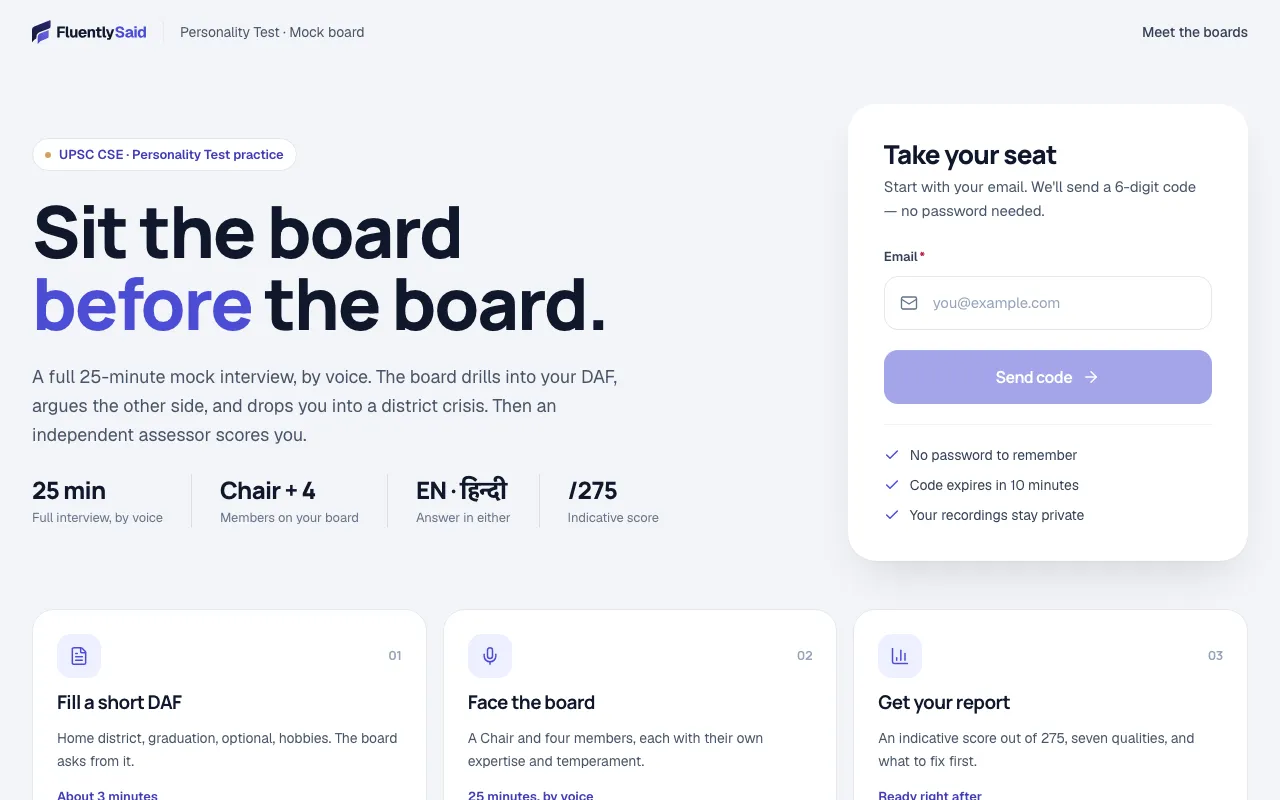
Sit the board before the board. Start a free UPSC mock interview.
Start a free mock interviewFluentlySaid is not affiliated with or endorsed by UPSC. Follow the instructions in your e-summon letter, which take precedence over any guide.