What to Do After Clearing UPSC Mains 2026: A Week-by-Week Plan Until Your Interview
By FluentlySaid Editorial TeamUpdated 7 November 20267 min read
Cleared Mains? Dates, DAF-II and next steps: UPSC Mains Result 2026
After clearing UPSC Mains 2026, your first task is DAF-II, due by 25 November 2026, 6:00 PM. After that, prepare in phases: map your DAF to likely questions, build balanced views on current issues, then practise answering aloud and review what you said. UPSC has not yet notified the interview dates, so the plan below runs in relative weeks and stretches or compresses to fit your date.
UPSC declared the result on 5 November 2026, and 2,526 candidates qualified for the Personality Test. The Mains result 2026 page has the key facts and a roll number check.
What does the UPSC interview actually test?
The Personality Test carries 275 marks, with no minimum qualifying mark, and those marks are added to your Mains total for the final merit list. UPSC describes its purpose as assessing a candidate's personal suitability for a career in public service.
In practice that means the board is listening for how you think, not how much you have memorised. Clear reasoning, balanced views, honesty when you don't know, and composure when challenged matter more than facts recited at speed. Your preparation should build those, which is why the plan below puts practice out loud at the centre.
The week-by-week plan
| Phase | Focus | Done when |
|---|---|---|
| Week 1 | DAF-II (window: 11 to 25 November 2026, till 6:00 PM). Collect documents, decide your service order, submit early. | DAF-II submitted and a copy saved |
| Weeks 2 and 3 | Map your full DAF: every entry becomes two or three likely questions. Write short notes, not essays. | A question bank of your own, roughly 100 to 150 questions |
| Weeks 3 to 5 | Current affairs of the last year, your district and state, your optional's basics, and your service choices. | A one-page view on each major issue, with both sides |
| Weeks 4 onwards | Practise aloud. Start with self-recorded answers, then AI mocks, then human mock boards. | Your repeated mistakes are named and shrinking |
| Final week | Light revision, two or three full mocks early in the week, then rest. Prepare documents and travel. | Rested, documents ready, no new topics |
Source: FluentlySaid suggested plan. Not official UPSC guidance. Phases overlap on purpose.
If your interview comes early in the schedule, compress weeks 2 to 5 and start practising aloud sooner. If it comes late, don't stretch the reading. Add more practice, and more rest between mocks.
Week 1: DAF-II first
Do nothing else until DAF-II is submitted and saved. Submit even if nothing has changed: UPSC's notice says otherwise no e-summon letter is issued. If you applied as "appearing" in your qualifying exam, upload proof of passing. Decide your service order and home cadre based on reasons you can say out loud. Our DAF-II guide covers what the form asks and the common mistakes.
Weeks 2 and 3: How do you turn your DAF into a question bank?
Print your full application and go through it entry by entry. For each one, write the questions a curious, informed stranger would ask. Keep answers to a few lines of notes. You are preparing to think on the topic, not to recite.
- Name and home district: history, economy, a current problem, a local success, and what you would change as District Magistrate.
- School and college: why that subject, what you learnt, how it connects to public service.
- Work experience: why you joined, why you left, what carries over.
- Hobbies: recent activity, depth, and a link to the wider world.
- Optional subject: basics, current debates, and why you chose it.
- Service preferences: why this order, what you know of each service's work.
Expect your bank to reach 100 questions or more. That is normal. You will not be asked most of them, and you don't need to. Working through them is what builds the ease the board is looking for.
Weeks 3 to 5: What current affairs should you cover?
Cover the major national and international issues of roughly the last year, plus anything recent in your state, your district and your field. For each issue, know the basic facts, the main arguments on each side, and your own view with its weakness.
Boards often ask current affairs through your background: an engineer may get infrastructure, a doctor public health, a candidate from a coastal district fisheries or cyclones. Prioritise the issues your DAF makes likely.
Weeks 4 onwards: How many mock interviews should you give?
There is no official number. Give enough mocks to find and fix your repeated mistakes, spaced so you have time to work on each one, and stop before your answers start sounding rehearsed.
- Record yourself first. Answer ten DAF questions aloud on your phone and listen back. Most candidates find their first fixes here: filler words, long preambles, answers that never land.
- Then practise with follow-ups. An AI board can question you from your DAF any time, as often as you like, and push back on what you say. Use it for the repetitions.
- Then sit human mock boards. Experienced panellists can read the room in ways software can't. Go in having already fixed the basics so the session teaches you something new.
- Review every mock. Write down the one thing to fix before the next. A mock you don't review is mostly wasted.
Spread mocks out. Two or three a week, with review in between, beats five on one weekend. If you notice you are performing rather than answering, take two days off.
The final week before your interview
Stop learning new material. Revise your DAF notes and your one-page issue views. Sit one or two full mocks early in the week, then rest. Download your e-summon letter (UPSC issues no paper letters), put your original certificates and TA Form in one folder, and fill in the DoP&T Attestation Form online, which the notice says opens when interviews begin. Plan your travel to Dholpur House with a margin. Our interview do's and don'ts cover the day itself.
Sleep matters more than one more hour of reading. A rested candidate who thinks clearly will do better than a tired one who knows a little more.
How do you know your preparation is working?
Look at your mock reviews, not your hours. Progress looks like this: your answers get shorter and land sooner, you say "I don't know" cleanly instead of guessing, you hold a view under pushback without getting defensive, and the same mistake stops appearing in your notes.
If the same issue keeps coming back, change how you practise it. Answer that type of question ten times in a row, aloud, until the fix feels natural.
This page will be updated when UPSC notifies the interview schedule. Check upsc.gov.in for official dates.
Questions
When should I start preparing for the UPSC interview?
Now. Your DAF already exists, and DAF-II is due first. You don't need the interview schedule to start mapping your DAF and practising answers aloud.
When will the UPSC CSE 2026 interviews be held?
UPSC had not notified the dates when this was written. Interviews are held at UPSC, Dholpur House, Shahjahan Road, New Delhi. In the previous cycle, the Mains result came on 11 November 2025 and the final result on 6 March 2026.
How many hours a day should I prepare for the interview?
There is no right number. Short daily sessions of DAF questions and current affairs, plus regular practice out loud, beat long days of reading. Keep time for rest and exercise.
Should I join a coaching mock interview programme?
Human mock boards are useful, especially closer to the day. Use them after you have fixed your obvious mistakes through self-practice, so each session teaches you something new.
Should I keep studying my optional?
Revise the basics and the parts that connect to your degree, job or district. The interview is not a viva, but a question on your optional is common enough to prepare for.
Face the panel before the panel
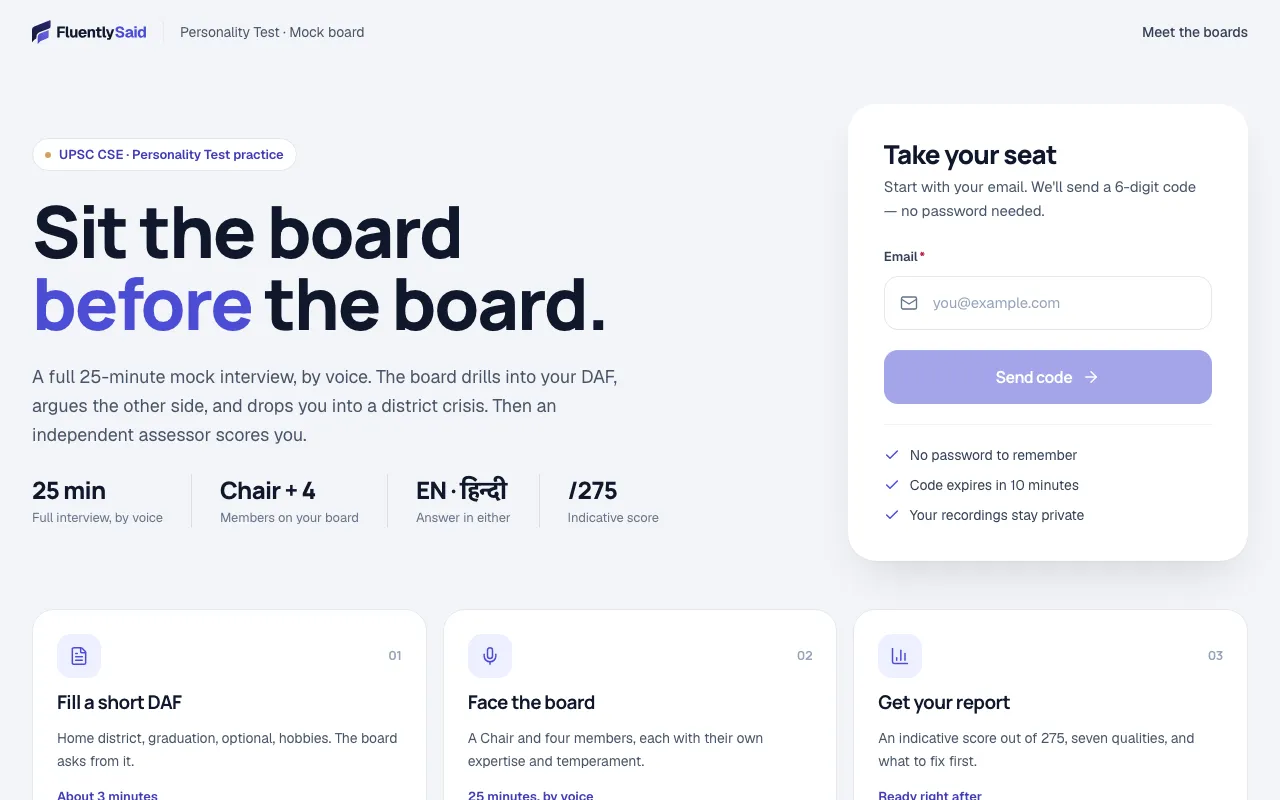
Sit the board before the board. Start a free UPSC mock interview.
Start a free mock interviewFluentlySaid is not affiliated with or endorsed by UPSC. The plan is a suggestion, not official guidance.