UPSC DAF Analysis: How to Analyse Your DAF Before the Interview
By FluentlySaid Editorial TeamUpdated 27 November 202611 min read
In short
UPSC DAF analysis means reading your own Detailed Application Form as the board will, and listing the questions each line can raise. Go section by section, write one fact, one story and one opposite view for every entry, then answer aloud. The board reads the form and follows your answers.
Interviews run 7 Dec 2026 to 12 Feb 2027. Schedule, e-Summon and prep: UPSC Interview Schedule 2026: Dates, e-Summon Letter and What to Do Next
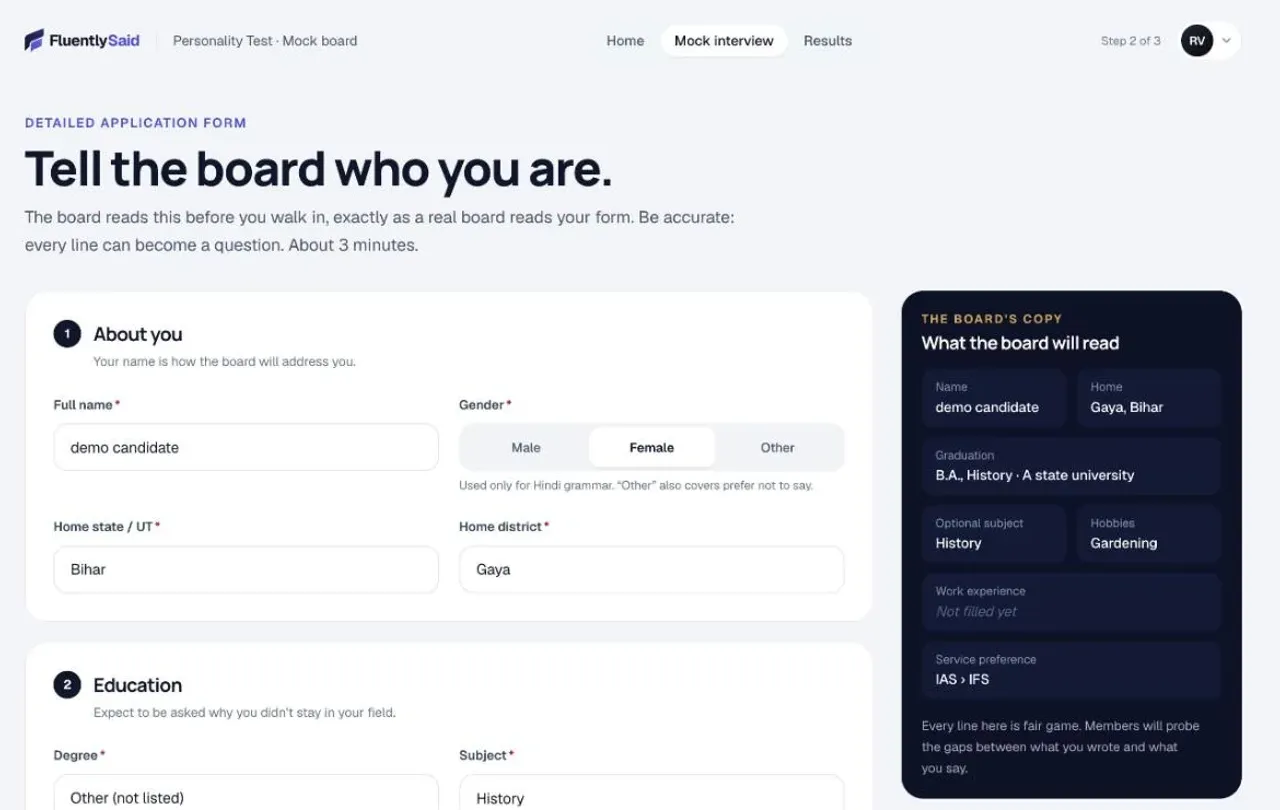
UPSC DAF analysis is the most useful preparation you can do for the Personality Test, and the one candidates most often do halfway. The board has your form open in front of it. This guide gives a method to read your DAF the way the board will, with a worksheet you can copy. For the full set of questions by category, see our UPSC interview questions guide.
UPSC DAF analysis: key facts
| Fact | Detail |
|---|---|
| Marks | The UPSC interview (Personality Test) carries 275 marks. See UPSC's examination notice. |
| What the board reads | The application form you submitted. Questions often begin from it. |
| DAF-II window, 2026 | 11 to 25 November 2026, till 6:00 PM. It has closed. See our DAF-II guide. |
| Interview dates | 7 December 2026 to 12 February 2027, per UPSC's notice of 17 November 2026. Live status on our UPSC interview 2026 hub. |
Sources: UPSC notices on upsc.gov.in. Checked on 26 November 2026.
What is UPSC DAF analysis, and why does it matter?
UPSC describes the interview as an assessment of your personal suitability for a career in public service. The board cannot test that in the abstract. It starts from you, and the page that describes you is your DAF.
That means every entry is a possible question. The board picks a line, asks one question and listens. Then it asks about what you said, not what you wrote. So the DAF gives the board its first question, and your answer gives the next four.
DAF analysis is how you prepare for both. You predict the first question from each line and you prepare for where your own answer will take the board.
How do you do a DAF analysis, step by step?
- Print your form. Work on paper. A screen invites skimming.
- Read it as a stranger. Imagine a board member who knows nothing about you. What would make them curious?
- Mark every entry that can be a question. That is most of them.
- Fill the worksheet for each entry. One fact, one story, one opposite view (see below).
- Rank by risk. Mark entries you know least in red.
- Research the red ones. Spend your time where you are weakest.
- Answer aloud with a timer. Ninety seconds is a good first limit for most answers.
- Get a mock to test it. A DAF based mock interview shows which entries still cause stumbles.
What goes into the DAF worksheet?
Use the same three boxes for every entry, so you do not drift into writing essays.
| Box | What to write | Why the board cares |
|---|---|---|
| One fact | A specific, checkable detail about this entry | Shows the entry is real and you know it |
| One story | A short personal example with a decision in it | Shows how you behave, not just what you know |
| One opposite view | The strongest argument against your position | Shows balance, which the interview tests |
Source: FluentlySaid's framework, not a UPSC publication.
How do you analyse each section of your UPSC DAF?
Sections differ by candidate, so follow your own form. These are the sections most candidates fill in, with the direction questions tend to take. The lists of sample questions are in our other guides, linked below, so this section focuses on method.
| DAF section | Where questions tend to go | What to prepare | Red flag to check |
|---|---|---|---|
| Name | Meaning, origin, how you introduce yourself | A 30-second answer if asked | A story you cannot support |
| Place of birth and home state | Economy, problems, culture, what you would change | Ten facts, one problem, one change | Facts you cannot source |
| Education | Why this subject, links to administration | One link from your subject to a public problem | A subject you switched from and cannot explain |
| Optional subject | Depth, a current issue, the other side | Two current examples, one criticism of your view | Topics you studied years ago and forgot |
| Work experience | What you learned, why you left, what you would bring | One decision story with a result | A gap or short stint without a reason |
| Hobbies and interests | Whether the interest is real, the second and third question | Three minutes on each, one recent example | A hobby you do not actually practise |
| Achievements and awards | Your own role, the effort, the result | What you did, not what the team did | Claims you cannot detail |
| Service preference | Why this order, what the job really is | One honest reason per service | An order that contradicts your story |
Source: FluentlySaid's practice framework. The board's questions vary by candidate.
How do you analyse home state and place of birth?
This is the section with the longest chains, because every candidate has a place and every board member has a view of it. Prepare facts, one unsolved problem and one change you would make. Verify your facts against official sources and say how you know them. Our guide on home state and district questions goes deeper.
How do you analyse education and optional?
Be ready to say why you chose your subject, what it taught you about public problems and what you would criticise in it. If your graduation differs from your optional, be ready for the question of why. Read our guide to graduation and optional questions for patterns by background.
How do you analyse work, gaps and achievements?
Pick the one decision at work you are proudest of, and tell it in four sentences: the situation, the choice, what you did, what happened. For a gap, say plainly what you did and what you learned. The board tests honesty here, not polish.
How do you analyse hobbies?
A hobby on your form can become five minutes of the interview. The board checks whether the interest is real by asking a second and a third question. Keep only hobbies you can talk about for three minutes. Our guide to UPSC interview hobbies in your DAF covers how to choose and defend them.
How do you analyse service preference?
Prepare an honest reason for each service on your list, and for the order. Your reasons should match the story the rest of your form tells. If you rank a service first, know what its daily work involves. Avoid reasons that sound like a brochure. Our guide to DAF based questions lists the patterns each section produces.
How is DAF-II different from your first DAF?
After the Mains result, qualified candidates fill up or update the application form. For 2026, the window was 11 to 25 November 2026, till 6:00 PM, as set in UPSC's notices. This stage is what candidates call DAF-II. Our DAF-II guide covers what it involved.
For analysis, the point is simple. The board reads what you submitted. Check that every entry is accurate and that you can defend each one. If you spot an error now, read the official notice and your login on the UPSC portal to see what is still possible. Do not guess.
How do you turn DAF analysis into answers you can say aloud?
Analysis on paper is half the job. A page of notes does not train your voice. Take each entry and speak the answer: fact, story, opposite view, in ninety seconds. Record it once, listen once and fix one thing. Then repeat the next day without notes.
A DAF based mock interview makes this faster, because someone else asks the follow-ups. On FluentlySaid you enter your DAF and a board of a Chair and four members drills into it in a 25-minute voice interview. The board argues the other side and puts you in situational and administrative scenarios. An independent assessor gives an indicative score out of 275. You can answer in English or Hindi.
After each mock you get a full report with member-wise feedback, a question-by-question analysis with stronger answers, every likely question from your DAF and a progress tracker. The first full mock interview is free. Unlimited mocks on the Board Ready plan let you sit one any time of day, with no slot booking and no travel. The score is a practice estimate, not a prediction. See the UPSC interview practice page, or read how many mocks to aim for in our guide to mock interviews for UPSC.
How long does UPSC DAF analysis take?
Plan two to four focused days for the first full pass, then short daily reviews until your date. Here is a way to split the first pass.
| Day | Task | Output |
|---|---|---|
| Day 1 | Read the form as a stranger, mark every entry, fill the worksheet for name, education and work | Worksheet 40 percent filled, red entries marked |
| Day 2 | Home state and place of birth: facts, one problem, one change | A one-page fact sheet you can say aloud |
| Day 3 | Optional, hobbies and achievements: examples and opposite views | Three minutes ready on each hobby |
| Day 4 | Service preference, then a full DAF based mock interview | A list of entries that still caused stumbles |
Source: FluentlySaid suggestion, not an official schedule. Adjust to your own form and date.
What mistakes spoil a UPSC DAF analysis?
- Writing too much. Long notes you never speak do nothing. Cut each box to two lines.
- Skipping the dull entries. The board may start from the entry you thought was too small to matter.
- Memorising answers. The board follows what you say, so a memorised paragraph breaks at the second question.
- Leaving out the opposite view. An answer with one side sounds like a speech.
- Never testing it. An analysis nobody has questioned you on is a guess.
A last check before your board
A week before your date, read your form once more as a stranger. Each entry should now have a fact, a story and an opposite view, ready to say aloud. If one does not, that is where your next practice session goes. The interview carries 275 marks and is a conversation about you. Know yourself well enough to enjoy it.
Questions
What is DAF analysis for the UPSC interview?
DAF analysis is the work of reading your Detailed Application Form as the interview board will, and listing the questions each entry can lead to. For every line you prepare a fact, a short story and a balanced view. The aim is that nothing you wrote can surprise you in the room.
How do I analyse my DAF for the UPSC interview?
Print your form and go section by section. For each entry, write what a board member could ask, then add one fact, one personal story and one opposite view. Mark the weak entries, research them, and then answer aloud with a timer. Repeat until you can speak without notes.
How long should DAF analysis take?
Plan two to four focused days for the first full pass, then short daily reviews until your interview. Most of the time goes on your home state, optional and hobbies, which produce the longest question chains. Do not spend a week on writing. Move to speaking early, because answers only become fluent when said aloud.
What are DAF based questions in the UPSC interview?
DAF based questions come from entries on the form you submitted, such as your home district, graduation, optional, work and hobbies. The board then follows your answers, so a question can leave the form quickly. Prepare each entry for at least three follow-ups, not only the first question.
Is DAF 2 different from the first DAF for the interview?
DAF-II is the stage after the Mains result where qualified candidates fill up or update their application form. For 2026, UPSC's notice gave the window as 11 to 25 November 2026, till 6:00 PM. The board reads what you submitted, so make sure every entry is accurate and that you can defend it. See our DAF-II guide for the steps.
Can I change my DAF after submitting it?
Do not assume you can. The window for updating the form has a deadline, and UPSC's rules decide what can change. Check the official notice and your own login on the UPSC portal instead of relying on advice from others. If you cannot change an entry, prepare to explain it honestly.
What if my DAF has a weak or empty section?
Do not hide it. A thin work history or a short hobby list is a fact, not a flaw. Prepare a calm, honest answer on why, and what you did instead. The board tests honesty and composure more than polish. A truthful, short answer scores better than an invented one that falls apart in the second question.
How do I practise a DAF based mock interview?
Use a mock that reads your form and follows up on your answers, not a fixed list of questions. A DAF based mock interview makes you answer aloud, interrupts you and goes one step deeper each time. After the mock, review which entries produced your weakest answers and prepare those again.
Face the panel before the panel
Face the board 20 times before you face it once.
Take your first board freeFluentlySaid is not affiliated with or endorsed by UPSC. The method here is our own framework, not official UPSC guidance. Every example question is written for practice and is not taken from any real interview. Nothing here promises selection, rank or marks.