Mock Interviews for UPSC: How Many Should You Take?
By FluentlySaid Editorial TeamUpdated 27 November 20268 min read
In short
UPSC sets no number for mock interviews, and no figure suits everyone. Aim for volume plus variety: a few human panel mocks from different panels, and many more practice mocks on your own. Stop adding mocks when you hear the same feedback and are not acting on it.
Interviews run 7 Dec 2026 to 12 Feb 2027. Schedule, e-Summon and prep: UPSC Interview Schedule 2026: Dates, e-Summon Letter and What to Do Next
How many mock interviews for UPSC are enough? No official figure exists, and any fixed number you hear is someone's opinion. This guide gives ours, with the reasoning: take mock interviews for UPSC in volume and in variety, and treat each one as a test of a single fix. For the questions you will be asked, see our UPSC interview questions guide.
Mock interviews for UPSC: key facts
| Fact | Detail |
|---|---|
| Marks | The UPSC interview (Personality Test) carries 275 marks. See UPSC's examination notice. |
| Interview dates | 7 December 2026 to 12 February 2027, per UPSC's notice of 17 November 2026. See the live status on our UPSC interview 2026 hub. |
| Required number of mocks | None. UPSC does not require or count mock interviews. |
| Nature of the test | UPSC describes the interview as an assessment of personal suitability for a career in public service. It is spoken, not written. |
Sources: UPSC notices on upsc.gov.in. Checked on 26 November 2026.
Why do mock interviews for UPSC help at all?
The interview is a spoken test. You can read for years and still stumble in your first minute, because reading trains recognition and speaking trains recall under pressure. A mock makes you do the real thing: answer aloud, get interrupted and handle a follow-up you did not expect.
A mock does three jobs.
- It lowers your nerves. The fear of the room shrinks each time you survive a simulated one.
- It builds structure. You learn to open with your position, give two sides and stop. Structure is a habit, and habits need repetition.
- It shows you what you cannot hear yourself doing. Filler words, a rambling opening and a defensive tone show up only when someone else listens.
Does repeating the same panel's mock interview help?
Only up to a point. The first sitting with a panel teaches you a lot. The second teaches you whether you improved. By the third, you know how that panel thinks, what it likes and where it will go next. That is comfortable, and comfort is the problem. The real board is a stranger.
Returns also diminish within a single style of mock. A panel that asks every candidate the same ten questions trains you for those ten. Variety fixes this. Different panels, different formats and different question styles keep you from rehearsing a script.
| Sitting | What you learn | Risk if you keep repeating |
|---|---|---|
| First mock | Your biggest gaps, such as DAF holes or a rambling opening | None. Sit it early. |
| Second mock, same panel | Whether you fixed the gaps | You start to anticipate the panel |
| Third mock, same panel | Little new, mostly comfort | You rehearse rather than think |
| Mock with a new panel | How a different style handles you | A new panel can be harsh. That is useful. |
| Daily practice mock | Repetition, calm and structure | Skipping the review makes it noise |
Source: FluentlySaid's view, not a UPSC publication or a study.
How many mock interviews for UPSC should you aim for?
We suggest thinking in two layers, not one total.
- Human panel mocks: two to four. Choose different panels if you can. Space them out and keep at least one for the final fortnight. Our buyer's guide to the UPSC interview guidance programme lists what to ask before you book.
- Practice mocks: as many as you can review. One a day or one every second day is a sound target. A mock you do not review is only noise, so five reviewed mocks beat fifteen skipped ones.
These are our suggestions. No source gives a number that works for everyone, and we do not cite any transcript or topper as proof of one.
What makes a UPSC mock interview a good practice sitting?
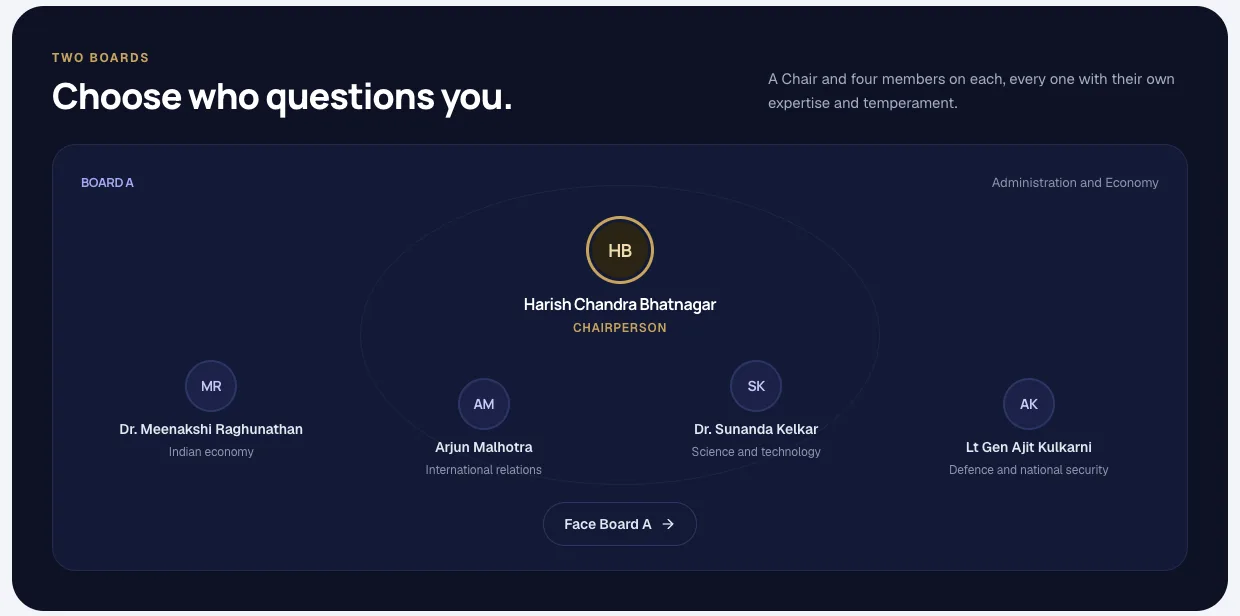
A good practice mock questions you from your own DAF, interrupts you and argues the other side. A FluentlySaid mock is a 25-minute voice interview with a Chair and four members. An independent assessor gives an indicative score out of 275, and you answer in English or Hindi. The first full mock interview is free. After each one you get a full report, member-wise feedback, a question-by-question analysis with stronger answers, every likely question from your DAF and a progress tracker.
On the Board Ready plan the mocks are unlimited, at any hour, so 11 PM or 6 AM, with no slot booking and no travel. That is what makes daily practice possible. It does not replace a human panel, which can read your presence in a room. Read more in our guide to the AI mock interview for UPSC, or see the UPSC interview practice page.
What is a good schedule for mock interviews for UPSC?
UPSC's notice schedules interviews from 7 December 2026 to 12 February 2027, so your own date decides this plan. Find it in your e-Summon letter when it is released, then count backwards. Here is a shape you can stretch or squeeze.
| Time to your board | Practice mocks (your own) | Human panel mocks | Focus |
|---|---|---|---|
| 4 weeks or more | Every second day | One, to find gaps | DAF holes and opening |
| 3 weeks | Every second day | One, a different panel | Balanced answers and current affairs |
| 2 weeks | Daily, one DAF section each | One or two | Follow-ups and stress |
| Final week | One or two, to stay warm | None | Rest and light review |
| Day before | None | None | Sleep, documents, travel |
Source: FluentlySaid suggestion, not an official or proven schedule. If your date is sooner, drop the human panel first, never the daily practice.
If you have less than three weeks, shorten the gaps rather than skip practice. Our plan for the weeks after Mains shows how to fit this alongside DAF work and current affairs.
How do you get value from every UPSC mock interview?
- Pick one thing to test. For example: a shorter opening, or a balanced answer on one current issue.
- Answer aloud and in full. Do not stop when you stumble. The board will not.
- Review the same day. Read the report or listen to the recording while it is fresh.
- Write one fix, not ten. Choose the one that would help most.
- Test the fix within two days. Re-sit a similar question and see if it worked.
Candidates who practise without a panel at all can use the seven-day method in our guide to practising the UPSC interview alone.
When should you stop taking mock interviews for UPSC?
Stop adding mocks when three things are true. You keep hearing the same feedback. You are not changing anything between sittings. Your mock scores bring you more worry than information. At that point another mock gives nothing. Take a day to fix the one repeated problem, then go back to short daily practice.
In the final days, rest. The interview carries 275 marks and is a conversation. You will do it best when you are calm, and you become calm by speaking aloud often, not by reading one more list.
Questions
How many mock interviews should I take for UPSC?
UPSC sets no number. A practical plan is two to four human panel mocks, from different panels if possible, plus a practice mock every day or every second day on your own. The right count is the number you can review properly. Stop adding mocks when feedback repeats and nothing changes.
Is one mock interview enough for UPSC?
One mock shows you your gaps, but it rarely fixes them. The interview is spoken, and speaking improves with repetition. If you can only sit one human panel, add as many practice mocks as you can, answer aloud every day, and review each attempt. Do not treat one good or bad mock as a verdict.
Can too many mock interviews hurt?
Yes, if you sit them without reviewing them. Back-to-back mocks with the same panel can make you rehearse a script and stop thinking. Some candidates also lose confidence chasing a better mock score. Space them out, fix one thing between sittings, and use varied panels so the questions stay unfamiliar.
Do mock interview marks predict the UPSC interview score?
No. A mock mark is one panel's view on one day, and panels differ in how they mark. Use the number to track your own trend, not to guess your result. FluentlySaid's score is an indicative estimate out of 275 for practice, never a prediction of marks or selection.
What is the best mock interview for UPSC?
The best mock is one that questions you from your own DAF, interrupts you, argues the other side and gives feedback you can act on. A human panel adds judgement of your presence. An AI voice mock adds volume at any hour. Most candidates are better served by using both.
When should I start mock interviews for UPSC?
Start as early as your DAF is ready. UPSC's notice schedules the Personality Test from 7 December 2026 to 12 February 2027. Begin with practice mocks now to find gaps, and keep your human panel mocks for the second half of your preparation, when each sitting can polish rather than diagnose.
How do I get value from each UPSC mock interview?
Before the mock, pick one thing to test, such as a shorter opening or a balanced answer on a current issue. After it, write down the one fix that matters most and nothing else. Re-sit a similar question within two days to check the fix worked. One tested fix beats ten notes.
Can I take UPSC mock interviews in Hindi?
Yes. Choose the language you will use on the day and practise in it, because technical terms come slowly in a language you mostly read. FluentlySaid lets you answer in English or Hindi. If you sit human panels, confirm before booking that the panel can follow your medium.
Face the panel before the panel
Face the board 20 times before you face it once.
Take your first board freeFluentlySaid is not affiliated with or endorsed by UPSC. The schedule here is a suggestion, not an official or proven plan. Nothing here promises selection, rank or marks. Check dates and rules at upsc.gov.in.