UPSC Interview Guidance Programme 2026: What It Includes and How to Choose
By FluentlySaid Editorial TeamUpdated 27 November 202612 min read
In short
A UPSC interview guidance programme (IGP) is a paid course that prepares Mains-qualified candidates for the 275-mark Personality Test. A good one includes DAF analysis, several panel mocks, one-to-one feedback and written notes. Ask how many mocks you get, who sits on the panel, and add daily practice between sittings.
Interviews run 7 Dec 2026 to 12 Feb 2027. Schedule, e-Summon and prep: UPSC Interview Schedule 2026: Dates, e-Summon Letter and What to Do Next
A UPSC interview guidance programme is the most common paid step between the Mains result and the Personality Test. This guide explains what a good one includes, what to ask before you join, and how to add daily practice between sittings. It is a neutral buyer's guide: it names and ranks no institute. For the questions themselves, start with our UPSC interview questions guide.
UPSC interview guidance programme: key facts
| Fact | Detail |
|---|---|
| Marks | The UPSC interview (Personality Test) carries 275 marks. See UPSC's examination notice. |
| Candidates qualified | 2,526 candidates qualified the CSE Mains 2026. See UPSC's 2026 notice. |
| Interview dates | 7 December 2026 to 12 February 2027, per UPSC's notice of 17 November 2026. Check the live status on our UPSC interview 2026 hub. |
| Form to analyse | The board reads the DAF you submitted. DAF-II was open from 11 to 25 November 2026. |
| Coaching required | UPSC does not require any coaching or programme. Every programme is optional. |
Sources: UPSC notices on upsc.gov.in. Checked on 26 November 2026.
What is a UPSC interview guidance programme?
A UPSC interview guidance programme, often written IGP, is a short course for candidates who have qualified the Mains. Institutes sell it under names such as interview guidance programme, personality test programme or mock interview programme. The format varies, but the aim is the same: to prepare you for a conversation that UPSC describes as an assessment of your personal suitability for a career in public service.
The programme is optional. UPSC does not ask for it, and the board never asks whether you joined one. Treat it as a way to get structured feedback and repetition, nothing more.
What should a UPSC IGP include?
Programmes differ, but a useful one covers five things. Check each against the brochure before you pay.
| Part | What it should give you | Ask this |
|---|---|---|
| DAF analysis | A line-by-line review of your form and the questions each line can lead to | Is it done by a person who has read my form, or a general session? |
| Panel mocks | Full-length mocks before a panel, with questions that follow your answers | How many mocks, how long, and who is on the panel? |
| One-to-one feedback | A private conversation on your weak areas, not only group comments | How long is it, and is it after every mock? |
| Written or recorded review | Something you can re-read or replay a week later | Do I get notes, a recording or both? |
| Current affairs and optional support | Briefing on issues the board may raise, and your optional | Is it included, or a separate fee? |
Source: FluentlySaid's checklist, not a UPSC publication.
How does DAF analysis work in an IGP?
DAF analysis means reading your form the way the board will and listing the questions it can raise. Your home state, graduation, optional, work, hobbies and service preferences each become a short chain of questions. Good DAF analysis ends with you saying each answer aloud, not with a printed list. For a method you can do yourself, see our guide to DAF based questions.
What makes a UPSC mock interview good?
A good UPSC mock interview feels slightly uncomfortable. The panel interrupts you, asks the second and third question, and argues the other side. A mock where every member nods and the feedback is all praise is a poor use of a slot. Ask whether the panel includes people who have served on interview boards or in the services, and whether they follow your answers or work through a fixed list.
What should you ask before joining a UPSC interview programme?
Most candidates compare fees and brand names. Compare these instead.
- How many full mocks do I get, and how long is each? A brochure that says "unlimited" for a human panel deserves a follow-up question.
- When will my mocks be held, compared with my interview date? A mock a week before your board helps more than three mocks in the first fortnight of December.
- Who sits on the panel, and will it be the same people each time? Different panels show you different styles. The same panel shows you whether you improved.
- What do I receive after each mock? Ask for a sample of the feedback.
- Is the DAF analysis personal? Ask to see one example, with the name removed.
- What is the batch size? A large batch can mean a short slot for you.
- What is the refund policy? Get it in writing, including what happens if you miss a slot.
- Can I attend in Hindi, or in English? Confirm the panel can follow your medium.
- Is travel to the centre needed? Count the cost and time of getting there.
Also speak to two or three candidates who joined last year, and ask what they would ask differently. Do not rely on testimonials printed in a brochure.
Are scheduled mock slots enough for the UPSC interview?
Scheduled mocks have a clear strength: a real panel, in a room, at a fixed time. They also have limits. Slots are few, dates may not suit your interview date, and travel adds cost. Most candidates sit a handful of them.
The interview is spoken, so the skill you need is speaking, and speaking improves with repetition. Between two panel mocks you have days when nobody interrupts you. That is where on-demand practice fits.
| Scheduled panel mock | On-demand practice mock | |
|---|---|---|
| When | A fixed slot, booked in advance | Any hour you choose |
| Number you can sit | A few, limited by slots and cost | As many as you can review properly |
| Strongest at | Reading your presence in a room, human judgement | Repetition, nerves, answer structure |
| Travel | Often needed | None |
| Best use | Polish in the final fortnight | Daily rehearsal from now to your board |
Source: FluentlySaid's comparison of formats. Individual programmes vary.
How many mock interviews should you aim for?
UPSC sets no number, and no source we can cite gives a figure that works for everyone. Our advice: aim for volume plus variety. A reasonable plan (our full reasoning on how many mock interviews for UPSC) is two to four human panel mocks, from different panels if you can, and one practice mock every day or every second day on your own. Stop adding mocks when you hear the same feedback again and are not changing anything. Fix one thing, then sit the next mock.
A suggested shape, if your interview is about a month away:
| Weeks to your board | Human panel mocks | Practice mocks on your own |
|---|---|---|
| 4 to 3 | One, to find your biggest gaps | Every second day |
| 3 to 2 | One, with a different panel | Every second day |
| 2 to 1 | One or two | Every day, a different DAF section each time |
| Final week | None, rest and light review | One or two, to stay warm |
Source: FluentlySaid suggestion, not an official or proven schedule. Adjust for your own date.
For a 30-day structure you can follow day by day, see our plan for the weeks after Mains.
Where does an AI mock interview fit in a UPSC programme?
An AI mock interview is the practice layer that sits alongside an IGP. It does not replace a human panel. A human panellist can see how you walk in, sit and look at the board. Software cannot.
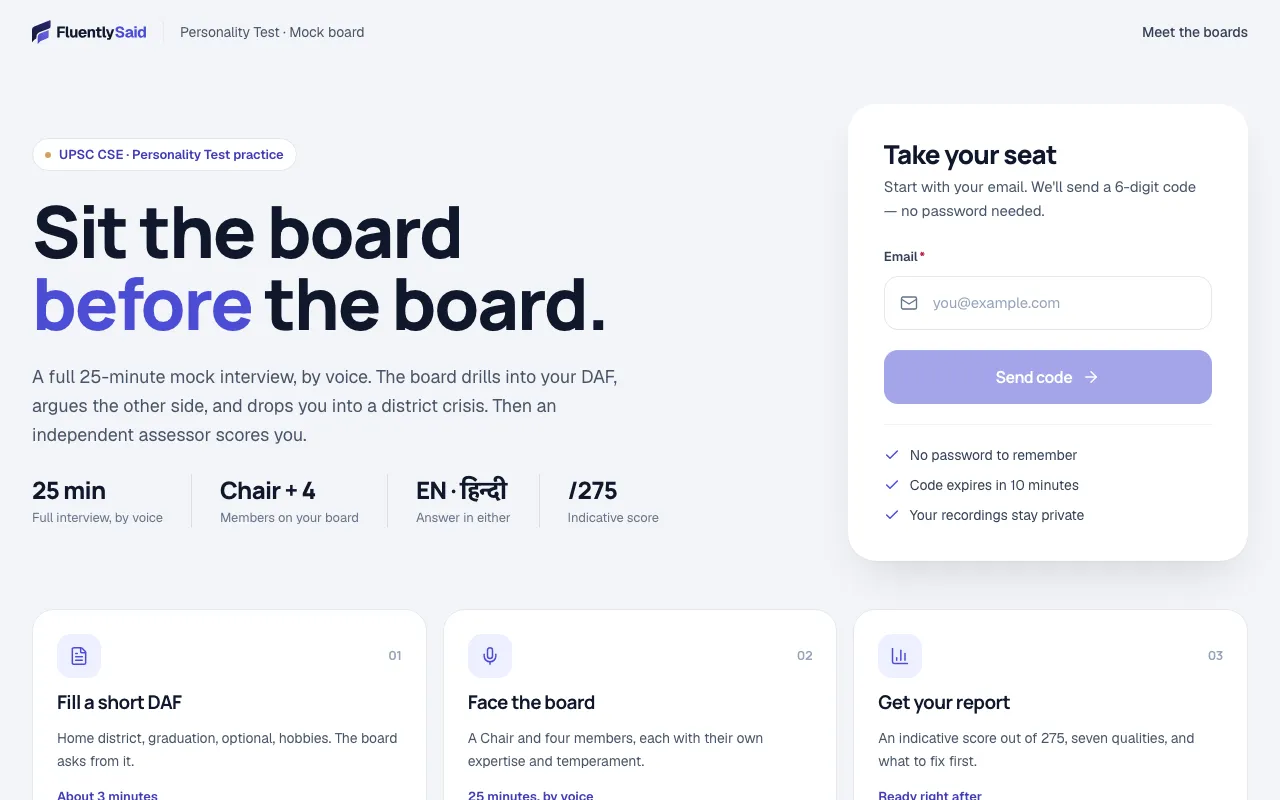
What the AI board adds is volume. A FluentlySaid UPSC mock is a full 25-minute voice interview with a Chair and four members. The board drills into your DAF, argues the other side, and puts you in situational and administrative scenarios. An independent assessor then gives an indicative score out of 275. You can answer in English or Hindi.
After each mock you get a full report with member-wise feedback, a question-by-question analysis with stronger answers, every likely question from your DAF and a progress tracker. The Board Ready plan offers unlimited mocks at any hour, so 11 PM or 6 AM, with no slot booking and no travel. The first full mock interview is free. The score is a practice estimate, not a prediction of your marks. Read how it works in our guide to the AI mock interview for UPSC, or see the UPSC interview practice page.
What mistakes do candidates make when choosing a UPSC IGP?
These are patterns we see in how candidates describe their preparation. They are not statistics.
- Joining late and sitting every mock in one week. Feedback needs days to absorb. Five mocks in a week teach you less than five mocks spread over a month.
- Treating the mock score as a verdict. A mock mark is one panel's view on one day. Use it to find the next fix, not to decide whether you will be selected.
- Collecting model answers. If your answer sounds like someone else's, the board will find the gap in the second question. Build answers from your own facts.
- Skipping the DAF analysis because the mock will cover it. A mock tests a few lines of your form. Analysis covers all of it.
- Never practising between sittings. The days between two mocks are most of your preparation time. Leave them empty and each mock starts from zero.
- Choosing on fear. Fear says join the biggest name. Your own list of gaps says join what fills them.
How do you use a programme's feedback well?
After each mock, write down the one thing that hurt you most, such as a rambling opening, a weak answer on your optional or a long pause on a current affairs question. Fix that one thing before the next sitting. If three panels tell you the same thing, it is a habit and needs daily work. If one panel says something the others do not, note it, and test it in the next mock.
Ask the panel to be blunt. A candid note in December is worth more than a kind one in February.
How to choose a UPSC interview guidance programme: a short method
- Count your days. Look at your interview date in UPSC's schedule and work backwards.
- Decide what you lack. If you do not know your DAF well, buy analysis. If you freeze when interrupted, buy repetition.
- Pick one or two human mocks, not five. Choose the ones closest to your date.
- Add a daily habit. Practise one DAF section aloud every day, with a timer.
- Act on feedback. After every mock, write one fix and test it in the next.
Some candidates also like to practise without any programme at all. If that is you, our guide on how to practise the UPSC interview alone gives a seven-day method.
Is a UPSC IGP worth it for you?
It depends on what you lack. A programme is worth the money if it gives you things you cannot get yourself: a real panel, a candid expert view and a fixed deadline for your preparation. It is not worth it if you are buying reassurance, or a brand, or a slot that falls three days after your interview.
Whatever you decide, the work that decides your board is the work you do between mocks. Speak every day, listen to yourself, and fix one thing at a time. The interview carries 275 marks, and it is a conversation. Practise it as one.
Questions
What is a UPSC interview guidance programme?
A UPSC interview guidance programme, or IGP, is a paid course for candidates who have qualified the Mains. It usually combines DAF analysis, mock interviews before a panel, one-to-one feedback and study material. It prepares you for the Personality Test, which carries 275 marks. Programmes differ widely in length, panel quality and number of mocks.
Is a UPSC interview guidance programme necessary?
No. UPSC does not require any coaching, and many candidates prepare with self-study and peer practice. A programme helps if you want structured DAF analysis and an experienced panel's view of your presence. If you cannot afford one, you can still build repetition through self-practice and mock interviews.
What should a good UPSC IGP include?
A good IGP includes a line-by-line DAF analysis, several full-length panel mocks, a written or recorded review after each, one-to-one discussion of your weak areas, and current affairs support. Ask for the number of mocks, the length of each and what feedback you receive in writing before you pay.
How many mock interviews should I take for UPSC?
UPSC sets no number. A practical target is two to four human panel mocks and as many voice practice mocks as you can review properly. Repetition builds calm and structure. Stop adding mocks when you keep hearing the same feedback and are not acting on it. Fix, then sit the next one.
Can an AI mock interview replace a human panel?
No, and it should not try to. A human panellist can read your presence, dress and body language in a room. An AI mock board gives you unlimited, on-demand practice at any hour, with a report after each. Use human mocks for polish and AI mocks for volume.
When should I join an IGP for the UPSC interview 2026?
UPSC's notice schedules the Personality Test from 7 December 2026 to 12 February 2027. Join as early as you can, because slots fill and your own DAF analysis takes time. If your date is close, choose a short programme with mocks in the final fortnight, and fill the gaps with daily practice.
Can I join a UPSC interview programme in Hindi?
Yes, many programmes offer panels in Hindi or English, but confirm this before you pay. Ask whether the panel members know your medium and whether feedback is given in the same language. Practise in the language you will use on the day, because technical terms come slowly in a language you only read.
How do I compare UPSC interview guidance programmes?
Compare what you will receive, not the brand. Ask for the number of mocks, the panel's composition, the feedback format, the batch size, the refund policy and the dates of your mocks against your interview date. Speak to candidates who joined last year, and ask what they wish they had asked.
Face the panel before the panel
Face the board 20 times before you face it once.
Take your first board freeFluentlySaid is not affiliated with or endorsed by UPSC and does not rank or review any coaching institute. This guide is general advice. Nothing here promises selection, rank or marks. Check dates and rules at upsc.gov.in.