UPSC CSE · Personality Test
A UPSC mock interview you can repeat until the answers hold
Fill a short DAF, then face a Chair and four members by voice for 25 minutes. They question you from your own form, argue the other side, and drop you into a district situation. Your report shows what to fix first.
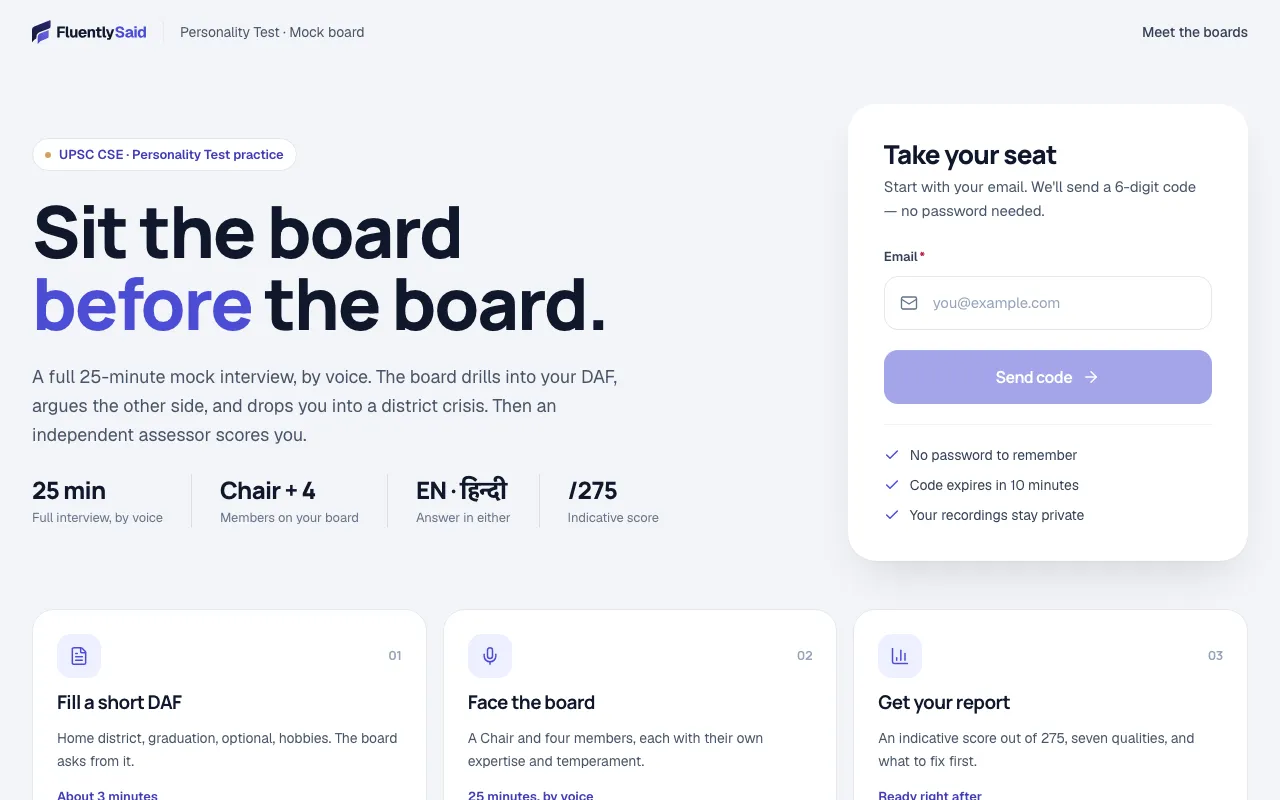
What is a FluentlySaid UPSC mock interview?
It is a 25-minute voice interview with an AI board of five: a Chair and four members, each with a subject area. The board reads the short DAF you fill in, questions you in English or Hindi, and an independent assessor then scores the transcript on the seven qualities UPSC lists, with an indicative score out of 275. It is free to start and does not replace a mock with a human panel.
- Interview
- 25 min, by voice
- Board
- Chair + 4 members
- Language
- English or Hindi
- Practice score
- Indicative, out of 275
How the UPSC CSE mock interview works
- 1
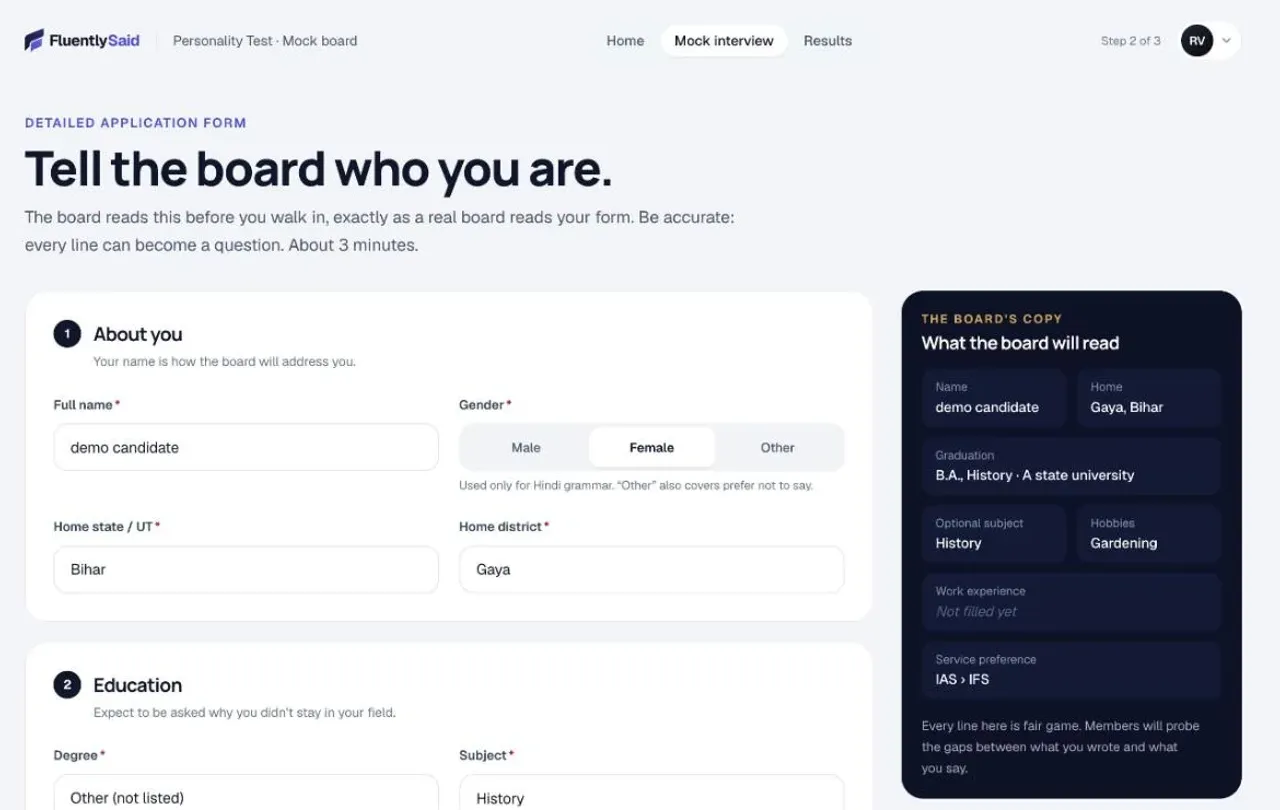
Fill a short DAF
Home state and district, graduation, optional, work, hobbies and service preferences. It takes about three minutes, and every line can become a question.
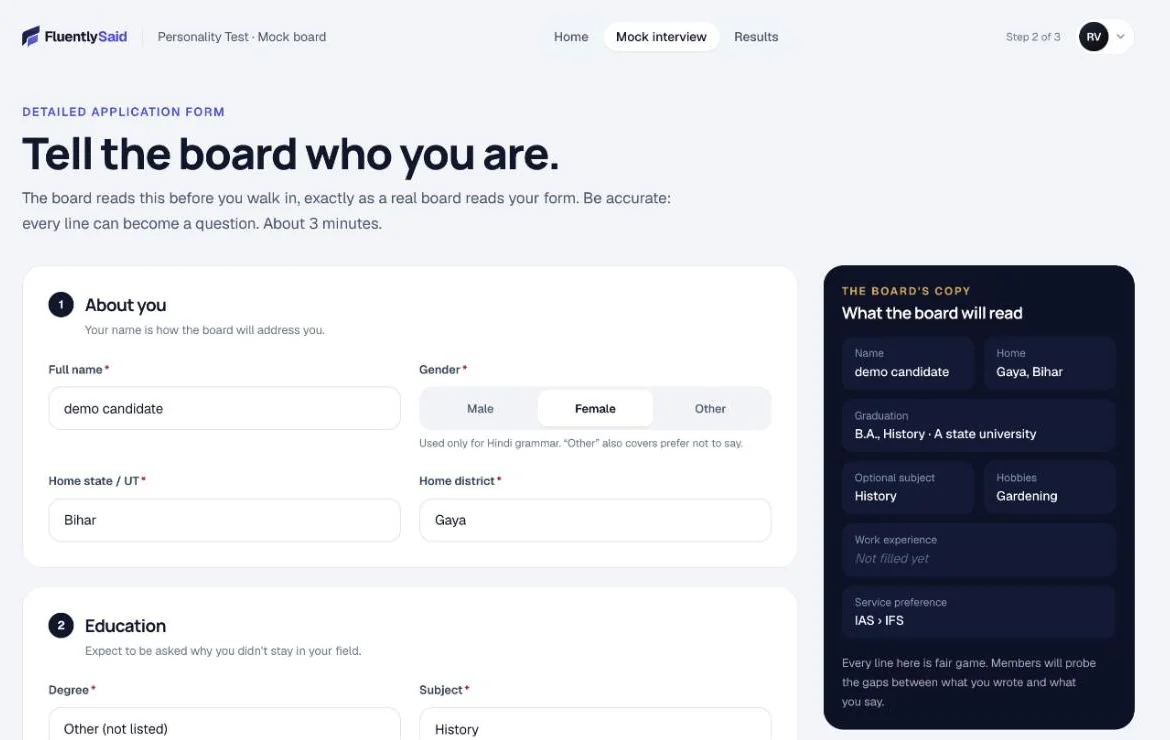
The form, with a live preview of what the board reads. The name shown is a demo entry. - 2
Face the board
Choose a board. The Chair opens, then each member asks from their own area. They follow up on what you said, so a memorised answer stops working fast.
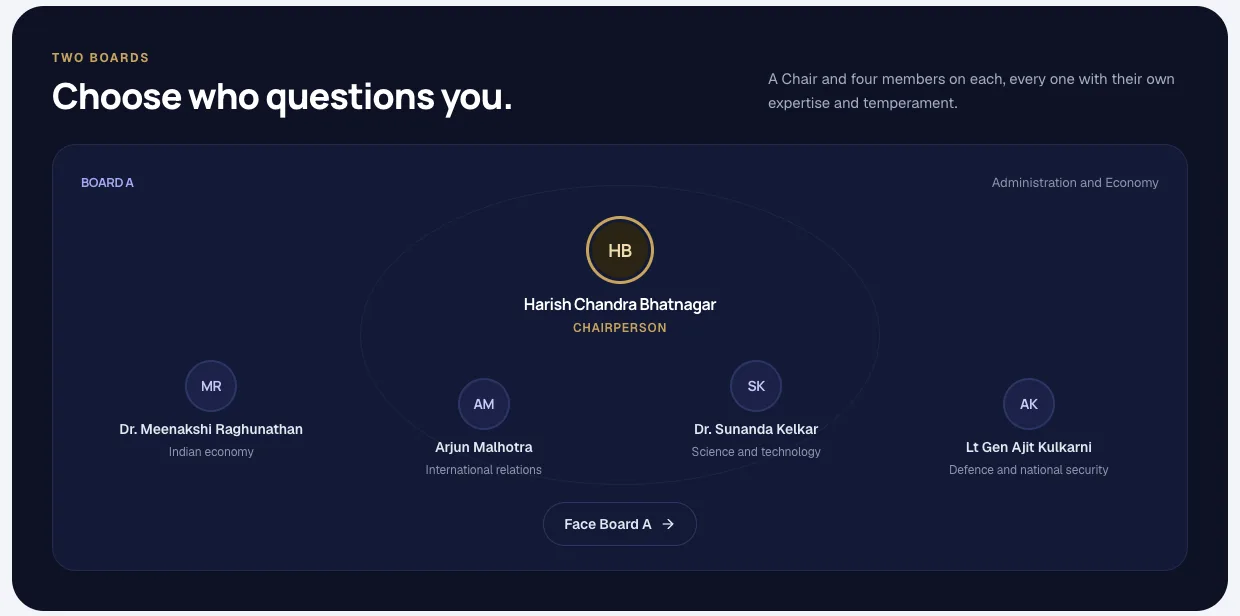
Board A: a Chair and four fictional members. - 3
Read your report
An independent assessor reads the transcript. You get an indicative score band, the seven qualities, how each answer went, a stronger way to say it, and what to fix first.
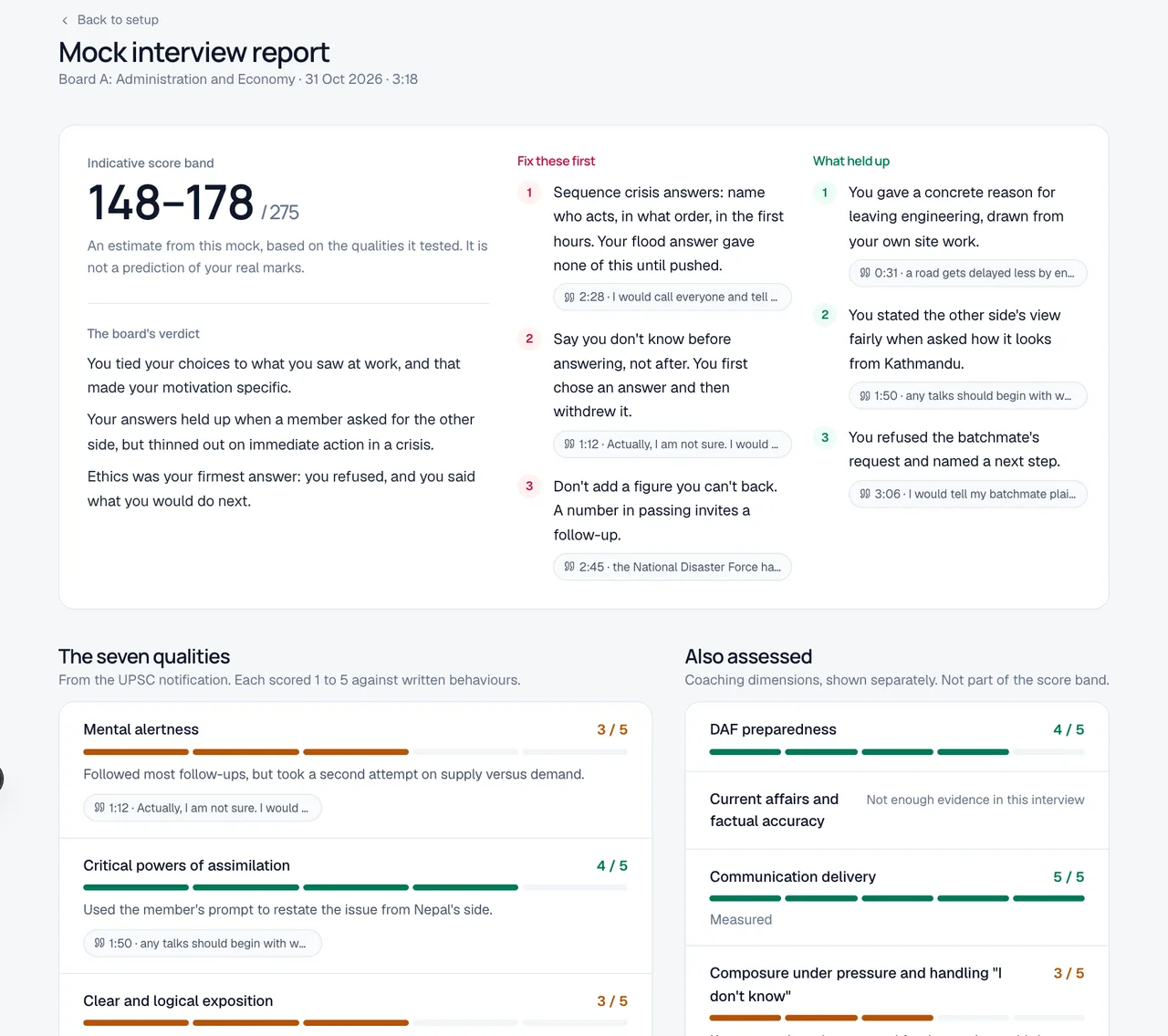
A sample report. The candidate and the board members are fictional, and the score is a practice estimate, not a prediction of your marks.
What the board asks, and why it starts from your form
UPSC describes the interview as an assessment of personal suitability for a career in public service. It is not a viva on your syllabus. Your DAF is how the board gets in. These patterns are written for practice and are not taken from any real interview.
- Your home district: What are the main economic activities there, and what is its biggest unsolved problem?
- Your degree and optional: Why did you choose this optional, and where would a district officer use it?
- Your job or your gap: What did you learn at work that you would use as a Collector?
- Your hobby: Which book, match or recipe, and what did it teach you? Expect the second and third question.
- The other side: You said the policy works. Name two reasons it has failed elsewhere.
- A district situation: It is 6 pm, a bridge has washed out, and a village is cut off. What do you do in the first two hours?
What your report shows
The report is built to be acted on in the next mock, not admired.
- An indicative score band out of 275, labelled as a practice estimate
- The seven qualities UPSC lists: mental alertness, critical powers of assimilation, clear and logical exposition, balance of judgement, variety and depth of interest, ability for social cohesion and leadership, and intellectual and moral integrity
- What held up, and the three things to fix first, each tied to a line you actually said
- A member-by-member view and a question-by-question log
- Which parts of your DAF the board never reached, so you prepare them anyway
- Delivery measures: pace, filler words, share of talk time and time before answering
In English or Hindi, and private by default
Pick English or Hindi before you start, and the board speaks in that language. Recording is optional and needs your consent. A recording is visible only with your login and is deleted after 30 days, or sooner if you delete it from the report.
How it compares with a coaching mock and practising alone
It does not replace a mock with a real panel. It gives you the repetitions before one.
| Coaching institute mock | Practising alone | FluentlySaid | |
|---|---|---|---|
| Available at any hour | On the institute's dates | Yes | Yes |
| Questions from your own form | Yes | No, you write them | Yes |
| Someone interrupts and disagrees | Yes | No | Yes |
| Reads your presence in a room | Yes, a human can | No | No, voice only |
| Report on each answer | Usually verbal | Only what you remember | Written, with quotes |
| Cost to repeat | Usually paid per sitting | Free | First interviews free |
Read before you practise
All UPSC CSE guides →UPSC CSE
UPSC Mock Interview with AI: How It Helps You Crack the Personality Test (2026-27)
What the board actually tests, where an AI mock helps, where a human panel still wins, and a four-week plan built around your DAF.
8 min read
हिन्दी · UPSC CSE
AI के साथ UPSC मॉक इंटरव्यू: पर्सनैलिटी टेस्ट की तैयारी में यह कैसे मदद करता है (2026-27)
बोर्ड असल में क्या परखता है, AI मॉक कहाँ काम आता है, मानव पैनल कहाँ बेहतर है, और आपके DAF पर आधारित चार हफ़्ते की योजना।
4 मिनट में पढ़ें
UPSC CSE
UPSC DAF-II 2026: How to Fill It and Why It Shapes Your Interview
The DAF-II deadline, what the form asks, how the board turns your entries into questions, and the mistakes that cost candidates in the room.
8 min read
UPSC CSE
What to Do After Clearing UPSC Mains 2026: A Week-by-Week Plan Until Your Interview
DAF-II first, then your DAF, current affairs and mocks in phases. A plan that works whether your interview is in four weeks or twelve.
7 min read
UPSC CSE
UPSC Interview Do's and Don'ts: What Actually Matters in the Personality Test
Conduct, honesty, stress questions, dress and the day itself. What the board is listening for, and the habits that cost candidates.
7 min read
UPSC CSE
UPSC Interview Questions: DAF-Based Patterns to Practise
Your DAF is the board's script. Here are the question patterns each section produces, and how to practise answering them without sounding rehearsed.
4 min read
UPSC CSE
UPSC Interview Hobbies: How to Prepare Your DAF Hobby Answers
A hobby you listed casually can become five minutes of the board. How to choose, prepare and defend the hobbies on your DAF.
3 min read
UPSC CSE
How to Practise for the UPSC Interview Alone: A Seven-Day Method
No panel, no coaching mock this week? A seven-day method that gets you out of your head and into your answers.
2 min read
Frequently asked questions
Is an AI UPSC mock interview useful?
Yes, for repetition. It makes you answer aloud, follows up on what you said, and shows where your answers break. It does not replace a mock with experienced human panellists, so use both.
Is the UPSC mock interview free?
It is free to start. Create a free FluentlySaid account with your email and your first interviews are free. An interview that ends too early to score is not counted.
Can I give the UPSC mock interview in Hindi?
Yes. Choose English or Hindi before you start, and the board speaks in that language.
How is my score calculated?
An independent assessor reads the transcript and scores it against the seven qualities UPSC lists. The result is an indicative band out of 275. It is a practice estimate, not a prediction of your marks.
Does the AI know my DAF?
It knows what you enter in the short DAF form on FluentlySaid: your home district, graduation, optional, hobbies and similar details. The board's questions come from those entries.
Are my recordings private?
Recording is optional and needs your consent. A recording is visible only with your login and is deleted after 30 days. You can delete it sooner from the report.
Face the board before the board
Your first interviews are free. Fill the form, sit the interview, read the report, and go again tomorrow.
FluentlySaid is an independent practice tool, not affiliated with or endorsed by UPSC. Board members are fictional. Scores are practice estimates, not predicted marks.