UPSC Interview Questions: DAF-Based Patterns to Practise
By FluentlySaid Editorial TeamUpdated 23 November 20264 min read
In short
UPSC board questions mostly start from your DAF: your home district, graduation, optional, work, hobbies and service preferences. The board then goes one step deeper each time. This guide lists the patterns each section produces, written for practice and not taken from any real interview, and how to prepare each one.
Cleared Mains? Dates, DAF-II and next steps: UPSC Mains Result 2026
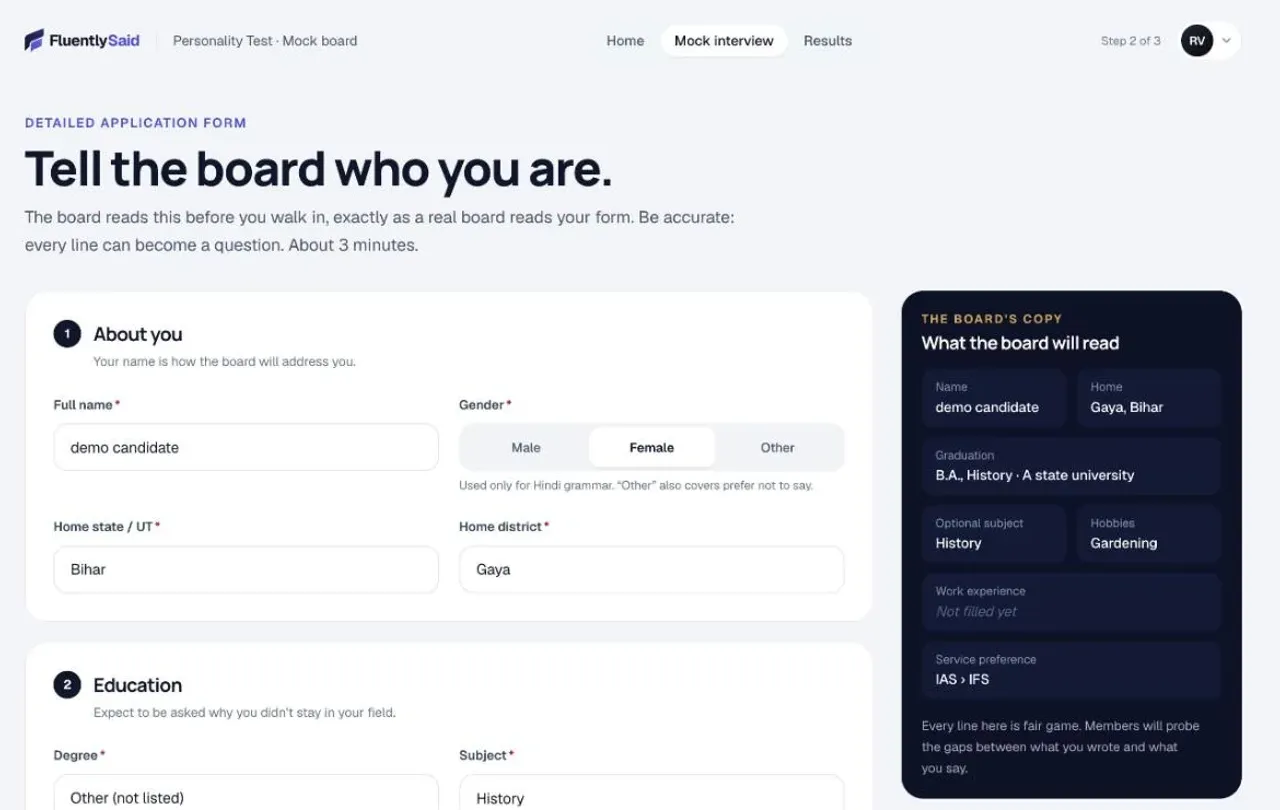
UPSC describes the interview as an assessment of the personal suitability of the candidate for a career in public service. The board does that by reading you, and the page it reads is your DAF. These questions are written for practice and are not taken from any real interview.
How the board uses your DAF
A board does not read your DAF aloud. It picks a line, asks one question, and listens to how you answer. Then it asks about what you said, not about what you wrote. So the DAF gets you the first question and your answer decides the next four.
That is why a list of questions helps less than it seems. What helps is knowing, for each DAF section, the direction questions will take.
Patterns by DAF section
| DAF section | Where the board goes | What to prepare |
|---|---|---|
| Home state and district | Economy, problems, culture, what you would change | Ten facts, one problem, one change you would make |
| Graduation and subject | Why this, why not that, where it applies in administration | A link from your subject to a real public problem |
| Optional subject | Depth, a current issue in it, the other side | Two current examples and one criticism of your own view |
| Work or gap | What you learned, why you left, what you would carry over | One specific story with a decision in it |
| Hobbies | Whether the interest is real, the second and third question | Three minutes on each, with a recent example |
| Service preference | Why this order, what the job really is | One honest reason per service |
Source: FluentlySaid's practice framework, not a UPSC publication.
Home state and district
- What is your district known for, and what is the biggest problem it has not solved?
- If you were its Collector, what would you do in your first month?
- Many people leave your district for work. Is that a supply problem or a demand problem?
- Which local festival, craft or food would you promote, and how?
Graduation, optional and work
- You studied engineering and chose the civil services. Why leave your field?
- Your optional is sociology. Where would a district officer use it on a bad day?
- You built roads for two years. What is one thing a design office never sees about a site?
- You said the policy works. Name two reasons similar policies have failed elsewhere.
The last one is the board arguing the other side. Do not fold, and do not dig in. Say what is true in their point, then say why you still hold yours.
A situation from the field
- It is evening and a bridge has washed out. A village is cut off. What do you do in the first two hours, and who acts at each step?
- A colleague asks you to look away from a small irregularity. What do you do?
- A minister asks you to move a file faster than the rules allow. What do you say?
Say the order of action and name who acts. A board listens for order and for who you involve more than for a perfect answer.
How to practise these without sounding rehearsed
- Answer each pattern aloud, with a timer. Aim for about a minute, then stop.
- Record one answer and listen once. Fix only what you hear, not everything.
- Ask a friend to interrupt you with "why?" three times in a row.
- Run a full mock that reads your own DAF. The FluentlySaid UPSC mock does this in 25 minutes, by voice.
- Read the report, change one thing, and go again the next day.
Also see how to fill the DAF-II well and the do's and don'ts.
Questions
Are UPSC interview questions based on the DAF?
Largely, yes. The board has your form in front of it, so your home district, graduation, optional, work and hobbies are the easiest way in. The board then follows your answers, so a question can leave the form quickly.
Can I predict UPSC interview questions?
Not the exact questions. You can predict the patterns, and you can prepare every line you wrote. If you can defend each line of your DAF, most of the interview is covered.
How do I practise DAF-based questions?
Answer them aloud, not in your head. A voice mock that reads your DAF and follows up on your answers is closer to the real thing than a list of questions.
What if I do not know an answer?
Say so plainly and politely. If you know something related, offer it briefly. Do not bluff.
Face the panel before the panel
Sit the board before the board. Start a free UPSC mock interview.
Start a free mock interviewFluentlySaid is not affiliated with or endorsed by UPSC. The questions here are written for practice and are not taken from any real interview.