IPS Interview Questions: What the Board Asks IPS Aspirants
By FluentlySaid Editorial TeamUpdated 27 November 202610 min read
In short
IPS interview questions in the UPSC Personality Test test whether you understand the job: policing, law and order, ethics and public trust. Expect service-choice questions, situational scenarios and balanced-view questions on police reform. The board wants a calm, lawful, humane answer. Practise them aloud, because scenarios are answered in the moment.
Interviews run 7 Dec 2026 to 12 Feb 2027. Schedule, e-Summon and prep: UPSC Interview Schedule 2026: Dates, e-Summon Letter and What to Do Next
IPS interview questions are not a separate paper. The UPSC board that interviews you is the same board that interviews every candidate. But if you put IPS high on your list, it will test whether you understand the job and whether you can stay lawful, calm and humane under pressure. For the wider list of questions by category, see our UPSC interview questions guide. Every question below is a practice question.
IPS interview questions: key facts
| Fact | Detail |
|---|---|
| Marks | The UPSC interview (Personality Test) carries 275 marks. See UPSC's examination notice. |
| Separate IPS interview | None. The Personality Test is common to all services. Your rank and preferences decide the service. |
| Interview dates | 7 December 2026 to 12 February 2027, per UPSC's notice of 17 November 2026. Live status on our UPSC interview schedule 2026 page. |
| Criminal laws | The Bharatiya Nyaya Sanhita, Bharatiya Nagarik Suraksha Sanhita and Bharatiya Sakshya Adhiniyam came into force on 1 July 2024. See All India Radio's report. |
Sources: UPSC notices on upsc.gov.in and All India Radio. Checked on 27 November 2026.
What does the board test in IPS interview questions?
UPSC describes the interview as an assessment of your personal suitability for a career in public service. For a policing role that translates into four qualities.
- Composure: can you think clearly when a situation is tense and a decision is needed now?
- Lawfulness: do you reach for the legal route first, even when a shortcut looks effective?
- Humanity: do you see the people on every side of a situation, including those who break the law?
- Integrity: do you stay the same person when a powerful person asks you to bend?
Nobody expects you to know police procedure. You are not yet an officer. The board looks for judgement and character, and uses a policing scenario as the way to see them.
What service preference questions will you get if you chose IPS?
Your order of preference tells the board what you value. If IPS is your first or second choice, expect the board to probe why. Our guide on why civil services covers the broader answer. These questions focus on IPS.
- Why IPS and not IAS? Why this order?
- What does an IPS officer do in the first ten years of service?
- What is the hardest part of a police officer's job, in your view?
- What would you do if you were not allotted IPS?
- A relative says policing is a thankless job. How would you respond?
- What do you think the public gets wrong about the police?
What do IAS interview questions look like next to IPS ones?
The board's approach is the same. If IAS is listed first, expect questions on districts, development and administration. If IPS is first, expect policing and law and order. Candidates often hear both, because the board likes to test why you put one above the other. Prepare an honest reason for each service on your list. Do not run down the one you rank lower.
| If your first preference is | Expect more questions on | Still expect |
|---|---|---|
| IAS | District administration, development, welfare delivery | DAF, current affairs, ethics |
| IPS | Policing, law and order, crime, public trust | DAF, current affairs, ethics |
| Foreign or other services | The service's work and why you chose it | DAF, current affairs, ethics |
Source: FluentlySaid's practice framework, not a UPSC publication. Boards vary.
What law and order questions can the board ask?
Law and order questions are usually scenarios. You are given a situation and asked what you would do. There is rarely one right answer. The board watches your order of thinking.
- A protest outside a government office turns tense and the crowd is growing. What do you do first?
- Two communities are about to clash over a procession route. How do you prevent it?
- A rumour on social media is inflaming a town. What steps would you take?
- A mob has surrounded a police station and demands the release of a detainee. What is your plan?
- You get a credible tip about a planned disturbance during a festival. Whom do you inform and what do you do?
- A senior leader's relative is stopped for a traffic violation and a call comes in. What do you do?
How do you structure a law and order answer?
- Safety first. Protect lives and prevent escalation.
- Stay within the law. Name the lawful tools and say you would use the minimum force necessary.
- Coordinate. Say whom you would inform: seniors, the district administration, other agencies.
- Communicate. Say how you would speak to the public and the people involved.
- Follow up. Say what you would review afterwards and how you would prevent a repeat.
Say it in under two minutes. Stop when you are done.
What does a weak versus strong answer sound like?
| Weak answer | Strong answer | |
|---|---|---|
| Opening | I will immediately disperse them with force. | My first priority is safety. I would assess the size and mood of the crowd and get reinforcements ready. |
| Law | I will do whatever is needed to restore order. | I would use only lawful, proportionate steps, and warn before any stronger measure. |
| People | They are troublemakers. | I would find their leaders and listen to what they want, while keeping the area safe. |
| Close | That will settle it. | Afterwards I would review what happened and report it to my seniors. |
Source: FluentlySaid teaching example, not a model answer from UPSC.
What ethics and integrity questions come up for IPS aspirants?
Ethics questions test what you do when the right step costs you something. They are common for policing, because officers hold real power over liberty.
- A powerful person asks you to go easy on a case. What do you do?
- Your own team made an arrest that looks wrong. How do you handle it?
- A subordinate reports a colleague's misconduct and asks you to keep his name out of it. What do you do?
- Is it ever right to bend a rule to get a criminal off the street?
- A person in custody is clearly guilty, but you cannot prove it. What is your duty?
The strong answer holds the line on the law and still shows concern for people. If you would escalate, say to whom. If you would refuse, say how you would do it politely.
How should you answer police reform questions for UPSC?
Police reform is a standard topic for IPS aspirants. The board wants a balanced view, not a political stand. Describe, do not accuse. Use this frame: the problem, what has been tried, the trade-offs, and one reform you would support.
- What is the biggest challenge facing the police in your state?
- Should police stations have more women officers? What would be the effect?
- How can technology help policing without invading privacy?
- How would you rebuild public trust in a police station with a poor reputation?
- What is your view on custodial violence, and what would you do to prevent it?
- How do you balance speed and fairness in an investigation?
How much do you need to know about the new criminal laws?
The Bharatiya Nyaya Sanhita, Bharatiya Nagarik Suraksha Sanhita and Bharatiya Sakshya Adhiniyam came into force on 1 July 2024, replacing the IPC, CrPC and Evidence Act. An IPS aspirant should know this in outline: what they replaced, a few headline changes and why they matter to investigation. You do not need to recite sections. Read the official summaries and write three lines of your own.
What current affairs should an IPS aspirant follow?
Follow the news on internal security, cyber crime, crowd control, women's safety, disaster response and the courts' views on policing. For each topic, write a three-line view with both sides. Our guide to the do's and don'ts of the UPSC interview lists habits that help you stay balanced.
How do you practise IPS interview questions?
Reading a list of scenarios is not practice. Practice is saying your answer aloud, being interrupted, and saying it again better. Use a timer, record yourself once and fix one thing. Our guide to practising the UPSC interview alone gives a seven-day method.
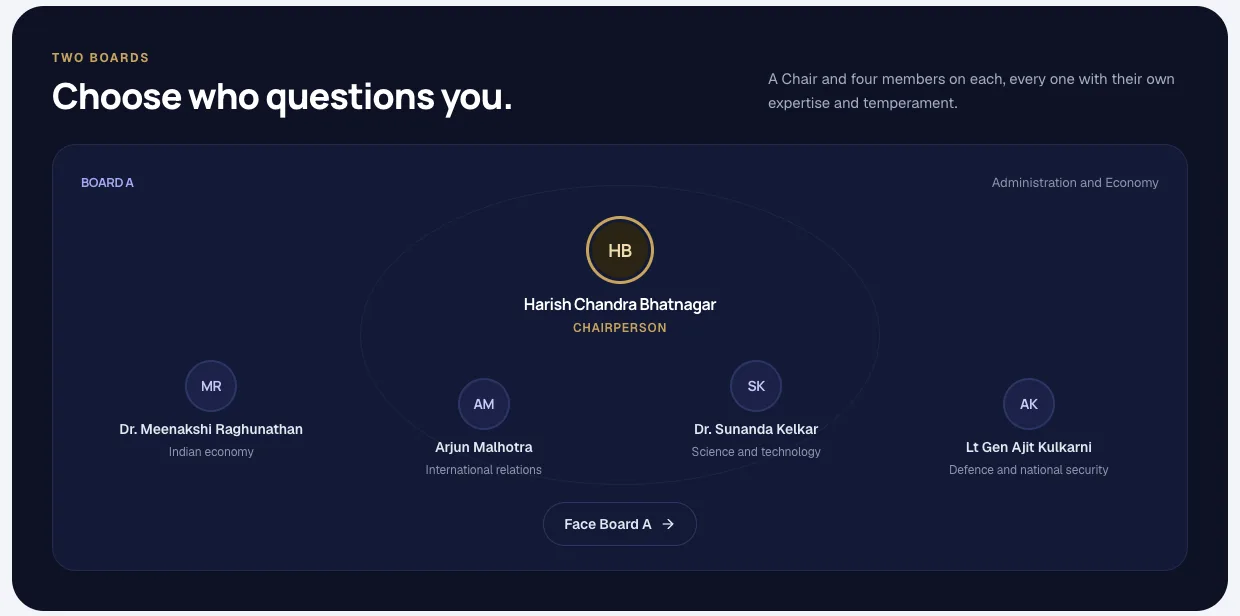
A mock interview helps because someone else asks the follow-up. A FluentlySaid UPSC mock is a 25-minute voice interview with a Chair and four members. The board drills into your DAF, argues the other side and puts you in situational and administrative scenarios. An independent assessor gives an indicative score out of 275. You can answer in English or Hindi.
After each mock you get a full report with member-wise feedback, a question-by-question analysis with stronger answers, every likely question from your DAF and a progress tracker. The first full mock interview is free. Unlimited mocks on the Board Ready plan let you sit one at any hour, with no slot booking and no travel. The score is a practice estimate, not a prediction. See the UPSC interview practice page, or read our guide to DAF based questions.
A last word for IPS aspirants
The board is not looking for a hero. It is looking for a calm, lawful and humane person who would be trusted with authority. Practise scenarios until your first sentence is always about safety and the law. The interview carries 275 marks and is a conversation. Treat it as one.
Questions
What questions are asked in the IPS interview?
There is no separate IPS interview. The UPSC Personality Test is common to all services, and the board asks questions from your DAF, current affairs and situations. If you list IPS high, expect service-choice questions, law and order scenarios, ethics dilemmas and questions on policing. All of these here are practice questions.
Is there a separate interview for IPS in UPSC?
No. UPSC holds one Personality Test of 275 marks for the Civil Services Examination, and your rank and preferences decide the service you get. The board may still ask about your service preferences, so know why you chose IPS and what the job involves day to day.
Why do you want to join the IPS? How should I answer?
Give a true reason with one specific example, then show you understand the work: maintaining law and order, investigation, public trust and long hours. Avoid answers about power, uniform or status. Name a real policing problem that concerns you, and say what you would do about it. Keep it short.
What is the difference between IAS and IPS interview questions?
The Personality Test is the same, so the board does not ask a separate set. The difference is in emphasis: if you list IAS first, expect development and administration questions. If you list IPS first, expect policing, law and order and ethics scenarios. Both lists get questions on your DAF and current affairs.
How do I answer law and order situational questions?
Start with the immediate priority: safety of people. Then name the lawful steps, who you would inform and coordinate with, and how you would communicate. State your reasoning calmly and mention a fair follow-up. Avoid heroics and shortcuts outside the law. A balanced, step-by-step answer scores better than a bold one.
Will the board ask about police reforms?
It can, especially if you chose IPS. Prepare a balanced view: what the problem is, what has been tried, what the trade-offs are and one reform you would support. Stay descriptive about policies and neutral about parties. The board wants clear thinking, not a political stand.
Do I need to know the new criminal laws for the IPS interview?
It helps. The Bharatiya Nyaya Sanhita, Bharatiya Nagarik Suraksha Sanhita and Bharatiya Sakshya Adhiniyam came into force on 1 July 2024, replacing the IPC, CrPC and Evidence Act, as reported by All India Radio. You need not recite sections. Know what changed in outline and why it matters to policing.
How do I practise IPS interview questions?
Answer scenarios aloud, with a timer, and have someone interrupt you with the second and third question. A voice mock that follows up on your answers is closer to the real thing than a list. After each practice, note the one habit that hurt you most and fix it before the next.
Face the panel before the panel
Face the board 20 times before you face it once.
Take your first board freeFluentlySaid is not affiliated with or endorsed by UPSC. Every question here is written for practice and is not taken from any real interview or attributed to any candidate or board. Answers shown are teaching examples, not model answers. Nothing here promises selection, rank or marks.