UPSC Interview in Hindi Medium: Questions, Preparation and Practice
By FluentlySaid Editorial TeamUpdated 27 November 20268 min readहिन्दी में पढ़ें
In short
The UPSC interview in Hindi medium tests your thinking, not your English. Practise in the language you will use, learn the English and Hindi terms for your optional and current affairs, and follow your e-Summon letter for language arrangements. UPSC's notification states no interpreter rule we could find, so ask the Commission directly.
Interviews run 7 Dec 2026 to 12 Feb 2027. Schedule, e-Summon and prep: UPSC Interview Schedule 2026: Dates, e-Summon Letter and What to Do Next
The UPSC interview in Hindi medium worries many candidates who wrote their Mains in Hindi. The worry is usually the same: will my language count against me? This guide gives what we could verify from UPSC's own documents, what we could not, and a practical way to prepare. For the questions themselves, see our UPSC interview questions guide.
UPSC interview in Hindi medium: key facts
| Question | What we found |
|---|---|
| Marks | The interview (Personality Test) carries 275 marks, per the Plan of Examination in UPSC's CSE 2026 notification (Appendix I). |
| Medium of Mains and optional | Candidates indicate it in the exam-specific form, and no change is allowed after submission (Note 4 of the same notification). |
| Interpreter rule | Not found. We searched the notification for the word interpreter and found no match, so we state no rule about it. |
| Where to check | Your e-Summon letter. UPSC's helpdesk is 011-24041001 / 011-40303444. |
| Interview dates | 7 December 2026 to 12 February 2027, per UPSC's notice of 17 November 2026. Live status on our UPSC interview schedule 2026 page. |
Sources: UPSC's Civil Services Examination 2026 notification (Notice 05/2026-CSE) and Personality Test notice on upsc.gov.in. Checked on 27 November 2026.
Can you give the UPSC interview in Hindi?
Candidates from Hindi-speaking backgrounds give the interview in Hindi every year, and the Personality Test is an assessment of your suitability for public service, not a language test. We have not found an official sentence that guarantees a particular arrangement, and we will not invent one.
So take two steps. Read the language details in your e-Summon letter when it is released. If anything is unclear, call the Commission on 011-24041001 / 011-40303444. Do this early, not on the morning of the interview.
What do you need to know about an interpreter in the UPSC interview?
Many candidates ask whether an interpreter is provided. It is a fair question and the honest answer is that we could not verify one from UPSC's documents. We searched the full 2026 notification and the word does not appear. Advice online about how it works comes from coaching sites and from candidates, not from a UPSC rule we can cite.
- Do not rely on hearsay. Language arrangements are UPSC's to decide.
- Read your e-Summon letter. It is the authority for your own interview.
- Ask in writing or by phone. Keep a note of what you were told and when.
- Prepare for both languages. Know key terms in English and Hindi, so you are comfortable whichever way the conversation goes.
Does Hindi medium put you at a disadvantage in the UPSC interview?
We found no UPSC rule that cuts marks for the language you speak. The board is looking at clarity, balance of judgement and character. A clear answer in Hindi shows all three. A muddled answer in English shows none.
What does hurt Hindi medium candidates is not the language. It is that most coaching material is written in English. Candidates then rehearse answers in English in their heads and translate on the spot. The fix is to prepare in the language you will speak.
What worries do Hindi medium candidates have, and what helps?
| Worry | What helps |
|---|---|
| I will forget the English term for my optional | Build a two-column glossary of English and Hindi terms. Say each aloud once a day. |
| The board will switch to English and I will freeze | Practise a few answers in both languages. You do not need perfection, only comfort. |
| I think in Hindi and translate to English | Choose one main language for the whole answer and prepare in it. |
| My accent will be judged | Boards listen for ideas. Speak slower and clearer, not more English. |
| I have no one to practise with | Use a voice mock that follows up on your answers, in Hindi, and review the report. |
Source: FluentlySaid's practice framework, not a UPSC publication.
What UPSC interview questions in Hindi can you practise?
These practice questions are written for practice and are not from any real interview. Answer each aloud in Hindi, in about ninety seconds.
- आपने इस सेवा को अपनी पहली पसंद क्यों चुना?
- आपके ज़िले की सबसे बड़ी समस्या क्या है और आप उसके लिए क्या करेंगे?
- आपके वैकल्पिक विषय का किसी वर्तमान समस्या से क्या संबंध है?
- आपने अपना पिछला काम क्यों छोड़ा?
- किसी विवादित नीति पर आपकी राय क्या है, और उसका दूसरा पक्ष क्या कहता है?
- यदि कोई मंत्री आपसे नियमों के विरुद्ध काम करने को कहे तो आप क्या करेंगे?
For questions by DAF section, see our guide to DAF based questions. For tricky ones, read tricky IAS interview questions.
How do you prepare for the UPSC interview in Hindi medium?
- Do your DAF analysis in Hindi. Write one prepared answer per entry, then say it aloud. Our method for UPSC DAF analysis works in either language.
- Build a glossary. English and Hindi terms for your optional, your home state and ten current issues.
- Speak every day. Ten minutes of recorded answers beats an hour of reading.
- Listen once, fix one thing. Pace, filler words or a long opening.
- Sit mocks in Hindi. Add follow-up questions and a report you can act on.
How do you practise a UPSC mock interview in Hindi medium?
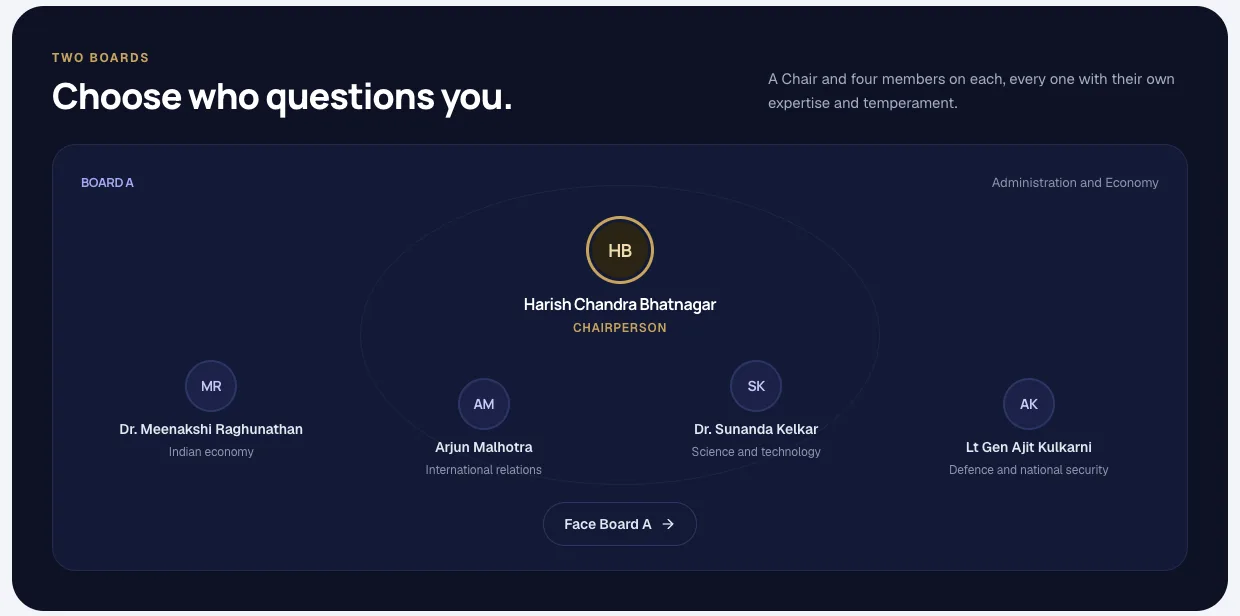
A FluentlySaid UPSC mock is a 25-minute voice interview with a Chair and four members. You choose Hindi or English before you start. The board drills into your DAF, argues the other side and puts you in situational and administrative scenarios. An independent assessor gives an indicative score out of 275.
After each mock you get a full report with member-wise feedback, a question-by-question analysis with stronger answers, every likely question from your DAF and a progress tracker. The first full mock interview is free. Unlimited mocks on the Board Ready plan let you sit one at any hour, with no slot booking and no travel. The score is a practice estimate, not a prediction. See the UPSC interview practice page, and read how many to take in our guide to mock interviews for UPSC.
If you sit human mocks too, check before you book that the panel can follow Hindi and that written feedback is in Hindi. Our guide to the UPSC e-Summon letter lists what to carry on the day.
A last word for Hindi medium candidates
You have already passed a Mains written in your own language. The interview asks the same thing in speech: can you think clearly and speak simply? Prepare in the language you will use, keep your answers short and stay calm. The interview carries 275 marks and is a conversation.
Questions
Can I give the UPSC interview in Hindi?
Candidates commonly give the interview in Hindi, and the Personality Test assesses suitability for public service, not English skill. UPSC decides the language arrangements, so follow your e-Summon letter and your application details. If anything is unclear, contact the Commission's helpdesk instead of relying on a coaching blog, including ours.
Is there an interpreter in the UPSC interview?
We could not confirm an official rule. We searched UPSC's Civil Services Examination 2026 notification for the word interpreter and found no match, so we do not describe how any interpreter facility works. Read your e-Summon letter and ask UPSC on 011-24041001 or 011-40303444 if you need clarity.
Does Hindi medium reduce my marks in the UPSC interview?
We found no UPSC rule that reduces interview marks for the language you speak. The board is assessing clarity, balance and character, which you can show equally well in Hindi. What costs marks is a weak answer, not the language. Prepare in the language you will use on the day.
Should I use English words in a Hindi interview?
A few common English terms, such as district names of schemes or technical words with no everyday Hindi form, are natural. Avoid switching languages mid-sentence out of nerves. Learn the standard Hindi and English terms for your optional and current affairs, and choose one main language for the whole answer.
How do I prepare for the UPSC interview in Hindi medium?
Start with your DAF, one prepared answer per entry, said aloud in Hindi. Build a short glossary of English and Hindi terms for your optional and current issues. Then sit mock interviews in Hindi, with follow-up questions, and listen to your recordings. Repetition in your own language builds fluency faster than reading.
Can I practise a UPSC mock interview in Hindi?
Yes. FluentlySaid lets you answer a full 25-minute voice mock in Hindi or English, with a board of a Chair and four members. Choose the language before you start. If you sit human panels, confirm that the panel can follow Hindi and that feedback is given in Hindi too.
What if I forget a word in Hindi during the interview?
Pause, then use a simple word that carries the meaning, or give the English term and continue in Hindi. A short pause sounds thoughtful. Apologising repeatedly does not. Boards are listening for the idea, so explain it in plain words rather than searching for a formal one.
Does my Mains medium decide my interview language?
We cannot confirm that from UPSC's documents. UPSC's notification says candidates indicate the medium of the Mains and of the optional subject in the form, and that no change is allowed once it is submitted. It does not state a rule for interview language, so follow your e-Summon letter.
Face the panel before the panel
Face the board 20 times before you face it once.
Take your first board freeFluentlySaid is not affiliated with or endorsed by UPSC. Language arrangements for the interview are decided by UPSC, so follow your e-Summon letter. Every question here is written for practice and is not taken from any real interview. Nothing here promises selection, rank or marks.