Tricky IAS Interview Questions (and How to Handle Them Calmly)
By FluentlySaid Editorial TeamUpdated 27 November 202610 min read
In short
Tricky IAS interview questions are rarely trick questions. They test composure: a stress remark, a contested opinion, a wrong fact slipped in, a dilemma or a gap in your record. Stay calm, correct politely, show both sides and give a clear position. Practise them aloud, because the first ten seconds decide how you sound.
Interviews run 7 Dec 2026 to 12 Feb 2027. Schedule, e-Summon and prep: UPSC Interview Schedule 2026: Dates, e-Summon Letter and What to Do Next
Tricky IAS interview questions are the ones candidates fear most, and they are the easiest to prepare for once you see what they test. This guide groups them by type, shows what the board is really looking for, and gives a weak and a strong answer for each. For the wider list, see our UPSC interview questions guide. Every question is a practice question.
Tricky IAS interview questions: key facts
| Fact | Detail |
|---|---|
| Marks | The UPSC interview (Personality Test) carries 275 marks. See UPSC's examination notice. |
| What it assesses | UPSC describes it as an assessment of personal suitability for a career in public service. |
| Interview dates | 7 December 2026 to 12 February 2027, per UPSC's notice of 17 November 2026. Live status on our UPSC interview schedule 2026 page. |
| Separate list of tricky questions | None. UPSC publishes no question list. The examples here are written for practice. |
Sources: UPSC notices on upsc.gov.in. Checked on 27 November 2026.
Why does the board ask tricky questions?
A civil servant faces hard questions every day: from a minister, a crowd, a reporter, a court. The board cannot recreate that, so it uses a few questions that press a little. It is watching four things.
- Composure: does your voice and pace stay steady?
- Honesty: do you admit what you do not know?
- Balance: can you hold two views at once?
- Courtesy: do you stay respectful when you disagree?
Most tricky questions have no trap in the content. The trap is in your reaction. A candidate who answers calmly and briefly almost always does better than one who answers brilliantly but defensively.
What are the main types of tricky IAS interview questions?
| Type | Example | What it tests |
|---|---|---|
| Stress remark | You seem nervous. Are you sure you can handle this job? | Composure |
| Contested opinion | Is the death penalty justified? | Balance of judgement |
| Fact trap | The Constitution was adopted in 1951, wasn't it? | Attention and courage to correct |
| Dilemma | Your minister asks you to transfer an honest officer. What do you do? | Integrity and method |
| Gap in record | You failed twice. Why should we trust you are ready now? | Honesty and self-awareness |
| Personal choice | You left a well-paid job. Aren't you running away? | Motive and consistency |
| Own weakness | What is the weakest part of your own argument? | Openness |
Source: FluentlySaid's practice framework, not a UPSC publication.
How do you answer a stress question calmly?
Practice question: "You seem nervous. Are you sure you can handle this job?"
The board is not asking about your nerves. It wants to see whether a pointed remark throws you. Treat it as a fair question and answer it.
| Weak answer | Strong answer | |
|---|---|---|
| First reaction | Sir, no, I am not nervous, I am very confident. | A little, sir. It is a big day. But I work steadily under pressure. |
| Evidence | (none) | In my last job I handled a month-end crisis with a small team, and we finished on time. |
| Close | Please do not doubt me. | I would be happy to be tested on any area, sir. |
Source: FluentlySaid teaching example, not a model answer.
The strong answer is honest, brief and backed by one example. Denying the obvious sounds defensive.
How do you answer contested opinion questions?
Practice question: "Is the death penalty justified?"
The board does not want your side of a debate. It wants your method. Use four steps: your position, the strongest argument for the other side, what would change your mind, and a practical conclusion. Stay descriptive about laws and neutral about parties.
| Weak answer | Strong answer | |
|---|---|---|
| Position | Of course it is justified, criminals deserve it. | I lean towards limiting it to the rarest cases, though I see strong arguments on both sides. |
| Other side | (ignored) | Those against it point to the risk of an irreversible error and to doubts about deterrence. |
| Close | That is my firm view. | The courts weigh these points case by case, and I would respect that process. |
Source: FluentlySaid teaching example. The position shown is illustrative, not a recommended view.
Any clear, reasoned position can work. A slogan cannot.
How do you handle a fact trap?
Practice question: "The Constitution was adopted in 1951, wasn't it?"
The board slips in a wrong fact to see if you will agree to be agreeable. The right move is to correct it politely and briefly.
| Weak answer | Strong answer | |
|---|---|---|
| Reaction | Yes sir, 1951. | If I may, sir, I believe it was adopted on 26 November 1949 and came into force on 26 January 1950. |
| If unsure | (guesses) | I am not fully certain, sir. My understanding is 1949 and 1950, and I would like to verify it. |
Source: FluentlySaid teaching example. Check dates against the Constitution of India on the government's own sites.
Do not agree to please the board. Do not correct with a smile that sounds superior. Be polite, clear and short.
How do you answer a dilemma question?
Practice question: "Your minister asks you to transfer an honest officer. What do you do?"
This tests method, not heroics. Use a sequence: clarify, check the rules, seek the reasons in writing, escalate if needed, and stay within the law.
| Weak answer | Strong answer | |
|---|---|---|
| Opening | I will refuse, it is unethical. | First I would understand why the minister wants it, and whether the transfer is within the rules. |
| Method | I would resign if forced. | I would put my concerns in writing, cite the rules, and consult my senior. |
| Close | Principle matters more than my job. | If the order is lawful I would follow it, and if not, I would say so politely and escalate. |
Source: FluentlySaid teaching example, not a model answer.
Dramatic answers sound brave but show no method. A calm sequence shows judgement.
How do you answer questions about your record?
Practice question: "You failed twice before. Why should we trust you are ready now?"
Be honest and specific. Name what went wrong, what you changed and what is different now. Do not blame the paper, the coaching or luck.
| Weak answer | Strong answer | |
|---|---|---|
| Cause | The papers were unfair. | My answer writing was weak, and I did not practise enough. |
| Change | I worked harder. | I started writing daily and getting feedback every week. |
| Proof | (none) | My Mains result this year is the result of that change, sir. |
Source: FluentlySaid teaching example, not a model answer.
How do you answer personal choice questions?
Practice question: "You left a well-paid job. Aren't you running away?" Answer with the moment you decided and what you want to do, not what you want to leave. Link it to something on your DAF. Our guide to why civil services shows how.
How do you answer the weakest-point question?
Practice question: "What is the weakest part of your own argument?" Name one real weakness, say what would answer it and show you can change your mind. Candidates who say they have none lose marks for it.
What if you do not know the answer to a tricky question?
- Pause for two seconds. A pause sounds thoughtful, not lost.
- Say what you do not know. "I am not sure, sir."
- Offer what you do know. One or two sentences, nothing invented.
- Reason aloud briefly. Show how you would think about it.
- Let it go. Move on when the board does.
A bluff is the one mistake you cannot recover from, because the next question will find it.
How do you practise tricky IAS interview questions?
Reading these will not make you calm. Saying them aloud, under interruption, will. Take one type a day, answer it in ninety seconds, record yourself once and fix one thing. Our guide to practising the UPSC interview alone gives a seven-day method, and our list of do's and don'ts helps with habits.
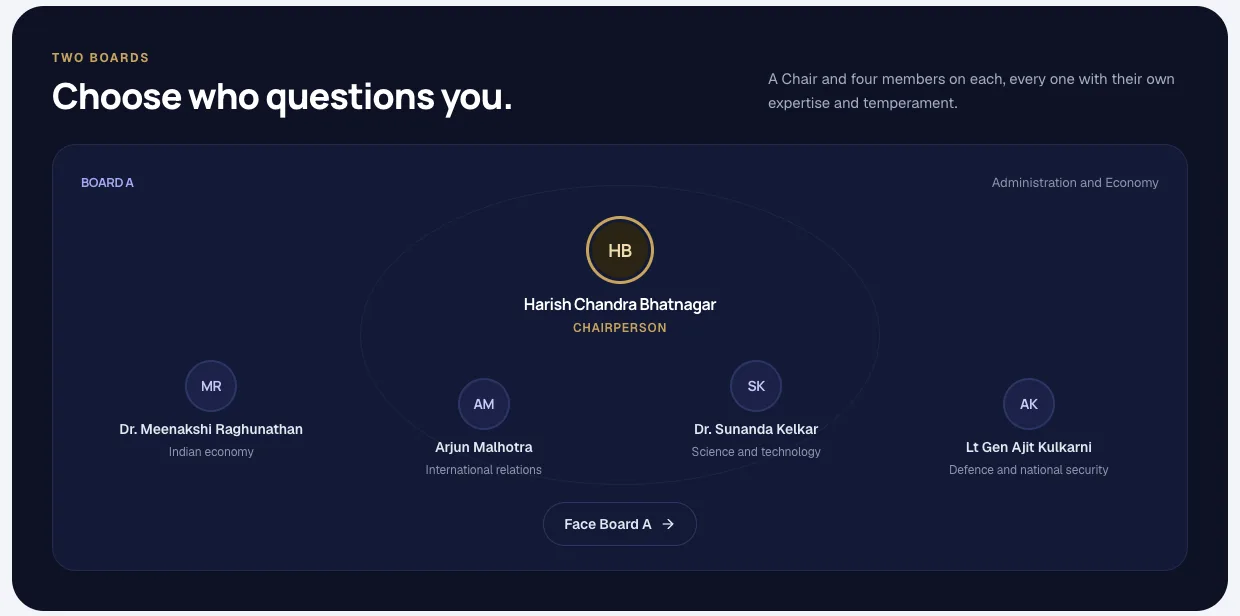
A mock adds the part you cannot do alone: someone presses you. A FluentlySaid UPSC mock is a 25-minute voice interview with a Chair and four members. The board drills into your DAF, argues the other side and puts you in situational and administrative scenarios. An independent assessor gives an indicative score out of 275. You can answer in English or Hindi.
After each mock you get a full report with member-wise feedback, a question-by-question analysis with stronger answers, every likely question from your DAF and a progress tracker. The first full mock interview is free. Unlimited mocks on the Board Ready plan let you sit one at any hour, with no slot booking and no travel. The score is a practice estimate, not a prediction. See the UPSC interview practice page. If you want policing-specific scenarios, read our guide to IPS interview questions.
A last word on tricky questions
Almost no question is as hard as it sounds. Take a breath, answer what was asked, stay courteous and stop. The interview carries 275 marks and is a conversation. The calm candidate has already passed half the test.
Questions
What are some tricky questions in the IAS interview?
Tricky questions are usually tests of composure, not knowledge. Examples of types: a remark that you look nervous, a contested opinion such as a policy you may personally oppose, a wrong fact slipped into a question, a dilemma with a powerful person, and a question on a gap in your record. All examples in this guide are practice questions.
Does the UPSC board try to stress candidates on purpose?
UPSC describes the interview as an assessment of personal suitability for public service. Some questions are pressing, because officers work under pressure. Do not assume hostility. A sharp question is usually a way to see how you think, not an attack. Stay courteous, answer the question asked and do not argue.
How do I handle a question when I do not know the answer?
Say so plainly and politely, for example: I am not sure, sir, but I would reason like this. Then offer what you do know in a sentence or two. Do not guess a fact or bluff. Boards respect honesty and notice a bluff in the next question. Move on calmly when the board does.
What if the board disagrees with my answer?
Listen to the point, acknowledge it and consider it honestly. If it changes your view, say so. If it does not, explain your reason briefly and respectfully, without raising your tone. The test is whether you can disagree calmly and stay open, not whether you win. Never turn the exchange into an argument.
How should I answer opinion questions on controversial topics?
State a clear position, give the strongest case for the other side, and explain how you would weigh them. Stay descriptive about policies and neutral about parties and leaders. Avoid extremes and slogans. A balanced answer with a clear conclusion shows judgement, which is what the board is testing.
Are there UPSC interview questions with answers I can memorise?
Lists with answers help you see patterns, but memorised answers fail because the board follows what you say. Use sample answers to learn structure: position, two sides, a conclusion. Then build your own answer from your own facts and say it aloud until you can do it without notes.
How do I stay calm during tricky questions?
Pause for two seconds before answering, breathe out slowly and speak a little slower than usual. Repeat the key part of the question if it helps. Calm is a habit built by repetition, so practise under interruption, with a timer, in mock interviews until a hard question feels familiar.
Can I practise tricky IAS interview questions in Hindi?
Yes. Choose the language you will use on the day, because composure suffers when the right word will not come. FluentlySaid lets you answer in English or Hindi. If you sit human mocks, check that the panel can follow your medium and that feedback is given in the same language.
Face the panel before the panel
11 PM and can't sleep before your board? Sit one more mock.
Take your first board freeFluentlySaid is not affiliated with or endorsed by UPSC. Every question here is written for practice and is not taken from any real interview or attributed to any candidate or board. The answers shown are teaching examples, not model answers to memorise. Nothing here promises selection, rank or marks.