UPSC Interview Preparation in 30 Days: A Day-by-Day Plan
By FluentlySaid Editorial TeamUpdated 27 November 202610 min read
In short
UPSC interview preparation in 30 days works if every day has one DAF task, one current affairs task and some speaking aloud. Spend week one on your DAF, week two on current affairs and your home state, week three on mock interviews, and week four on polish and logistics. Practise aloud daily.
Interviews run 7 Dec 2026 to 12 Feb 2027. Schedule, e-Summon and prep: UPSC Interview Schedule 2026: Dates, e-Summon Letter and What to Do Next
UPSC interview preparation in 30 days is a short race, but a manageable one, because you are not learning a syllabus. You are rehearsing a conversation about yourself. This guide gives a week-by-week plan with a task for every day and a practice mock built in. It is a suggestion, not official guidance. For the questions the board may ask, see our UPSC interview questions guide.
UPSC interview preparation in 30 days: key facts
| Fact | Detail |
|---|---|
| Marks | The interview (Personality Test) carries 275 marks, per the Plan of Examination in UPSC's CSE 2026 notification. |
| Interview dates | 7 December 2026 to 12 February 2027, per UPSC's notice of 17 November 2026. Find your own date on our UPSC interview schedule 2026 page. |
| Reporting time | Forenoon session 9:00 AM, afternoon session 1:00 PM. |
| Qualified candidates | 2,526, per UPSC's result notice of 5 November 2026. |
| Plan source | FluentlySaid's suggested plan. UPSC publishes no preparation schedule. |
Sources: UPSC notices on upsc.gov.in. Checked on 27 November 2026.
How should you prepare for the UPSC interview in one month?
Think in four blocks, one per week, each with one main goal.
| Week | Main goal | Daily speaking |
|---|---|---|
| Week 1 | Know your DAF: every entry has a tested answer | 30 minutes of answers aloud |
| Week 2 | Home state, optional and current affairs with balanced views | 45 minutes, plus a practice mock on most days |
| Week 3 | Mock interviews, situations and stress questions | A practice mock most days, one human panel mock |
| Week 4 | Polish, logistics and rest | One or two practice mocks, light review |
Source: FluentlySaid suggestion. Stretch or squeeze to your date.
Each day below has a morning task, a midday task and an evening task. Do them in any order that fits your day. The one rule is to speak aloud every single day.
Week 1: how do you analyse your DAF in the first seven days?
Your DAF is the board's script, so week one is your most valuable week. Our step-by-step method for UPSC DAF analysis has the worksheet. This table shows how to spread it.
| Day | DAF task | Current affairs and optional | Speaking |
|---|---|---|---|
| Day 1 | Print your DAF. Mark every entry that can become a question. | Pick eight issues linked to your DAF. | Introduce yourself aloud in two minutes. |
| Day 2 | Name, place and education: fact, story, opposite view. | One newspaper, 30 minutes. | Record answers for three entries. |
| Day 3 | Optional subject: depth and two current examples. | Write three lines on issue 1. | Say the optional answers aloud. |
| Day 4 | Work and gap: one decision story with a result. | Issues 2 and 3, three lines each. | Tell the story in ninety seconds. |
| Day 5 | Hobbies and achievements: three minutes on each. | Issue 4. | Record and listen once. |
| Day 6 | Service preference: one honest reason per service. | Issue 5. | First practice mock, to find gaps. |
| Day 7 | Review the mock report. Mark red entries. | Light reading only. | Rest, or repeat one weak answer. |
Source: FluentlySaid suggested plan, not official UPSC guidance.
For a deeper look at two sections, read our guides to home state questions and graduation and optional questions.
Week 2: how do you prepare current affairs and your home state?
Week two builds the knowledge behind your answers. The goal is not to know everything. It is to have a balanced view on a few live issues and ten solid facts on your home state.
| Day | Knowledge task | Current affairs | Practice mock |
|---|---|---|---|
| Day 8 | Home state: ten facts, one unsolved problem, one change you would make. | Issue 6. | Yes, focus on DAF questions. |
| Day 9 | Home district: economy, culture, problems. | Issue 7. | No. Review your week 1 report. |
| Day 10 | Optional: criticism of your own view. | Issue 8, then one fresh issue. | Yes. |
| Day 11 | Education: link your subject to a public problem. | Review all issues, two lines each. | Yes. |
| Day 12 | Schemes and institutions linked to your DAF. | Say three issues aloud, with both sides. | No, rest your voice. |
| Day 13 | Gaps in your fact sheet. Fill the weakest. | One newspaper. | Yes. |
| Day 14 | Weekly review: what improved, what repeats? | Light reading. | Optional. |
Source: FluentlySaid suggested plan, not official UPSC guidance.
Week 3: how do you practise mock interviews and tricky questions?
Week three is for being questioned. Sit your first human panel mock early in the week, so you have days to act on its feedback. Our guide to mock interviews for UPSC explains how many to aim for, and tricky IAS interview questions covers stress and trap questions.
| Day | Focus | Practice | Review |
|---|---|---|---|
| Day 15 | Situational and administrative scenarios | Practice mock | Write one fix |
| Day 16 | Human panel mock | Sit it fully, take notes | Same day |
| Day 17 | Act on the panel's feedback | Re-answer the three weakest questions | Test the fix |
| Day 18 | Stress and opinion questions | Practice mock, ask for pressing follow-ups | One fix |
| Day 19 | Ethics dilemmas | Answer five aloud, with a timer | Listen once |
| Day 20 | Practice mock on a different DAF section | Full mock | Update red list |
| Day 21 | Weekly review | Re-sit your weakest mock question | Rest |
Source: FluentlySaid suggested plan, not official UPSC guidance.
If you aspire to the police service, add the scenarios in our guide to IPS interview questions. If you will answer in Hindi, read the guide to the UPSC interview in Hindi medium.
Week 4: how do you polish and get ready for the day?
| Day | Task | Practice | Notes |
|---|---|---|---|
| Day 22 | Second human panel mock, if you can fit one | Full mock | A different panel from the first |
| Day 23 | Act on the feedback. Trim long answers. | Practice mock | Ninety seconds per answer |
| Day 24 | Re-read your DAF as a stranger. Spot new gaps. | Practice mock | One fix |
| Day 25 | Documents: gather originals. See what to carry. | Light practice | Follow your e-Summon letter |
| Day 26 | Travel and route plan. Check your date and session. | Practice mock | Print tickets for the TA claim |
| Day 27 | Current affairs refresh: your top eight issues. | Say them aloud | Both sides each |
| Day 28 | Weakest DAF entries, one last pass. | One practice mock | Stop at a fixed hour |
| Day 29 | Light review only. Dress and logistics ready. | A short warm-up | Early night |
| Day 30 | Rest. Check documents once. | None, or a short chat | Sleep |
Source: FluentlySaid suggested plan. Follow your e-Summon letter and UPSC's notices for the official requirements.
Our guide to the do's and don'ts of the UPSC interview covers conduct on the day.
What does a typical day of UPSC interview preparation look like?
A full day of study is about four to six focused hours. Here is one way to split it. Move the blocks around to suit your work and your energy.
| Time block | Task | Length |
|---|---|---|
| Morning | One newspaper and one current affairs issue written in three lines | 60 minutes |
| Late morning | DAF or knowledge task for the day, from the tables above | 90 minutes |
| Afternoon | Speaking: answer aloud and record it once | 45 minutes |
| Evening | Practice mock, then review the report and write one fix | 60 to 90 minutes |
| Night | Light revision of your red DAF entries, then stop | 30 minutes |
Source: FluentlySaid suggestion. Adjust to your own day.
How do you build daily mock practice into UPSC interview preparation?
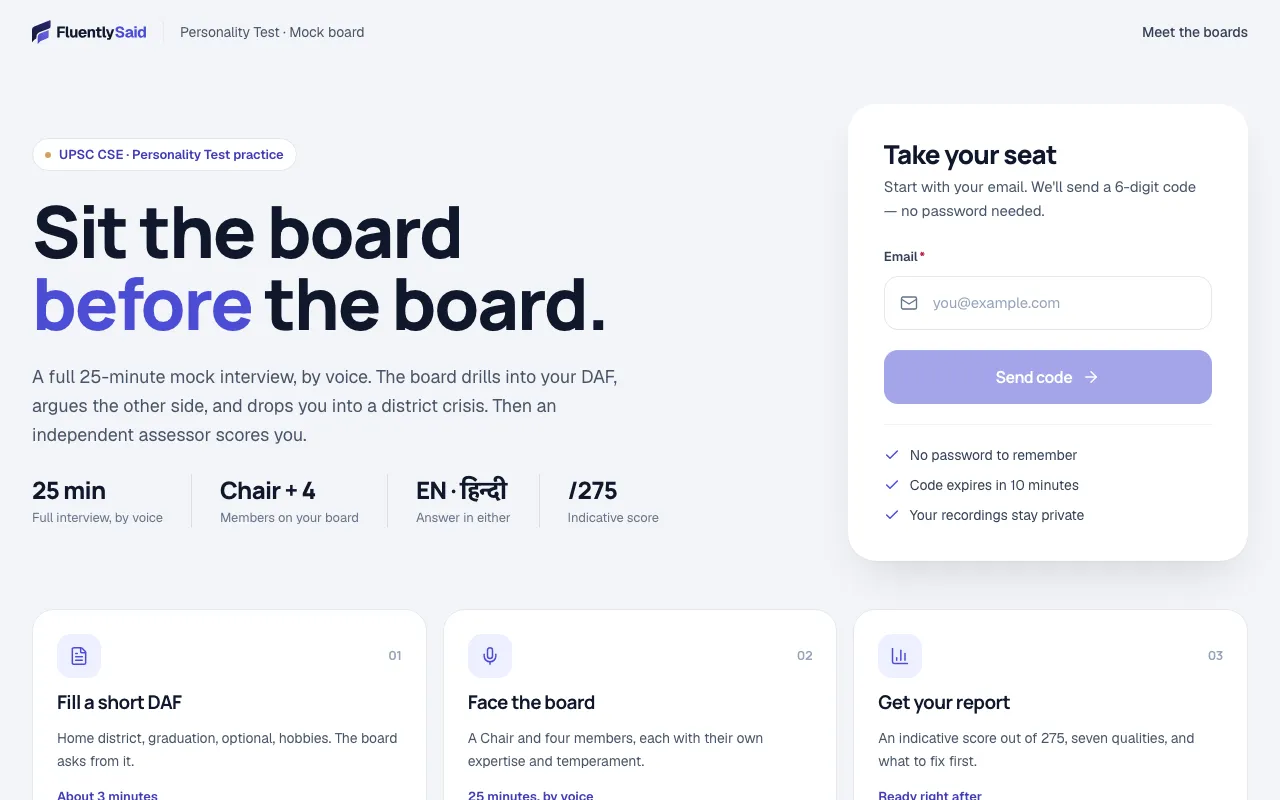
The interview is a spoken test, so the plan keeps a practice mock on most days. A FluentlySaid UPSC mock is a 25-minute voice interview with a Chair and four members. The board drills into your DAF, argues the other side and puts you in situational and administrative scenarios. An independent assessor gives an indicative score out of 275. You can answer in English or Hindi.
After each mock you get a full report with member-wise feedback, a question-by-question analysis with stronger answers, every likely question from your DAF and a progress tracker. The first full mock interview is free. Unlimited mocks on the Board Ready plan let you sit one at any hour, 11 PM or 6 AM, with no slot booking and no travel. The score is a practice estimate, not a prediction. See the UPSC interview practice page.
A mock only helps if you review it. Spend as long reviewing as you spent sitting, write one fix, and test it in the next mock. If a mock leaves you shaken, sit the next one the next day. Calm comes from repetition.
What if you have more or less than 30 days?
| Time to your date | What to change |
|---|---|
| More than 30 days | Stretch weeks 1 and 2 to a fortnight each. Add more current affairs and a third human panel mock. |
| 20 to 30 days | Shorten week 2. Keep a practice mock every second day. |
| 10 to 20 days | Do the DAF in three days, then mocks. Drop wide reading. Keep daily speaking. |
| Under 10 days | Red DAF entries, one practice mock daily, documents and sleep. |
Source: FluentlySaid suggestion. Check your date in UPSC's notice. Our plan for the weeks after Mains covers the wider picture.
A last word on UPSC interview preparation
The plan is a frame, not a cage. If a day goes wrong, move on, do not try to catch up by working through the night. The interview carries 275 marks, and it is a conversation about you. A month of daily speaking is enough to make that conversation familiar.
Questions
Is 30 days enough to prepare for the UPSC interview?
For most Mains-qualified candidates, a focused month is workable, because you already know the syllabus and your own DAF. What matters is daily speaking, not hours of reading. If your date is later, spread the same plan over more weeks and add more mocks. Nobody can promise a result.
How should I start UPSC interview preparation?
Start with your DAF. Print it, mark every entry that can become a question, and write one fact, one story and one opposite view for each. Then say each answer aloud. The board begins from your form, so this one step covers more of the interview than anything else.
How many hours a day should I study for the UPSC interview?
Four to six focused hours is a reasonable range for most candidates, with at least one hour spent speaking aloud. The right number depends on your job, your date and how rested you are. A tired six hours teaches less than a clear four. Protect your sleep, especially in the last week.
When should I start mock interviews?
Start in the first week with a practice mock to find your gaps, then increase through weeks two and three. Keep human panel mocks for the second half of the month, when each sitting can polish. Between them, sit practice mocks on most days and review each one before the next.
How do I prepare current affairs for the UPSC interview?
Pick eight to ten live issues connected to your DAF, your state and your optional. For each, write three lines: the facts, the two sides and your balanced view. Read one newspaper daily rather than many sources. Do not memorise opinions. Practise saying your view aloud in ninety seconds.
What if I have less than 30 days before my interview?
Keep the order but shorten each block: DAF first, then your home state and optional, then mocks. Drop wide reading, not speaking. If your date is within a week, do a daily practice mock, revisit your red DAF entries, prepare documents and sleep. Check your date and session in UPSC's notice.
Can I follow this plan if I work or have limited time?
Yes. Cut each day's tasks to the DAF and speaking tasks and keep one practice mock every second day. Use commutes for listening to your own recordings. Do not skip the weekend blocks if you can avoid it, because the long mock and review sessions sit there. Adjust, but keep the daily speaking habit.
Is it useful to follow a plan if the board asks random questions?
Yes, because the questions may be varied but your preparation is not random. The board starts from your DAF and follows your answers. A plan makes sure every entry has a tested answer, your current affairs have balanced views and you are used to being interrupted. That readiness carries over to questions you did not expect.
Face the panel before the panel
Unlimited mocks, any hour. A 5-member AI board and a full report after every one.
Take your first board freeFluentlySaid is not affiliated with or endorsed by UPSC. This plan is our suggestion, not official UPSC guidance and not a proven method. Nothing here promises selection, rank or marks. Check dates and rules at upsc.gov.in.