UPSC Interview: How to Introduce Yourself
By FluentlySaid Editorial TeamUpdated 29 November 20264 min read
In short
Your introduction is a short, spoken answer about who you are, built from facts your board already has in your DAF. Aim for about 90 seconds, say something the form does not, and end on a thread you are happy to be asked about.
Interviews run 7 Dec 2026 to 12 Feb 2027. Schedule, e-Summon and prep: UPSC Interview Schedule 2026: Dates, e-Summon Letter and What to Do Next
Your UPSC interview introduction should take about 90 seconds and say who you are, what shaped you, one thing you did and why you want this career. Your board has your DAF, so do not read it back. Add the reasons behind the entries. This guide gives a structure, a fictional example with critique and the mistakes to avoid. For dates and status, see the UPSC interview 2026 page.
Why does the introduction matter?
It is the one answer you control. The board then follows whatever you say, so what you mention is what you may be asked about. A vague introduction gives the board nothing to follow. A careless one invites a question you did not want.
UPSC has not published a script for the interview, and we do not claim to know how any board uses your opening. What we can say is practical: you should be able to talk about yourself clearly, honestly and briefly.
What is a good structure for a 90-second introduction?
| Part | What to say | About how long |
|---|---|---|
| Who you are | Name, where you are from, where you studied or work now | 15 seconds |
| What shaped you | One experience or decision that explains your path, not a list of degrees | 30 seconds |
| What you did | One piece of work or achievement from your DAF, with a concrete result | 30 seconds |
| Why this career | One honest reason, tied to the experience above | 15 seconds |
Source: FluentlySaid suggested structure. UPSC prescribes no format for the introduction.
Write it as notes of four lines, not as an essay. Say it aloud, time it, and cut anything that does not serve the four parts.
How do you plant threads you want the board to pull?
End each part on something you can discuss at length. If you mention a district library project you ran, be ready for five minutes on it. If you mention a topic you cannot discuss, remove it. Plant two or three threads and keep the rest for later questions.
This is a suggestion, not a trick: it only works if the threads are true and you know them well. A board will notice a thread that falls apart under one follow-up.
A fictional example, with critique
Weak version: "Sir, I am Rohan Verma from a small town. I did my BTech, then worked in an IT company, then left to prepare. I am hardworking, honest and passionate about serving the nation."
Why it is weak: it is a list the form already shows, and "hardworking, honest and passionate" are claims with nothing behind them. It plants no thread, so the board must pick one for you.
Stronger version: "Sir, I am Rohan Verma, from a town in eastern Uttar Pradesh. I studied engineering and spent two years at a software firm, where I built a tool that cut the time to process pension queries for a state client from days to hours. Seeing how much an ordinary person's life turned on one office's speed is why I left to prepare for the civil services."
Why it works: it ties the degree and the job to a reason, gives one concrete result and ends on a thread (pension queries) the speaker can discuss in detail. All names and facts here are fictional.
What mistakes weaken an introduction?
- Reading the DAF aloud. The board can read it. Add the reason, not the list.
- Adjectives with no evidence. Replace "hardworking" with one example of hard work.
- Planting a thread you cannot discuss. Remove anything you cannot talk about for three minutes.
- Running past two minutes. A long answer hides the part that matters.
- A different story each time. Keep the facts fixed. Only the wording should change.
How should you practise it?
Say it aloud every day for a week, in the language you will use on the day. Record it once and listen for filler words and rushed endings. Then practise being interrupted after your first thread, because a board may step in before you finish.
A mock interview helps here because it starts from your own details and asks a follow-up on whatever you say. Our guide to analysing your DAF shows how to find the entries worth planting, and the do's and don'ts cover conduct on the day.
Questions
Will the UPSC board ask me to introduce myself?
UPSC does not publish the questions or an order of questions. Many candidates are asked to speak about themselves, so prepare an introduction, and be ready to start from any entry in your DAF instead.
How long should my UPSC interview introduction be?
About 90 seconds is a sensible target. It is our suggestion, not a UPSC rule. Long enough to say something real, short enough that the board can step in.
Should I repeat what is in my DAF?
Do not read it back. The board has your form. Use your introduction to add the reason behind an entry: why you chose that degree, that job or that city.
Can I introduce myself in Hindi?
Choose the language you will answer in and practise your introduction in it. Say your introduction aloud in that language before the day, so it does not sound translated.
Should I memorise my introduction?
Memorise the four parts, not the sentences. A word-for-word script sounds recited, and one interruption can lose your place.
Face the panel before the panel
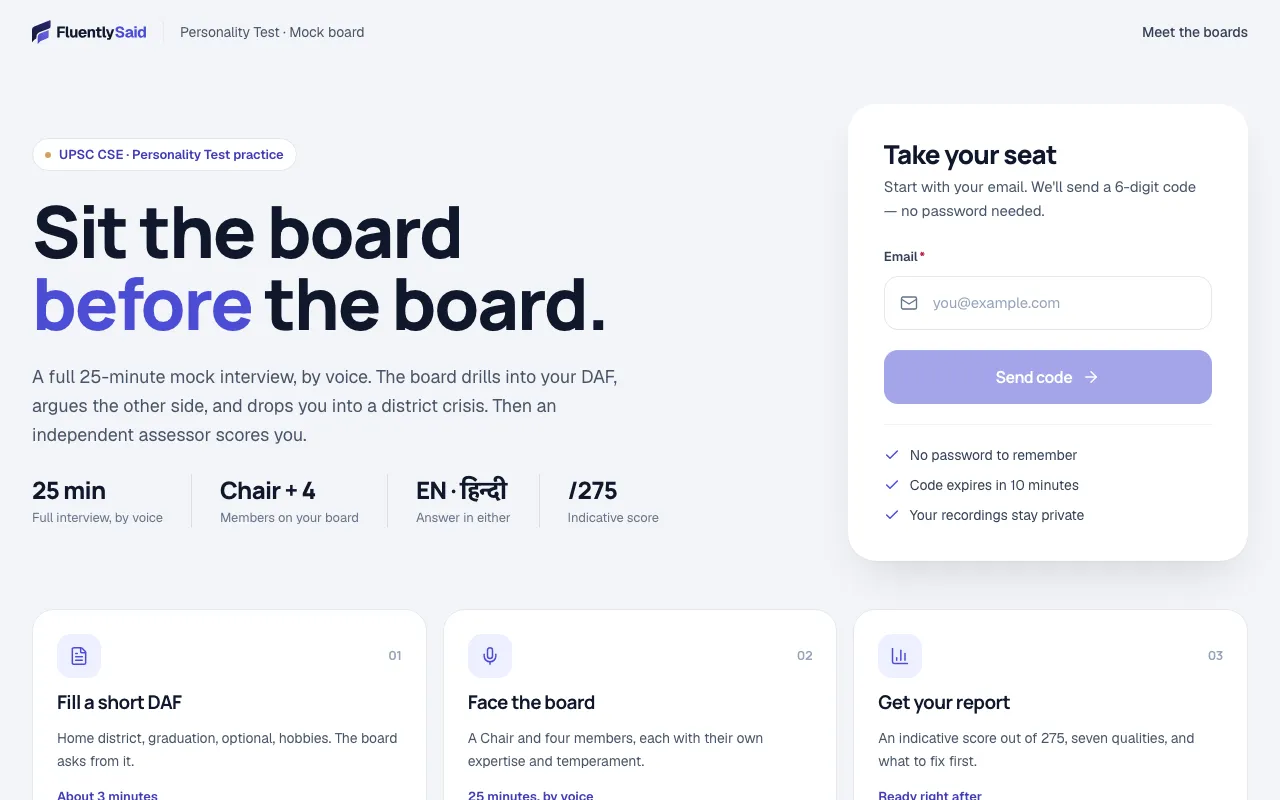
A 25-minute voice interview with a Chair and four members, built from your DAF, with a report on the answers that need work.
Practise this out loud on a mock boardFluentlySaid is not affiliated with or endorsed by UPSC. Advice here is our suggestion, not official UPSC guidance. Example questions and answers are fictional. Follow your e-Summon letter and UPSC's notices.