UPSC Interview Current Affairs: How to Prepare Issues Without a Daily Briefing
By FluentlySaid Editorial TeamUpdated 29 November 20264 min read
In short
You cannot read everything, so choose eight to ten issues tied to your DAF, your state and your optional. For each, write the facts, both sides and your balanced view in three lines, then say them aloud. Add one new issue a day and drop one.
Interviews run 7 Dec 2026 to 12 Feb 2027. Schedule, e-Summon and prep: UPSC Interview Schedule 2026: Dates, e-Summon Letter and What to Do Next
For the UPSC interview, prepare eight to ten live issues linked to your DAF, your home state and your optional. For each, write three lines (the facts, both sides and your balanced view) and say them aloud. Add one new issue a day and drop one. This method does not depend on this week's headlines, so it stays useful until your date. Find your date on the interview schedule page and plan backwards.
Why not just read everything?
The interview is a conversation. A board that follows up on an issue wants to hear how you reason, not how many headlines you remember. Ten issues you can discuss from both sides give you more to say than a hundred you can only name.
UPSC publishes no list of topics for the Personality Test, and we do not claim to know which issues any board will raise. The method below prepares you to reason about whatever comes.
How do you choose which issues to prepare?
| Source | How many | Example of the link |
|---|---|---|
| Your DAF | 3 to 4 | Your degree, job or hobby points to an issue in that field |
| Your home state or district | 2 to 3 | A problem or policy in the place you are from |
| Your optional subject | 2 | A current debate in the subject you chose |
| A live national or global issue | 1 to 2 | Something every informed citizen is expected to know about |
Source: FluentlySaid suggestion, not official UPSC guidance.
Start from the DAF, because the board has it. An issue connected to your own background is one you can speak about with substance.
What is the three-line template?
| Line | What to write | Check |
|---|---|---|
| 1. Facts | What is happening, with one or two figures you have checked at the source | Could you name where the figure comes from? |
| 2. Both sides | The strongest argument for and the strongest against | Would each side say you described it fairly? |
| 3. Your view | A balanced position and one practical step | Can you defend it if pushed? |
Source: FluentlySaid suggested template.
A fictional example, with critique
Question: "Groundwater is falling in your district. What should be done?" (The district and its facts here are fictional.)
Weak answer: "Sir, the government should stop farmers from using borewells and everyone should save water."
Why it is weak: it is one-sided, impractical and ignores why farmers depend on borewells. A board can respond with "How will farmers earn then?" and the answer has nowhere to go.
Stronger answer: "Sir, the water table in a district like mine has fallen because crops that need a lot of water are the most profitable and power for pumps is cheap. Restricting borewells would hurt farmers who have no alternative. I would start with better prices and procurement for less thirsty crops, with measured pumping in the worst blocks, and I would want data on each block before deciding."
Why it works: it explains the cause, respects both sides, proposes a practical step and admits what it would need to know.
How do you keep the list fresh?
Read one newspaper for 30 minutes a day and write down only what touches your list. Add one new issue per day and drop the weakest. Once a week, say all ten aloud, with both sides, as if a board were listening.
Check key figures at the source before you say them: a government release, a ministry dataset or a court order. A number you cannot source is a number to leave out. If you do not know, say so.
Which mistakes should you avoid?
- Memorising facts with no view. A board will ask what you think.
- Strong opinions you cannot defend. Prefer a balanced, reasoned view.
- Running down a party, state, group or institution.
- Quoting figures you did not check.
- Never saying it aloud. Writing is not speaking. Practise the spoken version.
Our 30-day plan shows where this fits each week, and a mock interview lets you test your views against follow-up questions. See also the guides to home state questions and DAF analysis.
Questions
How much current affairs is needed for the UPSC interview?
UPSC sets no number. A practical target is eight to ten live issues linked to your DAF, state and optional, each prepared with facts, both sides and your view. That is our suggestion.
Should I read a newspaper daily?
One newspaper for 30 minutes a day is enough for most candidates, if you write down what you read. Reading many sources without writing or speaking rarely helps in a conversation.
What if the board asks about an issue I have not prepared?
Say what you know, say what you do not and reason from principles. A short honest answer with a balanced view is better than a guess.
Do I need to have a strong opinion on every issue?
No. A considered, balanced view that you can defend is enough. Avoid extreme positions you cannot support, and do not run down any group or institution.
Where should I get facts from?
Prefer primary sources: government releases, ministry data, court orders and reports. Use newspapers to learn what is happening, then check key figures at the source before you say them aloud.
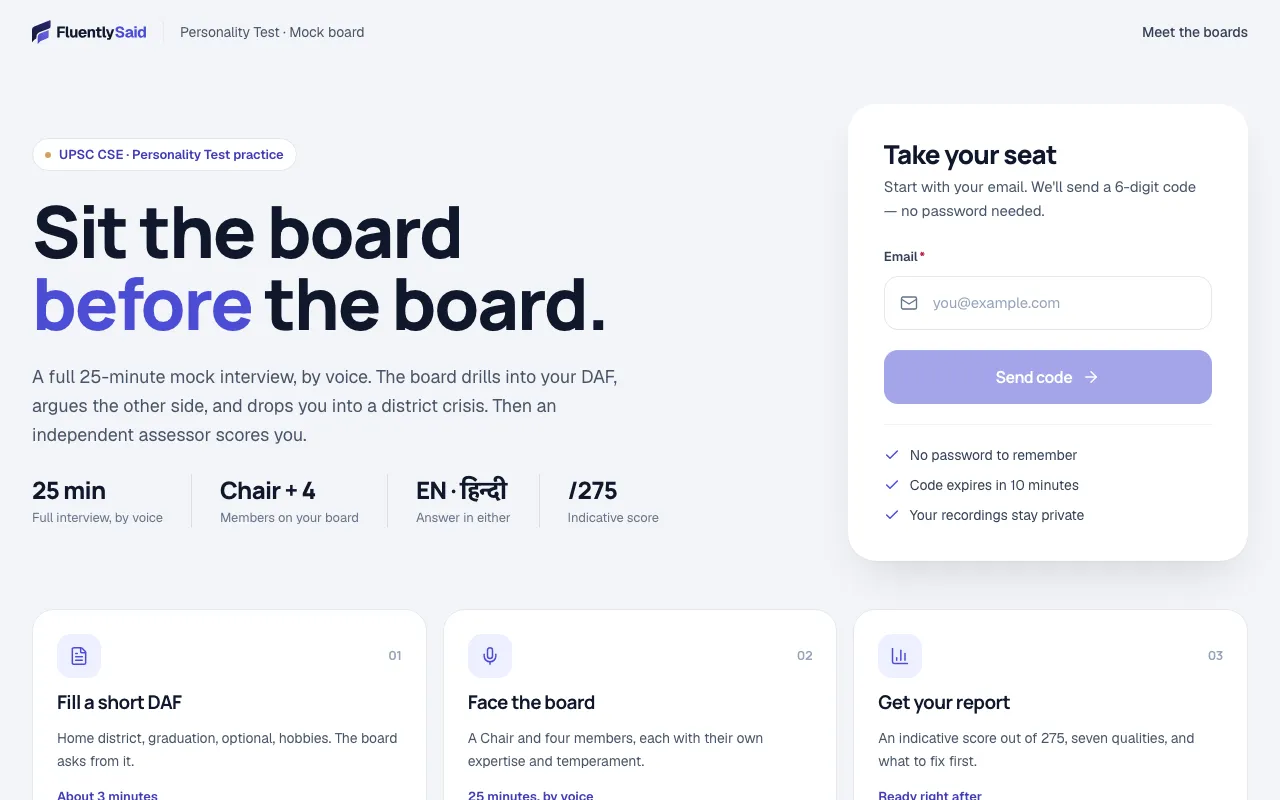
Face the panel before the panel
A 25-minute voice interview with a Chair and four members, built from your DAF, with a report on the answers that need work.
Practise this out loud on a mock boardFluentlySaid is not affiliated with or endorsed by UPSC. Advice here is our suggestion, not official UPSC guidance. Example questions and answers are fictional. Follow your e-Summon letter and UPSC's notices.