How to Handle Price Objections on Indian B2B Sales Calls
By FluentlySaid Editorial TeamUpdated 23 November 20263 min read
In short
A price objection on an Indian B2B call is usually one of three things: a comparison, a need to justify the spend upstairs, or a negotiation opening. Find out which before you respond. Then trade, do not discount: give something only for something. Get the approver on the next call, and practise the lines out loud.
"Price thoda zyada hai." You hear it on most calls, and most reps answer the words. The words are rarely the problem. Before you reply to a price objection, you need to know which of three things it is.
What a price objection usually is
- A comparison. They have another quote, a cheaper tool or an in-house option in mind.
- A need for a reason. They want it, and need something to say when someone above asks why it costs this much.
- A negotiation opening. In many Indian B2B deals, asking for a discount is simply how the conversation proceeds.
Each needs a different answer. If you defend the price against a comparison you have not heard, you lose. If you cut the price for someone who only needed a reason, you gave away margin for nothing.
Five moves
- Ask what they are comparing it with. "Aap kisse compare kar rahe hain?" Do this before you say anything about value.
- Isolate it. "If the price were right, is there anything else stopping you?" Now you know whether it is really price.
- Tie the price to their number. Return to what they told you in discovery: the cost of the problem, in their words.
- Trade, do not discount. Give something only for something: a longer term, faster payment, a reference, a larger scope.
- Get the approver on the next call. Ask what the decision maker will want to see, and offer to be there.
Lines to practise out loud
| The buyer says | Do not say | Say instead |
|---|---|---|
| Price zyada hai | We offer the best value in the market | Aap kisse compare kar rahe hain? Mujhe samajhna hai kahan farak lag raha hai. |
| Discount mil sakta hai? | Let me check what I can do | Ek saal ki jagah do saal ka plan lein, toh main iske liye approval le sakta hoon. |
| Boss se baat karni hai | Sure, I will send you a deck | Unhe kya dekhna hoga? Main ek page bana deta hoon, aur chahein toh call par bhi jud jaunga. |
| Competitor sasta hai | They are not as good as us | Sahi hai. Kaun si cheez aapke liye sabse zaroori hai, wahan unka aur humara kya farak hai? |
Source: FluentlySaid practice lines in Hinglish. Adapt them to your own voice and product.
Why reading this is not enough
You will read these moves and agree with them. You will still forget them when a buyer you like says the price is too high. The fix is repetition under pressure, which means saying the lines out loud to something that pushes back.
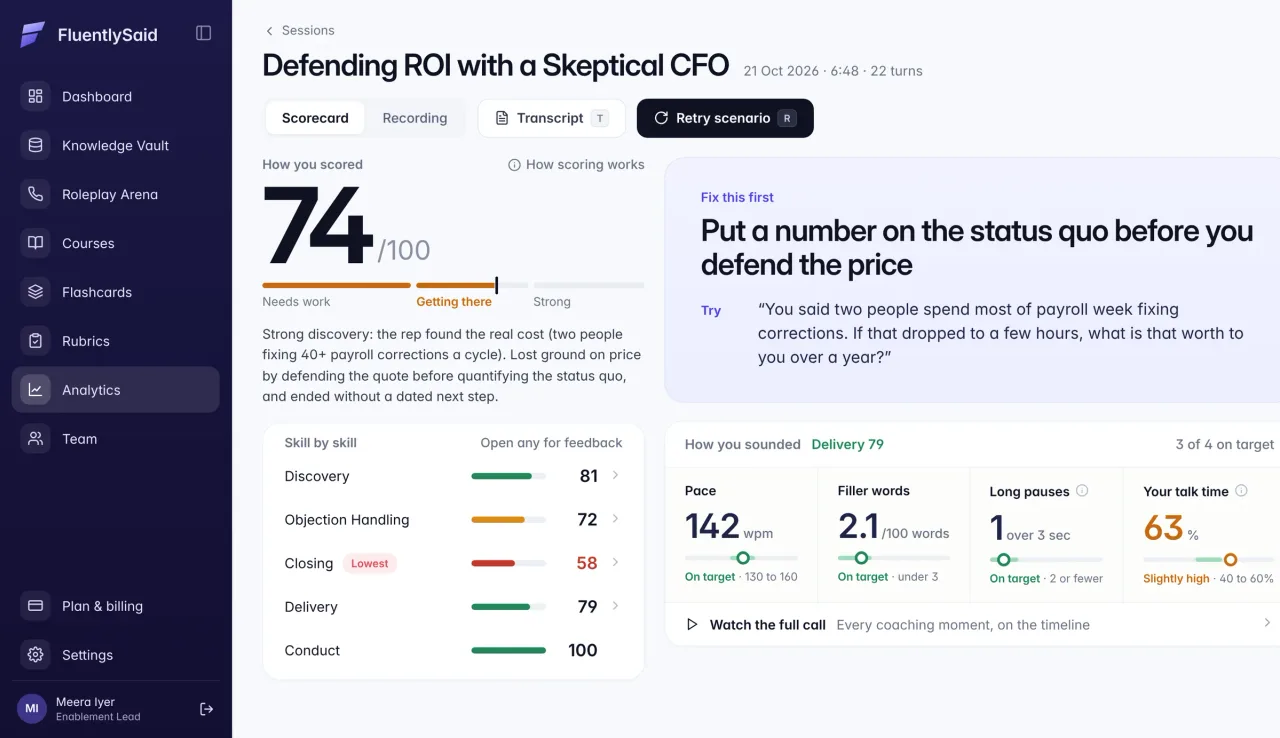
That is what a Sales Readiness roleplay is for. You describe what you sell, take a voice call against an AI buyer built for your domain, and get a scorecard that shows what you said, how long you spoke and the exact moment the buyer went cold. Try the Hindi and Hinglish version in this guide.
Questions
How do you handle a price objection?
Do not defend the price first. Ask what they are comparing it with, find out who else has to approve it, and offer a trade instead of a discount.
Should I give a discount to close the deal?
Only for something in return: a longer term, a faster payment, a reference, a bigger scope. A discount for nothing teaches the buyer to ask again.
What if the buyer says they will discuss it internally?
Ask what the people they will discuss it with will want to see, and offer to join that conversation or send a one-page summary built for them.
How can I practise price objections?
Out loud, against someone who pushes back. A voice call against an AI buyer who knows your domain lets you repeat it as often as you need and shows you the line where the buyer went cold.
Have the call before the call
Run a free voice call against an AI buyer built for your domain. No login needed.
Try a free sales call, no loginAI buyers are fictional and built from the context you give them. Scores are indicative.