Renewal Call Practice for CSMs: Five Scenarios to Rehearse
By FluentlySaid Editorial TeamUpdated 23 November 20263 min read
In short
Most renewals are decided by what you say in the first two minutes of a hard call. Five scenarios cover most of the risk: a price increase, a champion who left, low adoption, a competitor quote, and a multi-year discount ask. For each there is an opening to practise out loud and a mistake to avoid.
The renewal is not decided in the QBR deck. It is decided in a few sentences on a call, usually when the customer is already half-way out. The CSM who never loses a logo has already had that conversation before. Here are five to have in practice first.
1. The price increase
The call: the renewal is up and so is the price. The customer says, "Last year was cheaper."
Practise opening with: the number, plainly, then what the customer got for it. "The renewal is at the new rate. In the last twelve months your team did X."
Avoid: apologising for the increase, or hiding it until the end of the call.
2. The champion left
The call: your sponsor moved on. Their replacement did not buy this, does not use it and has not heard of you.
Practise opening with: the goal the account was bought for, in the new person's language, and one result that matters to them. Ask what they are measured on this year.
Avoid: retelling the history of the account. They do not care yet.
3. Low adoption
The call: usage has fallen for three months. The customer says, "We barely use it."
Practise opening with: agreeing, then asking what got in the way. "You are right, usage is down. What changed for the team?" Listen for a real blocker: a process, a person, a missing integration.
Avoid: defending the product or blaming training.
4. The competitor quote
The call: the customer has a cheaper quote and mentions it early to see what you do.
Practise opening with: curiosity. "What would you want the new tool to do that this does not?" The quote is often leverage. The reason underneath it is what you can fix.
Avoid: running down the competitor, or matching the price on the spot.
5. The multi-year discount ask
The call: the customer will renew only if you give a bigger discount for a longer term.
Practise opening with: a trade. "For three years, I can offer X. In return I would want Y." Y might be a reference, an expansion plan or an earlier payment.
Avoid: giving the discount and asking for nothing.
How to rehearse them
- Say each opening out loud, twice, before the call.
- Run the scenario against someone who stays upset, polite or already leaving.
- Review what you said, not what you meant.
- Run it again the next day.
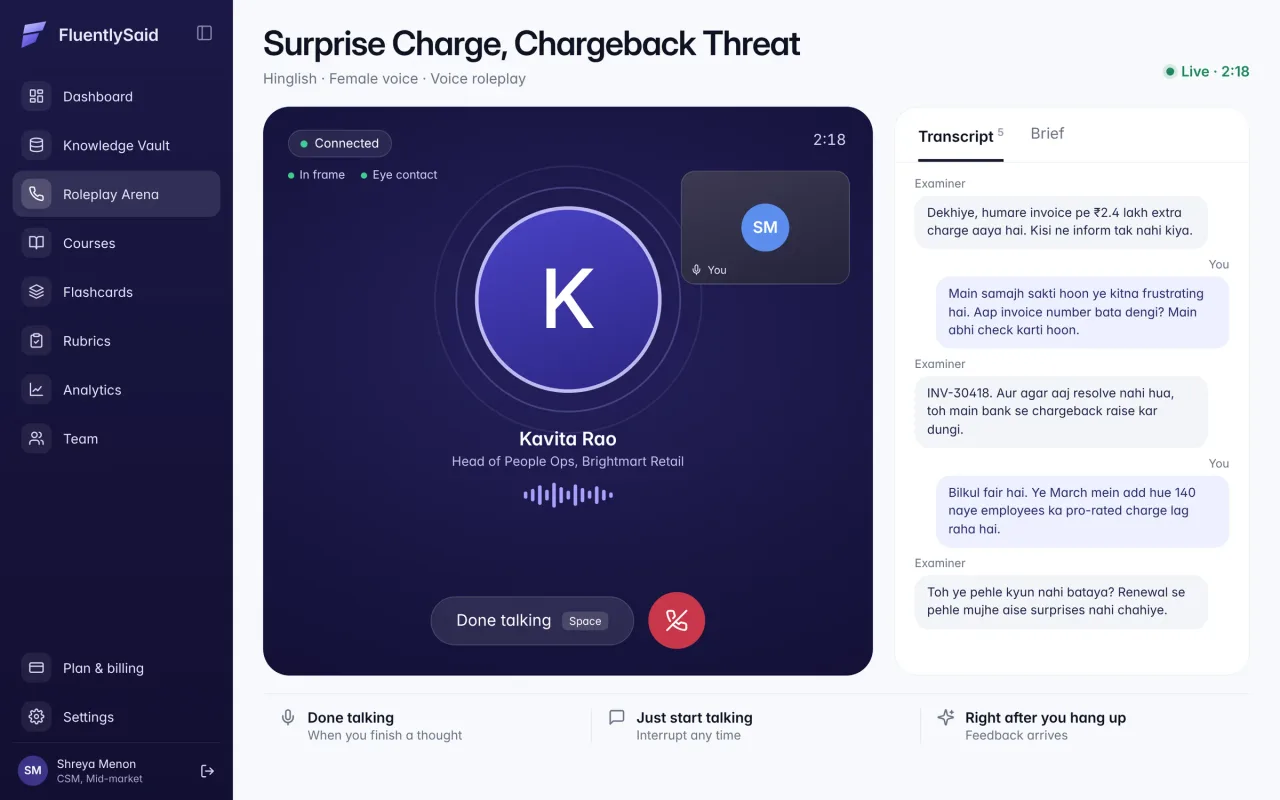
A Customer Success roleplay on FluentlySaid does this by voice: you describe your product, set the customer's mood, and take a live call with an AI customer built for your domain. Your scorecard shows the exact line where trust slipped, and one fix to make first. For the sales side, read how to handle price objections.
Questions
How do you prepare for a renewal call?
Know the account's usage, the original goal and what has changed. Then rehearse your opening aloud, because the first two minutes set the tone.
How do you handle a price increase with a customer?
State it early and plainly, tie it to what the customer has achieved, and do not apologise for the number. Offer a choice, such as a longer term, instead of a discount.
What do you do when your champion leaves?
Find the new owner within days, restate the goal the account was bought for, and show results in the new person's terms before the renewal is discussed.
How can CSMs practise churn saves?
Out loud against a customer who pushes back. A voice call with an AI customer who is upset, polite or already leaving lets you repeat the call and review the scorecard.
Have the call before the call
Run a free voice call against an AI buyer built for your domain. No login needed.
Try a free CS call, no loginAI customers are fictional and built from the context you give them. Scores are indicative.