AI Sales Roleplay in Hindi and Hinglish: Practise Calls the Way Indian Buyers Talk
By FluentlySaid Editorial TeamUpdated 23 November 20263 min read
In short
Indian buyers mix Hindi and English mid-sentence, and many calls are won or lost in that mix: the polite brush-off, the haggle, the "send me the details". English-only roleplay never rehearses it. FluentlySaid lets a rep choose English, Hindi or Hinglish before an AI buyer call and scores the call afterwards.
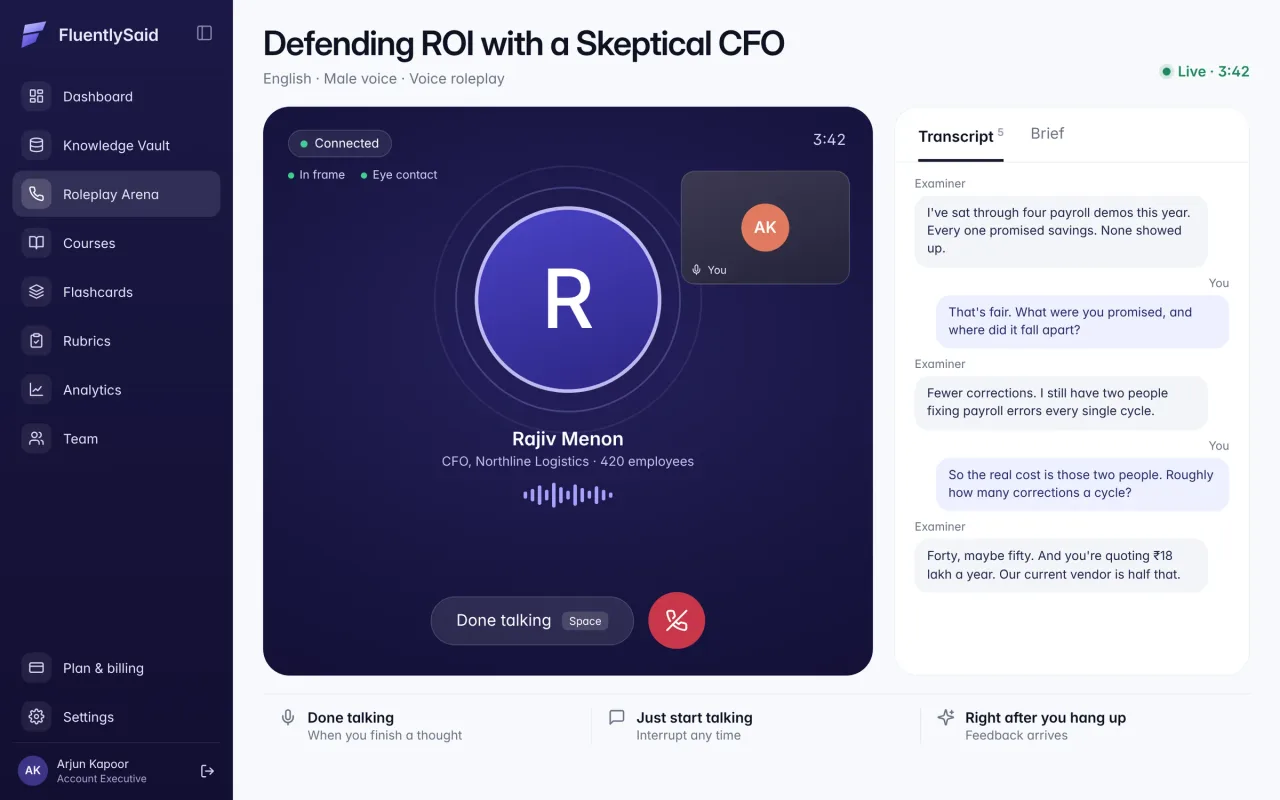
Most sales roleplay is in English, because the course was written in English. Your buyer is not. A buyer in Pune, Jaipur or Indore will start in English, drift into Hindi when the price comes up, and finish with a polite "I will discuss with my partner and let you know". If you have never practised that mix, the first time you meet it is on a live call.
What English-only practice misses
- The switch. The buyer moves to Hindi when the conversation becomes personal or about money. You need to follow without a beat of hesitation.
- The soft no. "Sir, let me check" and "we will see" are rarely a yes. English scripts are not written for them.
- The haggle. "Thoda discount mil sakta hai?" is a negotiation opening, not a question about discounts.
- The send-me-details brush-off. Often a polite end to the call. A good rep turns it into a next step.
- Hierarchy. The person on the call is rarely the person who decides. The real question is how you get the approver on the next call.
What to rehearse out loud
| The buyer says | What it often means | What to practise |
|---|---|---|
| Price thoda zyada hai | I need a reason to justify this internally | Ask what they are comparing it with before you defend it |
| Details bhej do, hum dekh lenge | I want to end the call politely | Offer a specific next step and a date, not a document |
| Boss se baat karni padegi | I am not the decision maker | Ask what the boss will want to see, and offer to join the call |
| Abhi budget nahi hai | Not now, or not this, or not you | Find out which of the three before you answer |
Source: FluentlySaid's practice framework. Your market will have its own versions.
How it works on FluentlySaid
- Describe what you sell, or paste your company URL, and pick your seat: Sales or Customer Success.
- Choose the buyer's mood and the call language: English, Hindi or Hinglish.
- Take a live voice call with an AI buyer built for your domain, about three minutes on the free trial.
- Get a scorecard from an independent judge: skills, pace and filler words, talk time, and one thing to fix first.
Why the scorecard matters more than the call
A call you rehearse and never review teaches you little. The scorecard shows what you actually said: how long you spoke, what you asked, and the exact line where the buyer went cold. Run the same call again the next day and watch the number move.
Read how teams use it on the Sales Readiness page, or see how to handle price objections on Indian B2B calls.
Questions
Can I practise sales calls in Hindi?
Yes. Before a call you choose English, Hindi or Hinglish. The AI buyer talks in that language, and the call ends with a scorecard.
What is Hinglish roleplay?
A call where the buyer mixes Hindi and English the way people do on real calls. It lets you rehearse the code-switching, not just the vocabulary.
Is there a free way to try it?
Yes. You can run a free call on FluentlySaid with no login, then sign up to unlock full-length sessions and your team's rubric.
Does the AI buyer know my product?
It is built for your domain from what you tell it, and on a team account from your own playbooks, decks and call transcripts.
Have the call before the call
Run a free voice call against an AI buyer built for your domain. No login needed.
Try a free sales call, no loginAI buyers are fictional and built from the context you give them. Scores are indicative.