Why Banking? How to Answer It in an IBPS PO or RRB PO Interview
By FluentlySaid Editorial TeamUpdated 23 November 20263 min read
In short
A good answer to "why banking" has three parts: a true reason from your own life, a link between your degree or experience and banking, and a picture of what you would do at a branch. Job security on its own is the answer every panel has heard. This guide gives examples for engineers, commerce graduates and arts graduates.
Every bank panel asks it, usually early. "Why banking?" sounds easy, so most candidates answer it without thinking, and the panel hears the same three sentences all day. That is a free chance to stand out, because the question is about you and only you can answer it.
A three-part answer
- A true reason. Something from your life, not from a brochure. A relative's loan, your first account, a branch you saw at work.
- Your link. How your degree or experience connects to banking.
- The branch. What you would actually do on your first posting.
Say it in about a minute. If it takes two, you are reciting.
Examples by background
| Background | A true reason | Your link | The branch |
|---|---|---|---|
| Engineer | I watched my uncle's workshop wait months for a loan | I can read a project's risk and cash flow | Appraise small business loans properly and quickly |
| Commerce graduate | I handled accounts for my family's shop | I know how a small business keeps its books | Explain products plainly and spot a weak file early |
| Arts graduate | I volunteered at a savings group in my town | I am comfortable explaining things to people unsure of money | Be the person a first-time customer is not afraid to ask |
Source: FluentlySaid's practice examples. Use your own story, not these.
Answers to avoid
- Job security alone. True for many, and it tells the panel nothing about you.
- "I want to serve the nation." The panel will ask how, and you will have one sentence left.
- Running down your field. "Engineering has no future" invites an argument you do not need.
- A memorised paragraph. The follow-up will break it.
The follow-ups to expect
- You studied mechanical engineering. Why not a job in your field?
- Many banks recruit every year. Why a public sector bank?
- What would you do on your first day at the branch?
- Imagine you are posted far from home in a language you do not speak. How will you manage?
These are written for practice. The point is not to have an answer for each. It is to have a reason that survives being pushed.
If you are sitting an RRB panel
An RRB panel adds a second question under the first: why a Regional Rural Bank, and can you run a village branch? Say what links you to rural life, name the main crops of the state you applied for, and say what you would ask a farmer who wants a loan after a bad season. The RRB PO guide has more patterns.
Practise it out loud
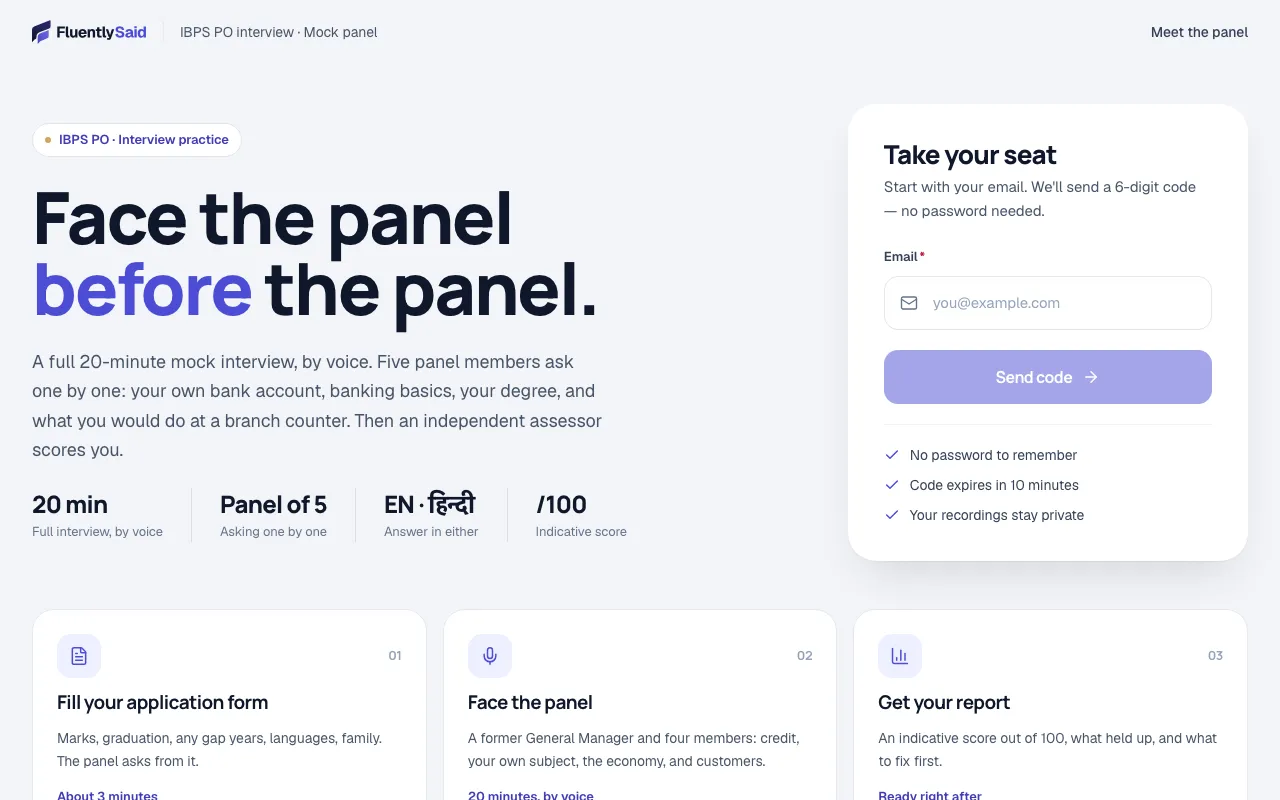
Say your answer to someone who will interrupt. Or sit a bank PO mock interview, where a panel of five asks it from your own application form and follows up on what you say. Read the IBPS PO guide for the full format.
Questions
What is the best answer to "why banking"?
One that is true and specific to you. Give a reason from your own life, link your degree or experience to banking, and describe what you would do at a branch.
Is job security a bad answer?
It is not wrong, but it is the answer every panel has heard, and it says nothing about you. If it is part of your reason, say it second, after something specific.
How should an engineer answer why banking?
Explain what drew you to the work, then show what your training brings: appraising a loan to a small workshop, reading a project's risk, using data. Do not run down your own field.
How is "why RRB" different from "why banking"?
An RRB panel also wants to know that you would stay in and cope with a rural posting. Name your link to rural life and what you would do for a farmer or a village customer.
Face the panel before the panel
Start a free mock interviewFluentlySaid is not affiliated with or endorsed by IBPS or any bank. The questions here are written for practice and are not taken from any real interview.